
Tesla's Musk Moment: Leadership and Geopolitical De-escalation Drive Tech Market Momentum
Elon Musk's return to full-time leadership at TeslaTSLA-- in early 2025 has reignited investor optimism, propelling the company's stock to its best monthly performance since late 2024. With shares surging nearly 22% in May to close at $346.46—a rebound from March's lows of $222—investors are betting that Musk's refocused priorities will unlock value amid a backdrop of geopolitical de-escalation and tech sector tailwinds. Yet, as Tesla faces headwinds like declining sales and governance scrutiny, the question remains: Is this a sustainable rally, or a fleeting reaction to leadership change?
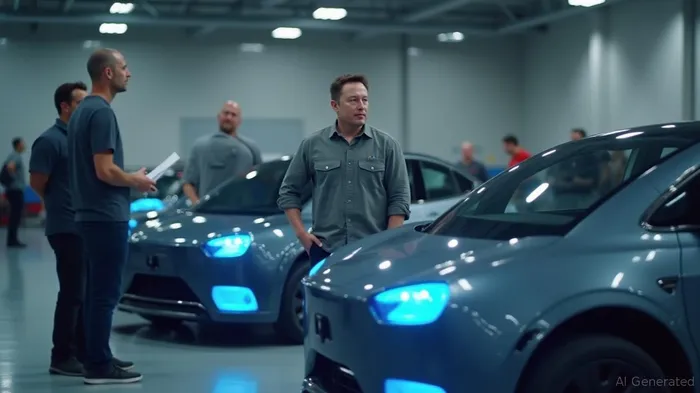
The Musk Pivot: From Politics to Production
Musk's departure from his controversial role as head of the Department of Government Efficiency (DOGE) under President Trump marked a critical inflection point. Analysts like Wedbush's Dan Ives argue that a 20% “overhang” weighing on Tesla's stock—stemming from fears of Musk's divided attention—has now dissipated. Ives, who raised his price target to $500 (implying a 44% upside from May's close), notes that Musk's vow to “work 24/7” and prioritize AI-driven projects like the robotaxi service signals a return to Tesla's innovation core.
The market has responded enthusiastically. show a clear rebound in late 2024 and 2025, coinciding with Musk's gradual withdrawal from politics. Yet, challenges persist: European sales fell 50% year-over-year in April, while Chinese sales dropped 25% in early 2025. Pension fund leaders are even demanding Musk dedicate at least 40 hours weekly to Tesla—a sign of governance concerns. Meanwhile, Tesla's Q4 2024 gross margins dipped to a four-year low of 17.6%, underscoring profit pressures.
Geopolitical De-escalation: A Tailwind for Tech and Tesla
The broader tech sector's performance in 2025 hinges on geopolitical risk reduction, particularly in trade policies. Recent developments, such as the U.S. imposing a 90-day tariff pause on EU imports of steel and aluminum, have calmed markets. The European Central Bank's May report highlights that such pauses stabilized financial conditions, reducing volatility in equities and bonds. For Tesla, this means eased trade frictions could boost its European exports, where tariffs had contributed to a 30% drop in vehicle demand in early 2025.
The EU's tariff-related trade volumes—critical to Tesla's supply chain—will be closely watched. could reveal whether de-escalation translates to sales recovery. Meanwhile, Musk's U.S.-centric manufacturing strategy (Texas, California) buffers Tesla against global tariff risks, a competitive edge over rivals reliant on Asian supply chains.
JPMorgan's “Rangebound” Outlook: A Contrarian Opportunity?
While JPMorgan's broader tech outlook for 2025 emphasizes “dispersion”—with winners and losers across sectors—Tesla's unique position offers a compelling case for strategic investment. The firm's reduced delivery forecast (355,000 units vs. 444,000 initially) reflects near-term risks, yet Musk's focus on high-margin AI and robotics could offset these. JPMorgan's skepticism about a sustained tech boom overlooks Tesla's $188x P/E ratio, which, while high, reflects its role as a “moat builder” in autonomous driving and energy storage.
Investors should note that Tesla's valuation hinges on execution: the June 12 robotaxi launch in Austin will be a pivotal test. If successful, it could validate Musk's vision and lift sentiment across the sector. Even JPMorgan's “rangebound” stance acknowledges that U.S. tech leadership in AI and semiconductors—fueled by fiscal policies—could underpin outperformance.
Strategic Entry Points: Leverage Leadership and De-escalation
The confluence of Musk's operational focus and geopolitical de-escalation creates a sweet spot for investors. With shares near $350—40% below their 2024 peak—and Musk's $500 target within reach, Tesla offers asymmetric upside. Key catalysts include:
- Robotaxi Launch Success: Demonstrating autonomous driving capability could unlock a $200 billion market.
- EU Tariff Resolution: Reduced trade barriers could reverse sales declines in Europe.
- Margin Recovery: Cost-cutting and AI-driven efficiencies aim to lift margins to 25% by 2026.
Risks remain: governance disputes, execution delays, and macroeconomic headwinds. Yet, Musk's track record of “solving hard problems”—from Mars rockets to neural interfaces—suggests he'll prioritize Tesla's survival.
Conclusion: The Musk Effect is Back—Investors Should Take Note
Tesla's May surge isn't just a rebound; it's a signal that leadership clarity and geopolitical de-escalation can reignite growth. While JPMorgan's “rangebound” outlook warns of volatility, the $350 price level presents a compelling entry for investors willing to bet on Musk's ability to execute. As trade tensions ease and AI innovation accelerates, Tesla's blend of operational focus and strategic positioning makes it a rare “buy” in a cautious market. The question isn't whether to invest—it's when to act before the next Musk milestone sends shares soaring.





Comentarios
Aún no hay comentarios