
Tesla's Margins vs. Megablock Scaling: Can Profitability Survive Hyper-Growth?
Tesla's 2025 financial results reveal a company at a crossroads. While its automotive and energy segments face margin compression due to pricing pressures, tariffs, and regulatory shifts, its AI-driven diversification strategies-spanning Full Self-Driving (FSD), Robotaxi, and proprietary AI chips-hint at a potential rebalancing of its revenue streams. This analysis evaluates whether Tesla's aggressive expansion into high-margin AI and energy markets can offset declining profitability in its core automotive business.
Automotive Margins: A Sinking Ship or a Temporary Storm?
Tesla's automotive gross margin in Q3 2025 stood at 15.4%, excluding credits, a marginal improvement from 15% in Q2 but still significantly lower than the 22% recorded in 2023. This decline is attributed to a $400 million tariff hit, reduced regulatory credit income, and lower fixed cost absorption for certain models. Analysts note that the automotive segment now accounts for 72% of total revenue but faces slowing growth, with Q3 2025 vehicle revenue rising just 5.9% year-over-year.
The margin pressure is compounded by Tesla's pricing strategy. Aggressive discounts in key markets like China and the U.S. have boosted volume but eroded profitability. For instance, the Model 3 and Model Y Standard variants, introduced to expand affordability, likely contribute to thinner margins. While CEO Elon Musk has emphasized that "price cuts are a feature, not a bug," the question remains: Can volume growth alone offset margin erosion?
Energy Segment: A Beacon of Stability
In contrast, Tesla's energy generation and storage business has emerged as a critical pillar of profitability. Q3 2025 saw energy gross margins reach 31.4%, with revenue surging 44% year-over-year to $3.4 billion. This growth was driven by record deployments of 12.5 GWh of storage, a 81% increase year-over-year, and the success of products like the Megapack and Powerwall. The energy segment's margins (30.5–31.4%) far outpace the automotive segment's 15.4%, making it a vital buffer against automotive margin compression. Moreover, Tesla's energy business now accounts for nearly 20% of total revenue, up from 14% in 2024. With the Shanghai Megapack facility set to boost global capacity, the energy segment's contribution to profitability is expected to grow further.
AI-Driven Diversification: The Long Game
Tesla's AI initiatives, while not yet major revenue drivers, are reshaping its business model. FSD subscriptions, for example, generated $326 million in Q3 2025, though this accounted for less than 2% of total revenue. However, the launch of Robotaxi services in the Bay Area and plans for mass production of the Cybercab by Q2 2026 suggest a long-term vision. Analysts project that robotaxis could generate half of Tesla's revenue by 2030 if adoption scales as expected.
Equally transformative is Tesla's vertical integration in AI hardware. The company now designs and produces its own AI chips (AI4, AI5, AI6), aiming to outproduce competitors like NVIDIA and AMD in volume. This shift not only reduces dependency on third-party suppliers but also positions TeslaTSLA-- as a global AI manufacturer. While AI chip sales figures remain undisclosed, the deployment of millions of proprietary chips across Tesla's fleet and training clusters underscores their strategic importance.
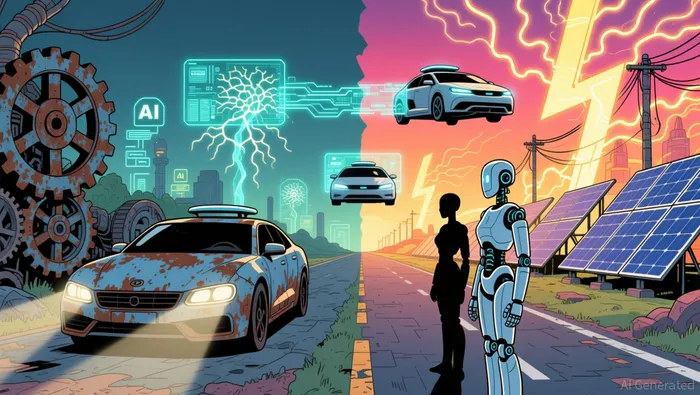
The Optimus robot, though still in an internal pilot phase, further illustrates Tesla's ambition. With thousands of units already assisting in battery cell production, Optimus could eventually disrupt industries ranging from healthcare to manufacturing. However, commercialization timelines and revenue potential remain speculative.
Can AI and Energy Offset Margin Compression?
The answer hinges on two factors: the pace of AI monetization and the energy segment's ability to sustain growth.
AI as a Profitability Catalyst:
While FSD subscriptions and Robotaxi are still nascent, their projected scale is staggering. A 5% share of the $118 billion robotaxi market by 2031 could generate $5.9 billion annually. If Tesla's AI chips achieve economies of scale, they could further reduce costs in autonomous driving and energy systems, indirectly boosting margins in core segments.Energy as a Margin Anchor:
The energy segment's 30%+ gross margins provide a stark contrast to automotive's 15%. As Tesla expands Megapack deployments and leverages AI for grid optimization, this segment could become a consistent profit engine. However, scaling energy storage globally will require navigating regulatory hurdles and supply chain constraints.
Risks and Uncertainties
Critics argue that Tesla's AI ambitions are overhyped. Optimus's commercial viability remains unproven, and FSD adoption (12% as of Q3 2025) lags behind Musk's expectations. Additionally, the automotive segment's margin compression could persist if trade tensions or cost inflation worsen.
Conclusion: A Balancing Act
Tesla's hyper-growth strategy is a double-edged sword. While margin compression in automotive and energy segments raises short-term concerns, the company's AI-driven diversification and energy expansion offer a path to long-term profitability. Investors must weigh the risks of overreliance on speculative AI projects against the potential for these initiatives to redefine Tesla's revenue mix. For now, the energy segment provides a critical buffer, but the true test will come when Robotaxi and AI chips transition from promise to profit.







Comentarios
Aún no hay comentarios