
Tesla's Long-Term Autonomy Premium Under Threat from Nvidia's AV Stack
The autonomous vehicle (AV) race has entered a pivotal phase, with Tesla's Full Self-Driving (FSD) system and Nvidia's AI-driven AV stack emerging as two dominant forces. While Tesla's end-to-end neural network approach has positioned it as a pioneer in data-driven autonomy, Nvidia's broader ecosystem and partnerships with traditional automakers are reshaping the competitive landscape. For investors, the critical question is whether Tesla's autonomy premium-its perceived first-mover advantage in self-driving technology-remains defensible in the face of Nvidia's accelerating advancements.
Tesla's FSD v12: A High-Stakes Bet on Scalability
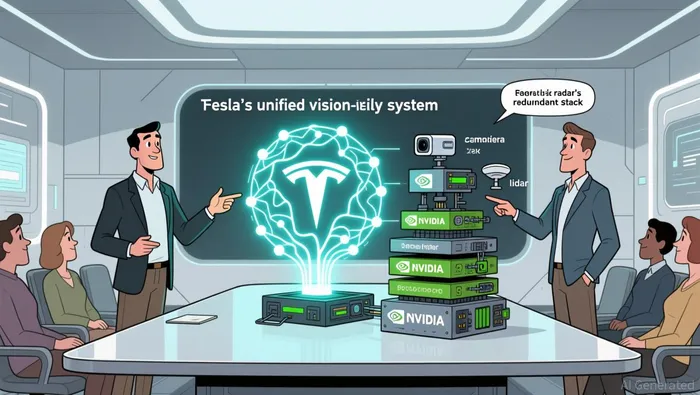
Tesla's FSD v12 represents a radical departure from conventional AV architectures. By replacing modular control systems with a unified AI model, TeslaTSLA-- aims to replicate human-like driving behavior, leveraging its vast fleet of vehicles to generate real-world training data. This approach has enabled rapid iteration, with FSD v14.2 now capable of navigating urban and highway environments. However, the system's reliance on vision-only sensors (cameras, no LiDAR) has drawn scrutiny. The National Highway Traffic Safety Administration is already investigating Tesla's performance in adverse conditions, raising regulatory and safety concerns that could delay widespread adoption.
Wedbush analyst Dan Ives estimates that successful FSD deployment could unlock a $1–2 trillion incremental valuation for Tesla, driven by robotaxi services and AI-driven monetization. Yet this optimism hinges on Tesla's ability to maintain its technological edge. The company's annual training costs for self-driving systems are projected to exceed $5 billion, a financial burden that could strain margins if competitors close the gap.
Nvidia's AV Stack: A Modular Counter to Tesla's Monolith
Nvidia's strategy contrasts sharply with Tesla's all-in approach. Its Alpamayo AV stack, combined with the Vera Rubin chips, offers automakers a flexible, modular platform that integrates multi-sensor redundancy and rule-based systems. This CAIS (Compound AI Systems) model, favored by Waymo and others, prioritizes safety and regulatory compliance through layered validation processes. By partnering with Mercedes-Benz, BYD, and Uber, NvidiaNVDA-- is democratizing access to autonomy, enabling traditional automakers to bypass Tesla's proprietary ecosystem.
Freda Duan of Altimeter Capital argues that Nvidia's infrastructure-first approach could erode Tesla's autonomy premium. "If Alpamayo proves successful in real-world deployment," she notes, "Tesla's terminal market share may decline as automakers gain access to competitive self-driving capabilities." This is particularly relevant in markets like China, where Tesla's FSD faces stiff competition from localized solutions.
Market Share Erosion: The China Factor
Tesla's dominance in the AV space is further challenged by its struggles in China. Despite launching FSD v14.2 trials in late 2025, the system remains classified as Level 2 automation, requiring constant driver oversight. Meanwhile, domestic players like Momenta and Huawei are gaining traction. Momenta holds a 60.1% share of China's ADAS NOA market, while Huawei's Qiankun ADS system is deployed in 28 vehicle models, leveraging its Harmony Intelligent Mobility Alliance. These solutions, tailored to local road conditions and regulatory frameworks, are outpacing Tesla's globalized but less adaptable offerings.
Regulatory delays in China have compounded Tesla's challenges. With full FSD approval potentially delayed until 2026, the company risks ceding ground to competitors who better align with local requirements. This dynamic mirrors broader trends in the EV sector, where Tesla's valuation has faltered against rising competition from BYD and shifting investor sentiment toward AI-driven opportunities.
Valuation Risks and Strategic Divergence
The valuation implications of these divergent strategies are stark. Tesla's FSD hinges on a high-risk, high-reward bet: scaling AI-driven autonomy before regulators and consumers fully trust its safety. In contrast, Nvidia's CAIS model offers automakers a safer, more incremental path to autonomy, reducing exposure to the specific risks of Tesla's vision-only approach.
Analysts warn that Tesla's current valuation may already reflect overly optimistic assumptions about FSD's success. As stated by Freda Duan, "Tesla is trading with a higher, sentiment-driven discount rate, as investors price in the uncertainty of its long-term market share." If Nvidia's AV stack gains traction, Tesla's premium could shrink, particularly as automakers opt for modular solutions that balance innovation with regulatory compliance.
Conclusion: A Tipping Point for the AV Ecosystem
The next 5–6 years will determine whether Tesla's autonomy premium holds. While Elon Musk dismisses immediate threats from Nvidia, the company's $5 billion annual training costs and regulatory hurdles suggest a fragile edge. Meanwhile, Nvidia's partnerships and flexible AV stack are accelerating the industry's shift toward standardized, modular solutions. For investors, the key takeaway is clear: Tesla's long-term valuation depends not only on the success of FSD but also on its ability to defend against a rapidly evolving competitive landscape.





Comentarios
Aún no hay comentarios