
Tesla's Imminent Full Self-Driving Launch and Its Implications for the Autonomous Mobility Sector
Tesla's Full Self-Driving (FSD) technology has long been a cornerstone of its vision to redefine mobility. As of November 2025, the company has accelerated its deployment timeline, with the supervised FSD version launched in September 2025 and the limited rollout of FSD v14.2 in November 2025. This update includes critical enhancements such as improved handling of emergency vehicles and the introduction of a "Self-Driving Stats" feature to track user engagement according to the official release notes. Meanwhile, regulatory progress in Europe, with the Netherlands committing to national approval by February 2026, signals a strategic pivot to bypass EU-wide delays and expand its footprint. These developments position TeslaTSLA-- at the forefront of the autonomous mobility race, but they also raise critical questions about competitive dynamics and valuation sustainability.
Strategic Timing: Accelerating Deployment Amid Regulatory and Technical Hurdles
Tesla's FSD rollout has been marked by a blend of rapid iteration and regulatory pragmatism. The December 2025 holiday software update (2025.44.25.1) further optimized the experience for vehicles equipped with the newer AMD Ryzen processor, though older hardware remains a limitation. This hardware-software interplay underscores the company's reliance on its fleet's computational capabilities to refine its AI-driven autonomy.
The strategic timing of FSD's expansion is equally noteworthy. By securing national approval in the Netherlands, Tesla is leveraging a regulatory "domino effect" to gain entry into the European market according to industry reports. This approach mirrors its historical playbook of incremental, jurisdiction-specific approvals rather than waiting for harmonized EU regulations. Such agility contrasts with competitors like Waymo, which has opted for geofenced urban deployments in Phoenix, San Francisco, and Los Angeles. Tesla's ability to scale FSD across diverse geographies could accelerate its data accumulation, a critical advantage in training its neural networks.
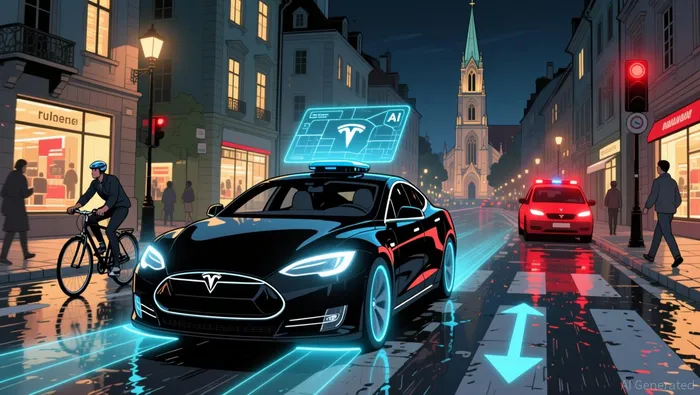 Tesla's competitive edge lies in its unparalleled fleet size. With over 4 million vehicles equipped with Autopilot and FSD beta globally, and 400,000 users in North America receiving the FSD Beta update, the company benefits from an unmatched feedback loop. This scale enables continuous refinement of its AI models, a process that Waymo and Cruise, with fleets of 700 and 300 vehicles respectively, cannot replicate.
However, Waymo's cautious, simulation-heavy approach-logging 20 million real-world miles and 1 billion simulated miles-highlights a different strength: precision. Its reliance on sensor fusion (LiDAR, radar, and cameras) and detailed HD maps ensures robustness in complex environments, albeit at the cost of slower geographic expansion. Cruise, meanwhile, has faced setbacks, including a 2024 suspension of operations due to a pedestrian safety incident according to industry analysis, which underscores the risks of prioritizing urban complexity over safety.
Tesla's recent claims of potential unsupervised FSD capabilities in select U.S. cities by late 2025 or early 2026 according to Elon Musk's statements have drawn skepticism, particularly given the industry's history of delayed autonomy milestones. Yet, its robotaxi launch in June 2025 according to market reports has already positioned it as a leader in AI-driven mobility, with analysts like Stephen Gengaro of Stifel raising price targets based on its progress according to financial analysis.
Valuation Impact: Optimism vs. Overvaluation Concerns
The financial implications of Tesla's FSD advancements are mixed. While the company's market cap exceeded $800 billion in 2025, valuation models suggest it is overvalued by 230% based on discounted cash flow (DCF) analysis, with an intrinsic value of $137.87 per share compared to its $455 trading price according to financial modeling. This disconnect reflects divergent investor sentiment: bullish analysts project a fair value of $2,708 per share, citing the $7 trillion potential of the autonomy sector, while bearish views anchor at $332.71 according to financial analysis.
The broader autonomous vehicle sector, valued at $204.46 billion in 2025, is projected to grow at a 39.9% CAGR through 2032 according to market research. Tesla's FSD rollout has amplified this growth narrative, with ETFs like the Global X Autonomous & Electric Vehicles ETF (DRIV) surging 29.2% year-to-date according to financial data. However, Tesla's stock has faced volatility, dropping 6.6% in November 2025 amid global EV market challenges and regulatory uncertainties.
A critical factor is FSD adoption rates. As of 2025, only 12% of Tesla's fleet has purchased FSD, but analysts predict a surge as users experience the system's improvements. This could drive recurring revenue through subscriptions, a model that Wall Street increasingly values. Yet, legacy automakers' reluctance to license Tesla's FSD technology-despite Musk's warnings-could limit its near-term monetization potential.
Conclusion: A High-Stakes Bet on Autonomy
Tesla's FSD launch represents a pivotal moment in the autonomous mobility sector. Its strategic timing, leveraging regulatory agility and fleet-scale data, positions it to outpace competitors like Waymo and Cruise. However, valuation concerns persist, with its price-to-sales ratio of 15.82x far exceeding the automotive industry average according to market research. For investors, the key question is whether Tesla can translate its technological lead into sustainable profitability, particularly as regulatory scrutiny intensifies and competitors like Waymo refine their safety-centric models.
The coming months will test Tesla's ability to balance rapid deployment with safety, regulatory compliance, and investor expectations. If successful, its FSD ecosystem could redefine mobility and justify its lofty valuation. If not, the sector's growth narrative may face a reckoning.







Comentarios
Aún no hay comentarios