
Tesla's FSD v14: A Catalyst for Autonomous Vehicle Adoption and Sector Disruption
Tesla's FSD v14: A Catalyst for Autonomous Vehicle Adoption and Sector Disruption
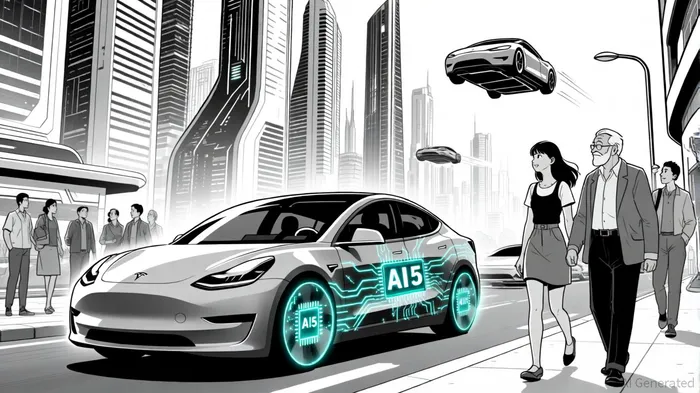
Tesla's Full Self-Driving (FSD) v14, set for an early wide release in late September 2025, represents a pivotal moment in the evolution of autonomous driving. With a 10x increase in neural network parameters and architectural upgrades designed to enhance scene understanding, the update promises to redefine the boundaries of supervised autonomy. For investors, the stakes are high: FSD v14 could not only accelerate Tesla's dominance in the autonomous vehicle (AV) market but also reshape the broader tech and automotive sectors.
Technological Leap and Market Positioning
FSD v14 introduces a paradigm shift in Tesla's approach to autonomy. By improving video compression and reducing data loss, the system gains a sharper understanding of complex urban environments, enabling smoother decision-making in edge cases like highway merges and intersections, according to a NotATesla report. Elon Musk's assertion that the update will make the system feel "sentient" by its v14.2 iteration underscores the ambition to mimic human-like driving behavior, as detailed in Musk's rollout plan. This leap is underpinned by the AI5 chip, which is expected to deliver 40x more computational power than its predecessor, AI4, further solidifying Tesla's hardware-software synergy, according to a TeslaOracle article.
The phased rollout-starting with v14.0, followed by v14.1 and v14.2-reflects a strategic balance between innovation and safety. Early adopters will experience reduced driver monitoring requirements, as the NotATesla report notes. However, the update's exclusivity to vehicles with fourth-generation hardware (HW4) creates a hardware divide, leaving older models like the Cybertruck with HW3 unable to access the full potential of FSD v14, according to a StockTwits analysis. This limitation could pressure TeslaTSLA-- to accelerate hardware upgrades or risk alienating a segment of its customer base.
Investor Sentiment and Market Dynamics
The market has already priced in optimism for FSD v14. Tesla's stock rose 0.6% to $443.21 following the announcement, reflecting investor confidence in the update's ability to drive software subscriptions and vehicle demand, per a Parameter analysis. Analysts project that FSD v14 could boost Tesla's third-quarter deliveries to 447,750 units, with the software itself becoming a key revenue driver. Piper Sandler analyst Alexander Potter, however, cautions that the current iteration still requires active driver supervision, limiting its ability to enable fully autonomous operations, as noted in the StockTwits analysis.
The broader AV market is poised for explosive growth, with FSD v14 playing a central role. By 2025, the global AV market is projected to reach $428.3 billion, with semi-autonomous systems accounting for $236.85 billion and fully autonomous systems contributing $191.45 billion, according to a Market.us projection. Tesla's advancements, particularly its AI-driven approach, position it to capture a significant share of this market. The company's collaboration with Nvidia to enhance computing power further strengthens its competitive edge, aligning with industry trends of automakers partnering with specialized chipmakers, as highlighted in an OpenTools report.
Regulatory Hurdles and Competitive Pressures
Despite its technological prowess, Tesla faces significant regulatory and competitive challenges. In Europe, the AI Act's stringent compliance requirements for high-risk AI systems like FSD could delay approvals until May 2025, according to a NotATesla update. Meanwhile, in China, conflicting data regulations between the U.S. and China have forced Tesla to rely on publicly available road footage for training, limiting the system's adaptability to local conditions, as reported by autoevolution. These hurdles highlight the fragility of Tesla's global expansion plans.
Competitors are also closing the gap. In China, BYD and Huawei are gaining traction with cost-effective ADAS solutions and LiDAR-driven systems tailored for complex urban environments, according to a TeslaAccessories post. While Tesla's FSD v14 offers superior technical capabilities, its localization challenges and regulatory delays could erode its first-mover advantage.
Strategic Implications for Investors
For investors, FSD v14 represents both an opportunity and a risk. The update's success hinges on its ability to scale safely, justify premium pricing for subscriptions, and navigate regulatory scrutiny. Key metrics to watch include active FSD users, subscription churn rates, and the pace of global approvals.
A critical question remains: Can Tesla monetize FSD effectively? While hardware margins for models like the Cybertruck face downward pressure, software-driven growth offers a path to margin expansion. However, this depends on overcoming hardware limitations and regulatory bottlenecks.
Conclusion
Tesla's FSD v14 is more than a software update-it is a strategic inflection point for the company and the AV industry. By pushing the boundaries of supervised autonomy, Tesla aims to redefine mobility while navigating a complex web of regulatory, competitive, and technical challenges. For investors, the rollout of FSD v14 offers a glimpse into a future where AI-driven vehicles could disrupt traditional transportation models. Yet, the path to full autonomy remains fraught with uncertainties, making it imperative to monitor both the company's execution and the evolving regulatory landscape.





Comentarios
Aún no hay comentarios