
Tesla's FSD Technology: A Liability to Market Growth and Brand Value?
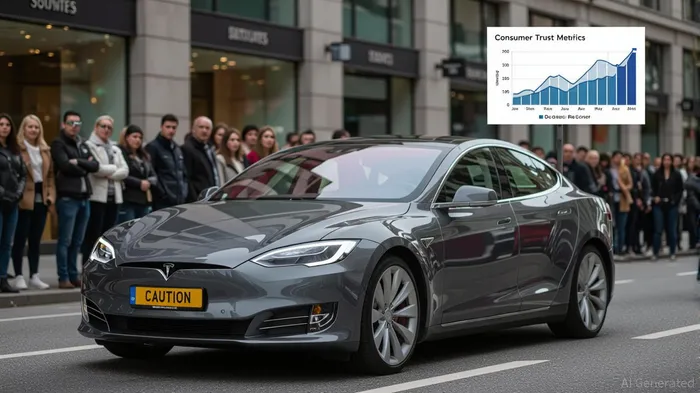
Tesla’s Full Self-Driving (FSD) technology, once heralded as a revolutionary leap in automotive innovation, is increasingly viewed as a double-edged sword. While the company touts its progress in autonomous driving, recent data reveals a stark disconnect between Tesla’s ambitions and consumer sentiment. Surveys indicate that FSD is repelling more buyers than it attracts, with 35% of U.S. consumers stating it would make them less likely to purchase a TeslaRACE--, compared to just 14% who see it as a draw [1]. This skepticism is compounded by safety concerns, regulatory scrutiny, and a growing demand for accountability—factors that could undermine Tesla’s long-term investment viability.
Consumer Sentiment: A Growing Divide
The core issue lies in public perception. Nearly half of surveyed consumers (48%) believe FSD should be illegal, and 70% advocate for autonomous vehicles to use both LiDAR and cameras, rejecting Tesla’s camera-only approach [2]. These findings reflect a deep mistrust in the technology’s safety. A 2025 study of FSD Beta users further exposed alarming behaviors: drivers sleeping at the wheel, placing weights on steering wheels, and experiencing erratic system responses like phantom braking [3]. Such incidents have fueled calls for stricter regulations, with 66% of consumers demanding Tesla be held legally responsible for accidents involving its driver-assistance systems [1].
Tesla’s brand reputation has suffered as a result. The company now holds a net brand positivity score of -15, the only EV maker in negative territory [5]. This decline is not merely statistical—it reflects a broader erosion of trust. For instance, 39% of consumers view Tesla negatively, while only 32% hold a positive opinion [3]. Even among Tesla owners, many remain unaware of or hesitant to use FSD, despite owning eligible vehicles [1].
Regulatory and Legal Risks
Regulatory challenges are intensifying. The National Highway Traffic Safety Administration (NHTSA) is investigating 2.4 million FSD-equipped vehicles following a 2023 fatal crash [2]. In Miami, Tesla was ordered to pay $329 million in damages after a fatal Autopilot-related accident, a verdict that has further damaged public confidence [1]. Meanwhile, the company faces legal battles over transparency, with critics arguing that suppressing crash data involving its systems prioritizes trade secrets over public safety [4].
Europe adds another layer of complexity. Regulatory delays there have hindered FSD deployment, with Tesla’s CEO attributing weak European sales partly to the lack of approval [1]. The company’s resistance to incorporating LiDAR—a technology widely seen as safer—has also drawn criticism, with 71% of consumers supporting government mandates for its use [2].
Market Implications and Investment Concerns
Despite the self-driving car market growing at a 22% compound annual rate, Tesla’s FSD adoption lags behind competitors like Waymo, which has driven over 20 million real-world miles and is perceived as more reliable [4]. Tesla’s brand struggles are compounded by its position as the only major EV maker with a negative net brand score, potentially deterring price-sensitive buyers and investors alike [5].
The upcoming FSD v14 update, which promises a 10× increase in model parameters, may face regulatory constraints that limit its deployment [3]. While Tesla continues to tout its data-driven approach—leveraging insights from 400,000 FSD-equipped vehicles—consumer trust remains elusive.
Conclusion
Tesla’s FSD technology is a polarizing force. While it offers a glimpse into the future of mobility, its current trajectory suggests it is more of a liability than a catalyst for growth. For investors, the risks are clear: declining consumer trust, regulatory headwinds, and a fragmented market position. Until Tesla addresses these challenges—through transparency, safety improvements, and regulatory collaboration—FSD may continue to drag on the company’s brand value and long-term prospects.
Source:
[1] Tesla FSD turns off more U.S. consumers than attracts, [https://www.cnbc.com/2025/08/28/tesla-fsd-turns-away-more-us-consumers-than-attracts-survey-finds.html]
[2] Tesla FSD Is Deeply Unpopular, Survey Shows [https://cleantechnica.com/2025/08/28/tesla-fsd-is-deeply-unpopular-survey-shows/]
[3] Tesla's FSD: A Liability, Not a Catalyst, for Long-Term Growth [https://www.ainvest.com/news/tesla-fsd-liability-catalyst-long-term-growth-2508/]
[4] Self-Driving Car Adoption Rates: How Fast Is the Market Growing? [https://patentpc.com/blog/self-driving-car-adoption-rates-how-fast-is-the-market-growing-latest-data]
[5] Full Self-Driving May Be Hurting Tesla's Reputation More..., [https://autos.yahoo.com/articles/full-self-driving-may-hurting-141055804.html]







Comentarios
Aún no hay comentarios