
Tesla's FSD (Supervised) Safety Report and Its Implications for Autonomous Tech Valuation
Safety Metrics: A Data-Driven Case for FSD's Advancement
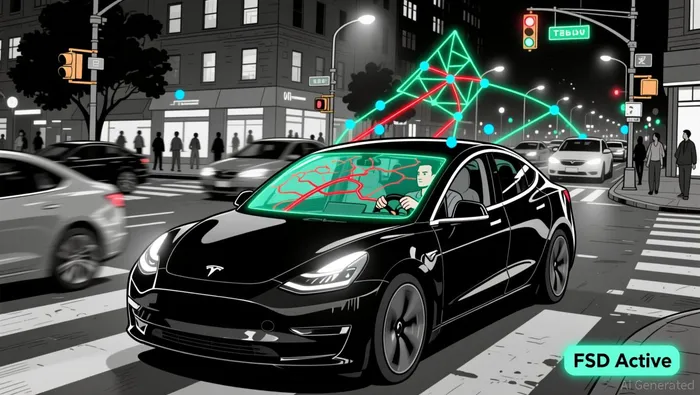
Tesla's FSD (Supervised) system has demonstrated significant safety improvements in real-world conditions. During Q3 2025, TeslaTSLA-- owners collectively drove 1.3 billion miles using FSD, averaging 14.1 million miles per day-a 30% increase from Q2 2025. This growth underscores growing user trust in the system's reliability. Crucially, Tesla's safety report highlights a higher miles-per-collision rate under FSD compared to manual driving, even when safety features like Autopilot are active.
The company's methodology, which aligns with federal definitions of collisions (49 C.F.R. § 563.5), avoids subjective fault attribution and focuses on objective metrics such as airbag deployment and Delta-V thresholds as defined in Tesla's safety documentation. By analyzing 2.5 billion telemetry packages globally (excluding China), Tesla has built a robust dataset that not only validates FSD's safety but also highlights its ability to outperform human drivers in complex scenarios according to Tesla's internal analysis. This data-driven approach is vital for investors, as it provides transparency and reduces reliance on anecdotal evidence or speculative claims.
Regulatory Readiness: U.S. MomentumMMT-- vs. European Hurdles
Regulatory approval remains a decisive factor in scaling AV technologies. In the United States, Tesla's FSD (Supervised) is already available as a paid upgrade, with the company planning to launch an "Unsupervised" version in select cities by year-end 2025. The U.S. Department of Transportation's SMART award program, which allocates $500 million for AV innovation, further supports a favorable environment for rapid deployment as reported by industry sources. Tesla's hardware (HW3/HW4) and software compatibility with U.S. infrastructure position it to lead the robotaxi market, which is projected to grow from $1.95 billion in 2024 to $188.91 billion by 2034.
Conversely, Europe's regulatory landscape remains a bottleneck. Despite installed hardware on many vehicles, FSD deployment is pending due to UNECE and DCAS rules requiring system-initiated maneuvers without driver confirmation as noted in regulatory filings. A key amendment to enable such maneuvers took effect on 26 September 2025, but as of Q3 2025, European rollout has stalled. France's consumer authority has even challenged Tesla's marketing of FSD as a "hands-off" system, signaling heightened scrutiny according to regulatory updates. For investors, this regulatory asymmetry highlights both opportunities (U.S. expansion) and risks (geographic fragmentation).
Investment Implications: Balancing Growth and Risk
The AV industry's projected economic impact-$26 trillion in global GDP by 2030-underscores its transformative potential. However, high R&D costs, cybersecurity concerns, and consumer trust gaps remain significant hurdles. Tesla's FSD progress, particularly its 1.3 billion-mile safety milestone, positions it as a leader in proving the viability of AI-driven driving systems. Yet, regulatory delays in Europe and competition from traditional automakers (e.g., Ford, GM) and tech firms (e.g., Waymo) necessitate caution.
For valuation purposes, investors should prioritize companies with:
1. Proven safety metrics (e.g., Tesla's telemetry-driven validation).
2. Regulatory agility (e.g., U.S.-centric strategies for early deployment).
3. Scalable infrastructure (e.g., Tesla's robotaxi ambitions).
While Tesla's FSD (Supervised) safety report bolsters its case as a market leader, the broader AV sector's success will depend on harmonizing safety standards, addressing cybersecurity risks, and navigating regional regulatory disparities.
Conclusion
Tesla's Q3 2025 safety report and regulatory developments paint a nuanced picture for AV investors. The company's data-driven safety improvements and U.S. deployment momentum are strong positives, but European regulatory delays and industry-wide challenges like consumer trust and infrastructure costs cannot be ignored. As the AV market races toward a $26 trillion GDP contribution by 2030, Tesla's ability to balance innovation with compliance will be a defining factor in its valuation trajectory.







Comentarios
Aún no hay comentarios