
Tesla's FSD Regulatory Hurdles: A Strategic Bottleneck for $1 Trillion Valuation?
Regulatory Landscape: A Patchwork of Progress and Resistance
Tesla's FSD deployment is advancing unevenly across geographies. In China, the company has secured partial approval for features like Navigate on Autopilot in cities such as Beijing and Shanghai, with full regulatory clearance expected by February–March 2026. This timeline reflects China's rigorous safety standards, which require TeslaTSLA-- to adapt its neural networks to local traffic conditions. By contrast, the European Union remains a critical battleground. The Dutch RDW, a key gatekeeper, is set to evaluate Tesla's FSD in February 2026, with broader EU approval contingent on a Technical Committee on Motor Vehicles (TCMV) vote. European regulators have emphasized safety validation, resisting external pressure to accelerate timelines. In the United States, Tesla's FSD rollout is more advanced, with plans for an "Unsupervised" version in select cities by late 2025, alongside a robotaxi pilot involving hundreds of thousands of vehicles by 2026.
The divergence in regulatory approaches underscores a strategic challenge: while Tesla's U.S. operations can leverage a more permissive environment, delays in Europe and China-markets representing over 30% of global automotive demand-could constrain scalability and revenue potential.
Technological Momentum: Innovation Outpaces Regulation?
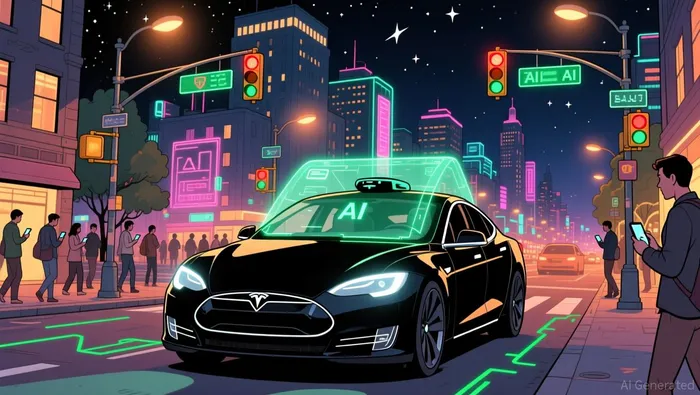 Despite regulatory headwinds, Tesla's FSD technology has advanced rapidly in 2025. The company has integrated "reasoning capabilities" into its software, enhancing features like optimal parking spot detection, and expanded robotaxi trials to 8–10 U.S. metropolitan areas. Notably, Tesla aims to operate robotaxis in parts of Austin without safety drivers by year-end 2025, signaling confidence in its AI-driven systems.
Analysts like Stifel's Stephen Gengaro argue that these advancements position FSD as a "foundational component" for Tesla's Cybercab initiative, unlocking revenue streams through licensing and fleet operations. Meanwhile, project a $1.13 trillion market cap by 2030, under a bull-case scenario, assuming 39% annual revenue growth and $238 billion in GAAP net income. This optimism hinges on Tesla's ability to monetize FSD and robotaxi services, which could rival traditional ride-hailing platforms.
Regulatory Risk vs. Technological Optimism: A Tug-of-War
The tension between regulatory caution and technological ambition is most evident in Europe. Dutch regulators have explicitly rejected calls to fast-track FSD approval, insisting on "stringent safety standards," while Tesla's lobbying efforts highlight the political dimension of the debate. In China, the partial approval granted in June 2025 demonstrates regulators' willingness to engage with Tesla's innovations, albeit incrementally.
Financial analysts caution that regulatory delays could disrupt Musk's $1 trillion performance-based compensation package, which ties payouts to milestones like robotaxi deployment. A bear-case scenario, factoring in technological or regulatory setbacks, projects a market cap of $600.9 billion by 2030. This divergence underscores the valuation's sensitivity to external factors beyond Tesla's control.
Valuation Implications: A Balancing Act
The interplay between regulatory risk and technological momentum creates a dual narrative for Tesla's valuation. On one hand, the company's AI and robotics roadmap-bolstered by advancements in AI5 and AI6 chips-suggests a potential to dominate a $7 trillion autonomous mobility market. On the other, geopolitical tensions and regulatory fragmentation could prolong the path to profitability.
Current valuations reflect this duality: Tesla's stock trades at 180 times projected 2026 earnings, a premium that hinges on the successful execution of its FSD and robotaxi strategies. If regulatory approvals align with technological progress, the $1 trillion threshold may be achievable by 2030. However, persistent delays-particularly in Europe-could erode investor confidence, especially as competitors like Waymo and Cruise refine their own autonomous systems.
Conclusion: A High-Stakes Gamble
Tesla's FSD regulatory hurdles are not merely technical or bureaucratic-they are a strategic bottleneck that could redefine its valuation trajectory. While the company's technological momentum is undeniable, the pace of regulatory adoption will ultimately determine whether its ambitions translate into market reality. For investors, the key lies in monitoring two variables: the speed of approvals in China and Europe, and the ability of Tesla's FSD to meet evolving safety benchmarks. Until then, the $1 trillion question remains unanswered, suspended between innovation and oversight.





Comentarios
Aún no hay comentarios