
Tesla's European Crossroads: A Structural Reckoning and Strategic Pivot
While Tesla's global sales are in freefall, the German electric vehicle market is surging. This stark divergence reveals a structural shift, not a cyclical dip. In 2025, the total number of newly registered electric vehicles in Germany grew by . This robust expansion stands in direct contrast to Tesla's performance, . The German market is not slowing down; TeslaTSLA-- is simply falling off the pace.
The story is even more telling when viewed through the lens of domestic competition. While Tesla's volume nearly halved, German automakers are capturing a commanding share of the growth. Volkswagen Group, in particular, has emerged as the dominant force. From January to September 2025, the VW brand delivered 113,607 EVs, . This isn't a minor gain; it's a market takeover, . The rise of the domestic champion is the antithesis of Tesla's decline.
The bottom line is a market splitting into two distinct narratives. For German consumers, the EV transition is accelerating, fueled by strong domestic brands. For Tesla, the German chapter is closing. The company's near-halving of sales is a structural failure to keep pace with a recovering market and a rising tide of local competition. It is no longer a question of timing or incentives; it is a question of relevance.
Drivers of the Collapse: Competition, Policy, and Brand Erosion
Tesla's sales collapse in Germany is not a simple story of a single policy change. It is the result of a perfect storm where a headwind from Brussels, a political gale from Washington, and a brand crisis in Berlin converged to accelerate a decline already underway. The withdrawal of Germany's national purchase subsidy, the , in late 2023 created a baseline headwind for all EV makers. This policy shift removed a direct financial incentive for buyers, contributing to a broader slowdown in demand. Yet the market's recovery since then shows the subsidy's impact was not the sole driver. In January 2026, , . This stark divergence reveals that Tesla's troubles are now deeply rooted in brand and political factors that have compounded the initial policy shock.
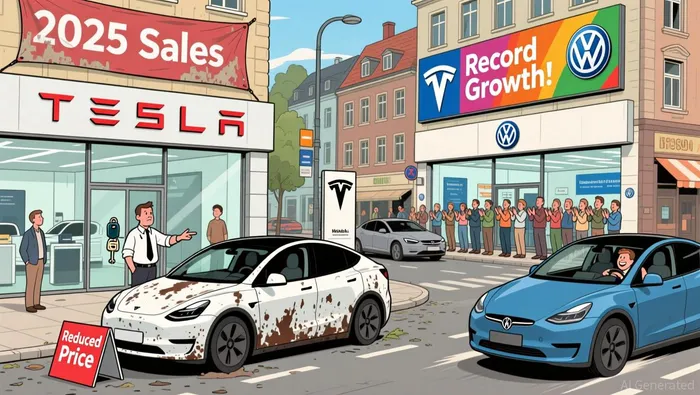
The most potent accelerant has been CEO Elon Musk's political activism. His vocal support for Germany's far-right Alternative for Germany () party, including calling its leader a "genius" and insulting national leaders, sparked immediate and severe consumer backlash. Industry experts have called his behavior "extremely damaging," noting that "nobody wants to be associated with it" and that "Tesla and Musk are almost inextricably linked." This brand erosion has hit Tesla harder than any other automaker, causing it to fall into third place in the German market with less than a 10% share. The political controversy has effectively turned a policy headwind into a reputational crisis, making it a self-inflicted wound that no subsidy can fix.
These factors are interconnected and mutually reinforcing. The subsidy withdrawal created a challenging market environment where brand loyalty and perception become even more critical. Musk's political endorsements directly attacked the values of a key European market, undermining the brand's appeal precisely when it needed to compete on more than just technology. This brand damage has occurred alongside intensifying global competition, with rivals like BYD and Volkswagen gaining significant ground. The result is a company caught between a structural policy shift, a self-created political firestorm, and a competitive landscape that is no longer forgiving. The 59.5% sales drop is not an isolated event; it is the visible symptom of a multi-year erosion in Tesla's market position.
The New Model Y Standard: A Strategic Pivot
Tesla's response to its European crisis is a direct, calculated pivot, not a minor adjustment. In the pre-dawn hours of November 4, 2025, the company launched a new, lower-cost Model Y Standard trim at its Giga Berlin factory. This move is a strategic counter-attack, explicitly designed to fight a "brutal new war for market share and volume leadership" in a market that has turned hostile. The catalyst was a catastrophic sales collapse, with October registration data showing Tesla's core European markets imploding: , . The company is now using its local manufacturing hub to aggressively defend its territory against a flood of "good enough" competitors and a market saturated with high interest rates and evaporating subsidies.
The pivot is defined by specific "de-contenting" to slash cost and complexity. The most visible change is the replacement of the iconic all-glass roof with a standard metal roof. This is a direct assault on manufacturing bottlenecks and a significant cost driver, simplifying assembly and likely reducing the Bill of Materials by hundreds of Euros. Similarly, the rear passenger touchscreen-a premium differentiator-is removed, cutting wiring and component costs. Most notably, the car swaps its signature premium-feeling seats for standard textile (cloth) seats. This is a clear move down-market, but it aligns with the practical needs of fleet buyers and budget-conscious consumers who prioritize durability and comfort over luxury aesthetics.
Viewed another way, this is a masterstroke of manufacturing agility. Tesla is intentionally sacrificing high-end features and premium margins to reclaim volume. The company is separating the "premium" features from the core "Tesla" experience, targeting a new, more price-sensitive segment. This calculated move signals a new, more aggressive era for the brand in Europe, where dominance must now be fought for, not assumed.
The 2026 Incentive Landscape and European Context
The European market for electric vehicles is entering a new phase, one defined by a powerful policy push and a fierce competitive battle. For Tesla, the stakes are high. The company's recovery in the region hinges on navigating a landscape where a new €3 billion targeted incentive package is expected to launch in 2026, while simultaneously facing a surge of competition from Chinese rivals. This convergence of policy and market dynamics creates a high-stakes environment where regaining brand favor is no longer optional.
The policy backdrop is shifting decisively. After the abrupt end of Germany's national purchase subsidy in late 2023, consumer demand for EVs stalled. The new €3 billion support scheme, agreed upon in October, aims to restart that momentum by targeting low- and middle-income households. The exact design-whether direct purchase grants or social leasing at rates like the proposed €99 per month-is still under discussion, but the political will is clear. This targeted approach is a direct response to the affordability gap that has hindered adoption, and it signals a broader European pivot toward inclusive e-mobility policies. For Tesla, a company that has faced a consumer backlash in Europe, this new wave of support represents a potential lifeline. Regaining favor with these core segments will be critical to benefiting from the program.
Yet the market is moving faster than any single policy. The broader European EV market is rebounding, with battery electric vehicles accounting for . This growth is not evenly distributed. , . This stark divergence highlights the intensifying competition. BYD's meteoric rise, coupled with the entry of other Chinese EV makers like Xiaomi and Geely, is reshaping the competitive map. Tesla's traditional advantages in brand and technology are being challenged on price and scale.
The bottom line is a market in flux. The new German incentives are a positive catalyst, but they are just one piece of a complex puzzle. For Tesla, the path forward requires more than just policy tailwinds. It demands a successful re-engagement with European consumers, a feat complicated by recent political rhetoric and a clear loss of market share. The company's ability to leverage the 2026 incentive landscape will be tested against a backdrop of fierce competition where Chinese automakers are capturing the growth. The environment is not one of passive waiting for policy; it is a high-stakes race to win back customers in a market that is moving on without them.
Financial and Strategic Implications
The recent European weakness is not an isolated regional issue for Tesla; it is a symptom of a broader strategic vulnerability that is now manifesting in the company's core financials. The data reveals a company in a precarious position: global vehicle deliveries fell , marking the second consecutive annual decline. This slide is a direct signal of diminishing market power and an over-reliance on a narrow product portfolio. In the fourth quarter, the Model 3 and Model Y accounted for 97% of production, a staggering concentration that leaves the entire business exposed to competitive pressures and shifting consumer preferences in a single segment.
The competitive threat is intensifying from multiple fronts. Legacy automakers are accelerating their EV offerings, while Chinese rivals are capturing market share with compelling value propositions. The most telling metric is the shift in global rankings: China's BYD recently surpassed Tesla as the top global EV maker, . This isn't just a headline; it reflects a fundamental erosion of Tesla's pricing power and brand dominance. The company's own European registrations fell , . This European weakness is a direct consequence of a volatile political environment and a consumer backlash fueled by CEO Elon Musk's controversial public statements, which has translated into tangible sales losses.
The bottom line is a company facing a perfect storm of product concentration, fierce competition, and a damaged brand in a key market. The financial impact is clear: declining deliveries and a loss of market leadership. Strategically, this sets up a high-stakes challenge. Tesla's future depends on its ability to diversify its product lineup and regain lost ground in Europe, all while defending its core volume against a wave of new entrants. The current trajectory suggests the company is not just losing share-it is becoming more vulnerable to the very forces it once seemed to lead.
Catalysts and Risks: The Path to Recovery or Further Erosion
The path forward for Tesla in Europe is now binary. It hinges on a single, critical question: can the company execute a volume recovery against entrenched domestic competition and persistent brand damage? The answer will be determined by a few key events and conditions, each acting as a litmus test for the company's new, more aggressive strategy.
The primary risk is that the damage is structural and irreversible. Volkswagen's dominance in Germany is not a temporary blip but a market takeover that has cemented its position. The VW brand captured a controlling in the first nine months of 2025, . This isn't just a sales victory; it's a command of the ecosystem, from manufacturing to dealer networks. For Tesla, which has fallen into third place with less than a 10% share, this creates a formidable moat. The company's own European registrations fell , . Without a fundamental shift in sentiment or a dramatic product repositioning, this entrenched market share makes a full recovery in Germany unlikely. The political controversy surrounding CEO Elon Musk has created a lasting brand erosion that rivals have not faced.
A key catalyst for a turnaround is the success of the new Model Y Standard and Tesla's global pricing strategy. This is the company's direct response to the volume crisis, a calculated move to fight a "brutal new war for market share." The de-contenting-replacing the glass roof and premium seats with standard metal and textile-aims to slash costs and complexity, targeting a more price-sensitive segment. The effectiveness of this strategy will be a critical test. If the new, more affordable Model Y can capture volume in Europe, it would signal that Tesla's manufacturing agility and pricing power can still win in a competitive landscape. However, this success is contingent on regaining consumer trust, which remains a significant hurdle.
The effectiveness of the new €3 billion incentive package will be the ultimate test. This targeted support, expected to launch in 2026, is designed to bridge the affordability gap for low- and middle-income households. The program, which could offer subsidies of , is a direct response to the market slowdown that followed the abrupt end of Germany's national purchase subsidy. For Tesla, this represents a potential lifeline. The company's new, lower-cost Model Y Standard is explicitly positioned to compete in this segment. Yet the program's design is crucial. It is structured for private purchases only, excluding corporate fleets and company cars-a segment where Tesla has historically had strength. If the subsidy successfully drives demand for Tesla's more affordable offerings, it could restart the company's European momentum. If not, it will merely fuel the growth of domestic brands like Volkswagen, which are already well-positioned to benefit.
The bottom line is that recovery hinges on execution and sentiment, not just policy. The new incentives are a necessary condition, but not a sufficient one. Tesla must prove it can win back volume with a product that appeals to a broader, more price-conscious market while navigating a political environment that has turned hostile. The coming quarters will reveal whether this is a temporary setback or the beginning of a permanent decline in Europe.





Comentarios
Aún no hay comentarios