
Tesla's Energy Business: A Catalyst for Sustained Stock Outperformance
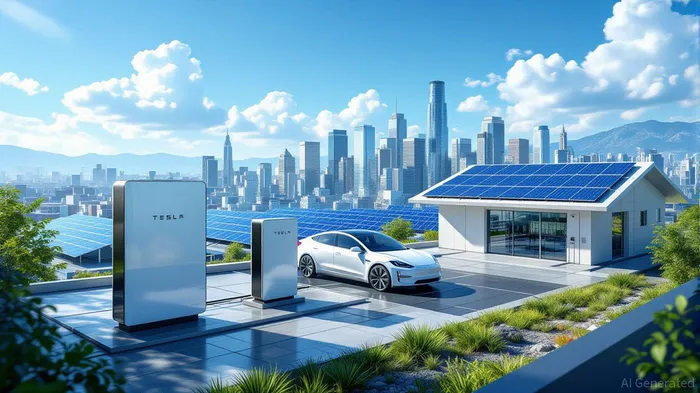
Tesla's energy business has emerged as a cornerstone of its long-term strategic vision, offering a compelling narrative for investors seeking sustained stock outperformance. While the company's dominance in electric vehicles (EVs) remains its primary growth engine, the energy segment—encompassing solar systems, battery storage (Powerwall, Powerpack, Megapack), and grid-scale solutions—is rapidly evolving into a critical driver of diversification and valuation. This analysis examines how Tesla's energy division is reshaping its financial profile, mitigating risks, and unlocking new revenue streams that could propel its stock higher in the coming decade.
Strategic Diversification: Beyond the EV Playbook
Tesla's energy business now accounts for a significant portion of its revenue. According to a report by Britannica Money, the segment generated over $10 billion in revenue in 2024 alone[1], representing a substantial contribution to the company's total $97.7 billion in annual revenue[1]. This growth underscores a deliberate shift toward energy as a complementary pillar to its EV operations.
The strategic logic is clear: energy storage and solar solutions address a global demand for decentralized, renewable power infrastructure. Tesla's Powerwall, for instance, has become a household name in residential energy storage, while the Megapack is revolutionizing utility-scale applications. By integrating solar generation with battery storage, TeslaTSLA-- is positioning itself as a one-stop provider of clean energy ecosystems—a model that reduces customer acquisition costs and enhances cross-selling opportunities.
Financial Resilience and Margin Expansion
The energy business also serves as a buffer against sector-specific volatility. While EV markets face cyclical demand shifts and regulatory headwinds, energy storage and solar demand are driven by long-term decarbonization trends. In 2024, Tesla's energy storage systems saw production of 31.4 gigawatt-hours (GWh)[1], a figure that reflects robust global adoption. Analysts note that the segment's gross margins—already exceeding 30%—are poised to expand further as production scales and software integration (e.g., Tesla's energy management platforms) adds value[1].
Moreover, Tesla's energy division benefits from ancillary revenue streams. Regulatory carbon credits, for example, contributed $2.76 billion in 2024[1], a windfall that underscores the company's ability to monetize environmental policies. This dual-income model—hardware sales plus recurring software and regulatory incentives—creates a durable competitive advantage.
Long-Term Valuation Potential: A New Growth Frontier
To assess Tesla's energy business as a valuation catalyst, consider the broader market dynamics. The global energy storage market is projected to grow at a compound annual rate of 20% through 2030, driven by grid instability, renewable integration, and corporate sustainability goals[1]. Tesla's first-mover advantage, coupled with its vertical integration (battery R&D, manufacturing, and software), positions it to capture a disproportionate share of this expansion.
Investors should also consider the company's balance sheet strength. With $122.1 billion in total assets and $72.9 billion in equity as of 2024[1], Tesla has the financial flexibility to accelerate energy R&D, expand Gigafactories, and pursue strategic acquisitions in adjacent sectors (e.g., grid software or solar panel manufacturing). This capital allocation strategyMSTR-- reinforces its ability to scale the energy segment profitably.
Risks and Mitigants
Critics argue that Tesla's energy business faces competition from established players like LG Energy Solution and startups specializing in niche storage technologies. However, Tesla's brand equity, software ecosystem, and Elon Musk's vision for a “solar city” provide a moat that rivals struggle to replicate. Additionally, the company's focus on over-the-air updates for energy systems—similar to its EVs—creates a recurring revenue stream that traditional competitors lack.
Conclusion: A Strategic Imperative for Sustained Outperformance
Tesla's energy business is no longer a side note—it is a strategic imperative. By diversifying revenue streams, expanding margins, and aligning with global decarbonization goals, the segment enhances Tesla's resilience and long-term valuation. For investors, this represents a unique opportunity: a company leveraging its EV expertise to dominate an entirely new industry. As the energy transition accelerates, Tesla's dual focus on mobility and power could cement its status as a multi-decade growth stock.





Comentarios
Aún no hay comentarios