
Tesla's Emerging Role as the Physical AI Leader and Its Implications for Long-Term Growth
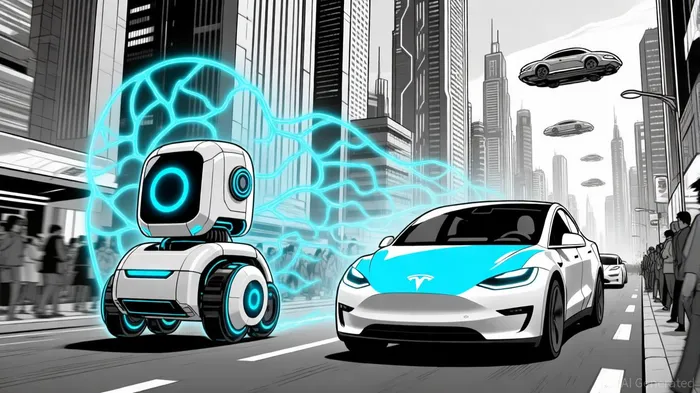
Tesla's strategic evolution from an electric vehicle (EV) manufacturer to a leader in physical artificial intelligence (AI) has accelerated in 2025, driven by ambitious advancements in robotics, autonomous systems, and AI infrastructure. The company's Optimus humanoid robot, now in its third generation, represents a pivotal step in this transformation, with Elon Musk projecting that it will account for 80% of Tesla's future value[1]. This shift is not merely speculative but rooted in tangible technological convergence between Tesla's EV innovations and AI-driven robotics, creating a unified ecosystem with transformative implications for industries ranging from manufacturing to urban mobility.
Technological Convergence: Bridging EVs and Robotics
Tesla's AI infrastructure, including the Dojo supercomputer and vision-based neural networks, underpins both its Full Self-Driving (FSD) system and the Optimus robot. The FSD system, trained on millions of miles of real-world data, enables real-time object detection and adaptive navigation[2]. This same architecture powers Optimus, allowing it to perform tasks such as factory logistics, home automation, and even complex manual labor[3]. The cross-platform synergy reduces development costs and accelerates innovation, as advancements in one domain—such as improved sensor fusion for autonomous vehicles—directly enhance robotic capabilities[4].
A critical enabler of this convergence is Tesla's focus on inference chips optimized for real-time decision-making. By streamlining AI chip development, TeslaRACE-- ensures that both its vehicles and robots can process data efficiently, a necessity for applications like emergency braking in cars or dexterous hand movements in Optimus[5]. Furthermore, the integration of Tesla's Grok AI assistant into Optimus underscores the company's vision of creating interactive, human-centric AI systems capable of answering questions and adapting to user needs[1].
Financial Implications and Investor Considerations
While Tesla's pivot to AI and robotics is ambitious, it comes with financial trade-offs. In 2024, the company's net income fell by 52.46% to $7.13 billion, despite strong revenue growth[6]. Capital expenditures have surged, with $10 billion allocated to autonomous driving and $5 billion directed toward AI infrastructure like the Cortex training cluster[6]. These investments, while critical for long-term dominance, may constrain short-term profitability and margin expansion.
However, Tesla's operational cash flow remains robust, with Q3 2024 reporting $2.7 billion in free cash flow—a 223% increase year-over-year[6]. This liquidity provides flexibility to scale production of Optimus, which is projected to reach 5,000–12,000 units in 2025 and 100,000 units by 2026[3]. For investors, the long-term potential of these ventures is substantial. Optimus and FSD could unlock high-margin businesses in ride-hailing and industrial automation, while Tesla's robotaxi service aims to disrupt urban mobility[6].
Strategic Risks and Market Dynamics
Tesla's dominance in physical AI is not without challenges. Production delays and supply chain constraints—particularly for rare-earth materials used in robotic actuators—pose risks to scaling Optimus[7]. Additionally, regulatory hurdles for autonomous systems, such as Tesla's robotaxi, could slow adoption. Competitors in the semiconductor and AI infrastructure space, like NvidiaNVDA--, stand to benefit from increased demand for advanced computing resources[1], but Tesla's vertical integration strategy aims to mitigate reliance on external suppliers.
For traditional automakers and EV startups, Tesla's integrated approach to AI and robotics raises the bar for innovation. Companies unable to match Tesla's pace may face obsolescence in key sectors[6]. This dynamic positions Tesla as a market leader, but investors must weigh the speculative nature of its current valuation—reflected in a forward P/E ratio of 83.1x[6]—against its execution risks.
Conclusion: A New Era of Sustainable Abundance
Tesla's vision of “sustainable abundance” hinges on the seamless integration of EVs, energy systems, and AI-driven robotics. The company's ability to scale Optimus production and refine its AI infrastructure will determine whether it realizes Musk's projection of a $25 trillion global market shift[2]. For investors, the long-term upside is compelling, but patience is required to navigate near-term challenges. As Tesla bridges the physical and digital realms, its role as the physical AI leader could redefine industries and cement its legacy as a transformative force in the 21st century.







Comentarios
Aún no hay comentarios