
Tesla's Earnings Volatility and Narrative-Driven Stock Performance: Is the AI Hype Justified?
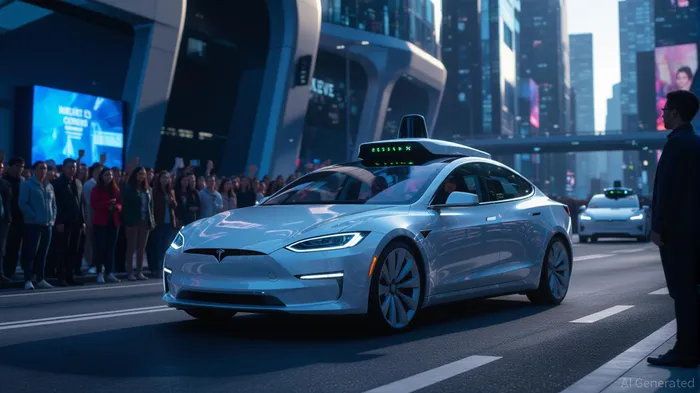
Tesla, Inc. (TSLA) has long been a case study in the tension between tangible financial performance and speculative narrative-driven valuations. As of Q2 2025, the company's earnings report revealed a 11.2% year-over-year revenue decline to $22.75 billion, with automotive gross margins contracting to 19.6%—a drop of 270 basis points since 2024. Yet, during the same period, its stock surged 90% in June 2025, fueled by optimism around its robotaxi launch and AI-driven monetization. This divergence raises a critical question: Is Tesla's stock still a compelling long-term investment, or is the market overestimating the impact of Elon Musk's vision ahead of tangible results?
Earnings Fundamentals: A Mixed Picture
Tesla's Q2 2025 earnings underscored persistent challenges in its core business. Automotive revenue fell 12.5% to $19.8 billion, driven by lower average selling prices (ASPs) in Europe and China, where the company implemented price cuts to stimulate demand. Logistics costs and tariffs further eroded margins, while global deliveries declined 13.5% to 384,122 units. These figures suggest a slowdown in demand amid a saturated EV market and intensifying competition from Chinese automakers like BYD and Xiaomi.
However, Tesla's energy and software segments showed resilience. Energy generation and storage revenue rose 25% year-over-year, and FSD subscriptions grew 35% quarter-over-quarter, adding 20,000 new subscribers. These metrics highlight Tesla's pivot toward software monetization, a strategy that could diversify its revenue streams but remains unproven at scale.
Narrative-Driven Sentiment: AI and Robotaxis as a “Narrative Meme”
The June 2025 stock surge was catalyzed by the robotaxi launch and Q1 2025 earnings, which exceeded lowered expectations. Despite a 17% drop in China deliveries and a 10% decline in European sales, Wall Street focused on Tesla's AI advancements. The company's forward P/E ratio of 62—6x higher than the industry average—reflects investor bets on a $1 trillion expansion of Tesla's total addressable market (TAM) through autonomous mobility.
Analysts like Wedbush's Dan Ives argue that Tesla's FSD technology could unlock a new revenue stream by 2026, with robotaxis potentially generating $100 billion annually. This narrative has positioned TeslaTSLA-- as a “tech platform” rather than a traditional automaker, attracting growth investors willing to overlook near-term margin pressures.
Yet, this optimism is not universally shared. UBS and Wells FargoWFC-- have downgraded Tesla, warning that its valuation is driven by momentum rather than fundamentals. The company's trailing P/E of 108.2 and P/S of 14.19 are stretched relative to peers like BYD (P/E: 22x) and Rivian (negative P/E). Critics argue that regulatory hurdles, technological delays, and declining market share in key regions could undermine these lofty expectations.
Valuation Metrics: A Premium on Potential, Not Performance
Tesla's valuation metrics remain a point of contention. While its ROE of 3.18% and 7.85% revenue growth outperform industry averages, its EBITDA and gross profit fall short. This disconnect suggests investors are pricing in a future where AI and autonomous driving dominate Tesla's revenue mix, rather than its current financials.
Morningstar and UBS have assigned Tesla price targets of $250 and $215, respectively, while bullish analysts like Ives project $500–$550. The wide range of forecasts—from $115 to $500—reflects deep uncertainty about Tesla's ability to execute its AI and AV roadmap. For context, Tesla's stock has historically been volatile, with a 56% drawdown in 2025 despite a 90% rebound in June. This volatility underscores the risks of a valuation anchored to speculative narratives.
Execution Risks and Regulatory Uncertainties
Tesla's AI ambitions face significant hurdles. The robotaxi rollout, while a technological milestone, is contingent on regulatory approvals and safety validation. The National Highway Traffic Safety Administration (NHTSA) is scrutinizing Tesla's FSD safety record, and delays in U.S. regulatory frameworks could stall progress. Additionally, Tesla's vision-only FSD system—eschewing LIDAR—has drawn skepticism from industry experts, who question its readiness for mass deployment.
Competition is another wildcard. Chinese EVs are gaining traction in global markets, with BYD and Xiaomi outpacing Tesla in consumer preference. In the U.S., Tesla's top-choice preference fell from 38% to 29% in 2025, while traditional automakers like Audi and BMW are regaining ground. Meanwhile, the proposed 50% EU import tariff could further strain Tesla's European operations, already struggling with ASP declines.
Is Tesla a Compelling Long-Term Investment?
For long-term investors, Tesla's potential as an AI-driven tech platform is undeniable. Its Dojo supercomputer, FSD software, and energy storage business position it to benefit from the $1 trillion autonomous mobility market and the $9 trillion urban air mobility (UAM) sector by 2050. If Tesla can scale robotaxis and achieve 50% FSD penetration, its margins could improve significantly, justifying a premium valuation.
However, the risks are substantial. Investors must weigh Tesla's current financials—declining margins, margin pressures, and competitive threats—against the speculative upside of its AI roadmap. The stock's 90% June surge was driven by hype, not fundamentals, and a return to reality could trigger volatility.
Investment Advice: Balancing Optimism and Caution
- For Growth-Oriented Investors: Tesla's AI and AV initiatives offer a compelling narrative for those comfortable with high-risk, high-reward bets. A position in Tesla could benefit from its potential to dominate the autonomous mobility space, provided execution risks are mitigated.
- For Value Investors: Tesla's stretched valuation metrics and weak earnings fundamentals make it a less attractive option. Consider waiting for a pullback or a clearer path to profitability before investing.
- For Diversified Portfolios: Tesla could serve as a speculative satellite holding, but it should not form the core of a portfolio. Pair it with more stable, cash-generative assets to hedge against volatility.
Conclusion
Tesla's stock performance in 2025 exemplifies the power of narrative-driven investing. While its AI and autonomous vehicle ambitions have captivated markets, the company's fundamentals remain under pressure. For now, Tesla appears to be a stock priced for a future where robotaxis and software monetization dominate its revenue streams. Whether this vision materializes will depend on Tesla's ability to execute on its roadmap, navigate regulatory challenges, and maintain its technological edge. For investors, the key is to balance optimism about its long-term potential with caution regarding its current valuation and execution risks.







Comentarios
Aún no hay comentarios