
Tesla's Self-Driving Lead: How Long Can It Sustain Against Nvidia's Challenge?
The race to dominate autonomous driving has intensified in 2025, with TeslaTSLA-- and NvidiaNVDA-- emerging as two of the most influential players. Tesla's Full Self-Driving (FSD) V12, with its vertically integrated approach and proprietary AI, has long been seen as a benchmark in the industry. Meanwhile, Nvidia's Alpamayo platform, an open-source AI solution, is reshaping the competitive landscape by enabling third-party automakers to build their own systems. As both companies vie for leadership, investors must assess how long Tesla's current edge can hold-and whether Nvidia's platform-based strategy will erode it.
Strategic Divergence: Vertical Integration vs. Open Platforms
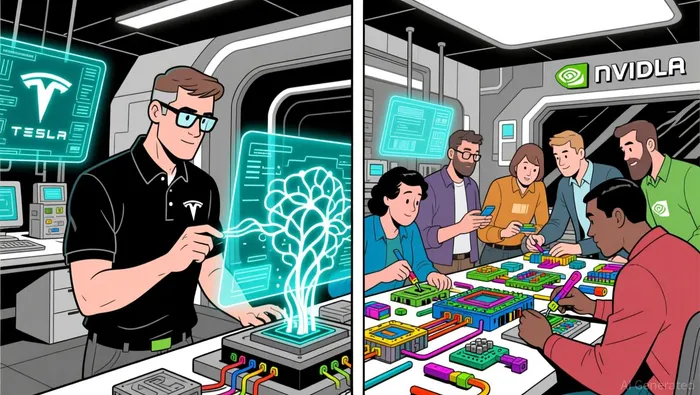
Tesla's FSD V12 exemplifies a vertically integrated model, where the company controls every layer of the autonomous driving stack, from custom silicon (e.g., HW5/AI 5 chips) to end-to-end neural networks according to Digitimes. This approach allows Tesla to optimize performance and reduce reliance on external suppliers, a critical advantage in a field where hardware-software synergy is paramount. The FSD v12 update, with its tenfold increase in neural network parameters and enhanced object detection, underscores Tesla's ability to leverage its vast real-world data fleet for rapid iteration.
Nvidia, by contrast, has adopted a platform-based strategy. Its Alpamayo AI, unveiled at CES 2026, is designed to democratize autonomous driving by providing modular tools-including simulation frameworks and datasets-to automakers like Mercedes-Benz and Lucid. This open approach reduces development barriers for partners, enabling faster deployment of Level 4 autonomy. As Jensen Huang, Nvidia's CEO, noted, Tesla's FSD is "world-class," but Alpamayo's flexibility could appeal to automakers lacking Tesla's in-house expertise.
Regulatory Hurdles and Market Adoption
Regulatory challenges loom large for both companies, particularly in Europe and China. Tesla's FSD rollout in Europe faces fragmented EU regulations, such as the UK's requirement for hands-on-the-wheel driving and the UNECE's stringent safety protocols according to Tesla's official blog. In China, where Tesla must navigate a ban on "smart driving" terminology in ads and strict data governance laws, the company's camera-centric FSD system struggles with dynamic infrastructure and environmental extremes. Elon Musk has acknowledged that full FSD availability in Europe may not occur before 2028 due to these hurdles.
Nvidia's open-platform strategy, while less constrained by hardware limitations, must adapt to regional data laws and liability frameworks. For instance, China's "black box" AI regulations necessitate a tiered liability system, complicating adoption for partners. However, Nvidia's modular tools allow automakers to tailor solutions to local requirements, potentially accelerating market penetration compared to Tesla's one-size-fits-all approach.
R&D Investment and Long-Term Sustainability
Tesla's R&D expenditures in self-driving technology have exceeded $10 billion, reflecting its commitment to maintaining a first-mover advantage. This investment has enabled breakthroughs like FSD v12's enhanced video compression and edge-case resolution. However, the cost of sustaining a vertically integrated system-both in terms of capital and operational complexity-poses risks. Analyst Freda Duan estimates Tesla's self-driving training costs at $3–4 billion annually, a burden that could strain margins as competition intensifies.
Nvidia's open-platform model, while less capital-intensive, relies on ecosystem growth. By providing foundational tools to automakers, Nvidia reduces the need for individual companies to reinvent the wheel. This scalability could prove critical as the autonomous driving market grows at a 12.4% CAGR from 2025 to 2034. However, the success of Alpamayo hinges on partners' ability to integrate and customize its tools effectively-a challenge that could delay widespread adoption.
Timeline and Competitive Pressure
Elon Musk has downplayed immediate threats from Nvidia, noting that solving the "long tail" of edge cases-where 99% functionality is easy but 100% reliability is elusive-remains a universal challenge. He predicts that rivals like Alpamayo will take 5–6 years to exert meaningful competitive pressure. This timeline aligns with industry analyst Philippe Ferragu's assessment that the automotive sector is approximately 12 years behind Tesla in autonomous driving adoption.
Yet, Nvidia's open-source approach could accelerate innovation. By enabling partners to iterate rapidly, Alpamayo may shorten the time required to address edge cases. For example, Mercedes-Benz's use of Nvidia's simulation tools could allow it to test scenarios more efficiently than Tesla's in-house methods. Additionally, as legacy automakers scale AI-driven solutions, Tesla's lead may narrow. Ross Gerber, an industry observer, argues that Tesla must address hardware and mapping limitations to retain its edge.
Conclusion: A Tug-of-War for the Future
Tesla's vertically integrated strategy has positioned it as a leader in autonomous driving, but its long-term sustainability depends on navigating regulatory complexity and sustaining high R&D investments. Nvidia's open-platform model, while less mature, offers a scalable alternative that could disrupt Tesla's dominance as more automakers adopt AI-driven solutions. For investors, the key question is whether Tesla's first-mover advantage and proprietary systems can outpace the collaborative, modular approach of Nvidia and its partners.
The next 5–6 years will be pivotal. If Tesla can overcome regulatory hurdles and maintain its hardware-software synergy, it may retain its lead. However, if Nvidia's ecosystem gains traction and partners achieve rapid deployment, the playing field could shift dramatically. In either case, the competition between these two titans will likely drive the industry toward safer, more capable autonomous systems-a win for innovation, even as market dynamics evolve.





Comentarios
Aún no hay comentarios