
Tesla's Divergent Performance: Norway's EV Success vs. Broader European Struggles
The electric vehicle (EV) market has long been a battleground for innovation, policy influence, and consumer sentiment. Nowhere is this more evident than in Tesla's contrasting fortunes in Norway and the broader European landscape. While the Scandinavian nation remains a beacon of success for the automaker, the rest of Europe tells a starker story of declining market share and intensifying competition. This divergence not only highlights the role of policy in shaping EV adoption but also raises critical questions about Tesla's long-term valuation and strategic resilience.
Norway: A Policy-Driven Success Story
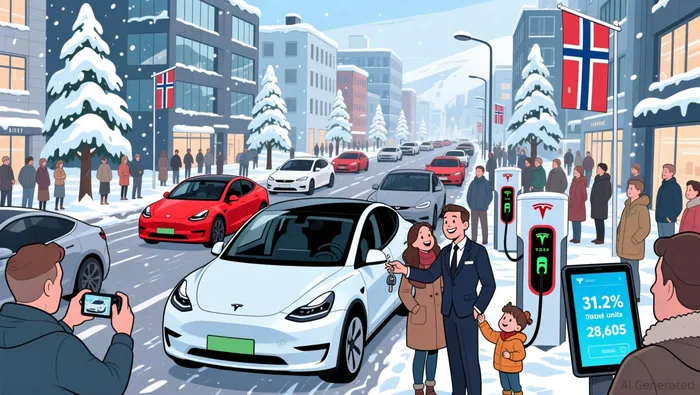
Norway's EV market has consistently defied global trends, with 97.6% of new car sales in November 2025 being electric vehicles (EVs). TeslaTSLA--, in particular, has capitalized on this environment, securing a 31.2% market share in November 2023 and setting a new annual sales record in 2025 with 28,606 vehicles sold. This surge was driven by a combination of factors: aggressive tax incentives, the impending expiration of EV tax breaks in 2026, and the popularity of the refreshed Model Y and Model 3.
According to a report by The Driven, Tesla's dominance in Norway is not merely a reflection of product quality but a direct result of government policies that prioritize EV adoption through exemptions from value-added tax (VAT) and tolls, as well as access to bus lanes. These incentives have created a "policy-driven" market where consumer behavior is heavily influenced by fiscal and regulatory frameworks rather than organic demand.
Broader Europe: A Market in Retreat
While Norway's success story is well-documented, Tesla's performance in the rest of Europe has been markedly weaker. In the first 11 months of 2025, European sales fell nearly 40% compared to the same period in 2024, with the EU market share dropping from 16.82% in January–July 2024 to 7.65% in the same period in 2025. Key markets like France and Sweden saw deliveries plummet by 66% and 64%, respectively, in September 2025.
Analysts attribute this decline to a confluence of factors. First, the rise of Chinese EV manufacturers such as BYD, which saw a 240% sales increase in the first 11 months of 2025, has eroded Tesla's competitive edge. Second, regulatory headwinds including the lack of approval for Tesla's Full Self-Driving (FSD) technology in Europe have limited the automaker's ability to differentiate its offerings. Third, political sentiment has played a role: a survey cited by found that 43% of Norwegian respondents would avoid Tesla vehicles due to Elon Musk's public support for right-wing political figures.
Valuation Implications: A Tale of Two Markets
The divergent performance of Tesla in Norway and broader Europe has direct implications for its stock valuation. Despite the automaker's energy storage business growing to 10.4 GWh deployed in Q1 2025, its core automotive segment faces headwinds. Analysts project a 32% decline in Tesla's earnings per share (EPS) for 2025, reflecting the third consecutive annual drop since 2022.
The stock's valuation metrics, such as the price-to-earnings (P/E) ratio, remain contentious. While 16 of 41 analysts covering Tesla recommend a "Strong Buy," 10 advise a "Strong Sell," with an average target price of $290-below the current trading price of $344. This disparity underscores the market's uncertainty about Tesla's ability to sustain growth in Europe, where it now holds just 10.2% of the market in 13 countries, down from 23.4% in Q3 2017.
The Norway anomaly complicates this narrative. While the automaker's success there is undeniable, it is largely tied to temporary incentives rather than long-term consumer loyalty. As CleanTechnica notes, the rush to purchase EVs before 2026's tax hike may not translate into sustained demand. This raises questions about whether Tesla's European strategy-relying on product upgrades like the revamped Model Y-can offset the broader market's decline.
Conclusion: A Critical Juncture for Tesla
Tesla's divergent performance in Norway and Europe underscores the fragility of its market position in the latter. While Norway's policy-driven success offers a temporary reprieve, the automaker's struggles in other European markets highlight systemic challenges: rising competition, regulatory barriers, and shifting consumer sentiment. For investors, the key question is whether Tesla can adapt its strategy to address these headwinds or if its valuation will continue to be dragged down by regional underperformance.
As the EV market evolves, the interplay between policy, innovation, and consumer behavior will remain pivotal. Tesla's ability to navigate this complex landscape-particularly in Europe-will likely determine not only its stock's trajectory but also its legacy as a leader in the transition to sustainable mobility.





Comentarios
Aún no hay comentarios