
Tesla's Declining US Market Share: A Strategic Reassessment for Investors
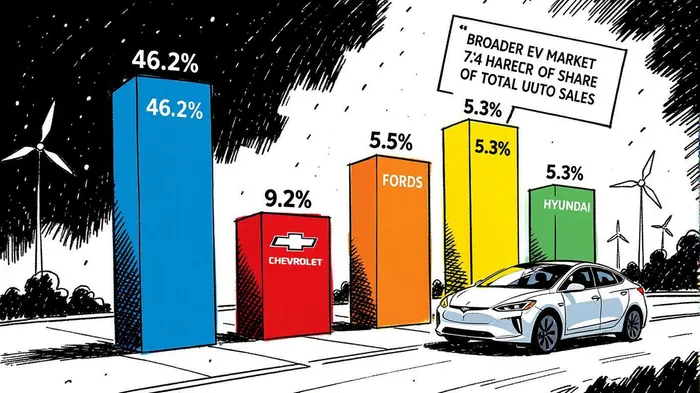
The U.S. electric vehicle (EV) market in 2025 is undergoing a seismic transformation, with Tesla’s once-unassailable dominance now under pressure from a confluence of competitive, regulatory, and consumer-driven forces. While the company still commands 46.2% of the U.S. EV market share in Q2 2025—selling 143,535 units—this figure represents a 10% decline compared to previous years, signaling a critical inflection point for investors [2]. The broader EV market, meanwhile, accounts for 7.4% of total U.S. auto sales, a slight year-over-year contraction [2]. This article examines the structural shifts reshaping the EV landscape and evaluates their implications for long-term capital allocation in Tesla’s ecosystem.
Structural Shifts: Competition, Consumer Trends, and Regulatory Dynamics
Tesla’s leadership is being challenged by a dual threat: legacy automakers accelerating their EV transitions and Chinese manufacturers flooding the market with cost-competitive models. General MotorsGM-- (GM) has emerged as a formidable rival, doubling its EV sales to capture 15% of the U.S. market, while Ford and Hyundai hold 5.5% and 5.3%, respectively [2]. These gains reflect a broader industry trend: legacy automakers are no longer playing catch-up. Instead, they are leveraging scale, brand equity, and government incentives to erode Tesla’s first-mover advantage.
Simultaneously, Chinese EV producers like BYD have disrupted global dynamics. BYD, for instance, surpassed TeslaRACE-- in delivery volume in China and is gaining traction in the U.S. through aggressive pricing and localized strategies [1]. This shift underscores a critical vulnerability for Tesla: its premium pricing model is increasingly at odds with a market prioritizing affordability. As stated by a report from CleanTechnica, “The rise of low-cost EVs from China is forcing Tesla to reconsider its pricing strategy, with margins already dipping below 18% in 2025” [1].
Regulatory headwinds further complicate the outlook. The expiration of the $7,500 federal EV tax credit at the end of September 2025 is expected to trigger a short-term sales surge in Q3 2025, followed by a potential Q4 slump [2]. Such policy-driven volatility introduces uncertainty for investors, particularly as state-level incentives remain inconsistent. Additionally, stringent emissions regulations and supply chain bottlenecks are elevating costs for all automakers, but Tesla’s reliance on rapid, low-margin growth makes it especially susceptible to margin compression [1].
Investment Implications: Navigating a Fragmented Landscape
For long-term capital allocators, Tesla’s challenges necessitate a nuanced reassessment. While the company’s brand strength, software ecosystem, and vertical integration remain competitive advantages, its ability to sustain profitability hinges on three key factors:
- Product Diversification: Tesla’s planned $25,000 compact EV, slated for 2025, aims to counter low-cost Chinese rivals. However, delays or cost overruns could exacerbate margin pressures [1]. Investors must weigh the risks of over-reliance on a single product launch against the potential to regain market share.
- Software and AI Monetization: The robotaxi platform and FSD (Full Self-Driving) subscriptions could unlock new revenue streams, but regulatory hurdles and technical delays remain significant risks [1].
- Global Market Exposure: While the U.S. market is maturing, Tesla’s growth in China and Europe is constrained by geopolitical tensions and local competition. A diversified global strategy is critical to offsetting U.S. headwinds.
Strategic Recommendations for Investors
Given these dynamics, investors should adopt a balanced approach:
- Short-Term Hedging: Position for Q3 2025 tax credit-driven demand while hedging against Q4 volatility through diversified EV sector exposure.
- Long-Term Focus on Innovation: Prioritize Tesla’s AI and software initiatives, which could differentiate its offerings in a commoditizing EV market.
- Competitive Benchmarking: Monitor GM’s and BYD’s strategies closely, as their success in affordability and scale could redefine industry benchmarks.
Conclusion
Tesla’s 46.2% U.S. EV market share in Q2 2025 is a testament to its enduring influence, but the structural shifts in the EV sector demand a recalibration of investment theses. As competition intensifies and regulatory environments evolve, Tesla’s ability to innovate beyond hardware—leveraging AI, software, and global diversification—will determine its long-term viability. For investors, the path forward lies in balancing optimism for Tesla’s ecosystem with a pragmatic assessment of its vulnerabilities in a rapidly maturing market.
**Source:[1] Tesla in 2025: Still the Market Leader, but for How Long? [https://skilling.com/eu/en/blog/market-insights/tesla-in-2025-still-market-leader/][2] Electric Vehicle Sales and Market Share (US - Q3 2025) [https://caredge.com/guides/electric-vehicle-market-share-and-sales]





Comentarios
Aún no hay comentarios