
Tesla's Decline in China: A Warning Signal for Global EV Market Dominance?
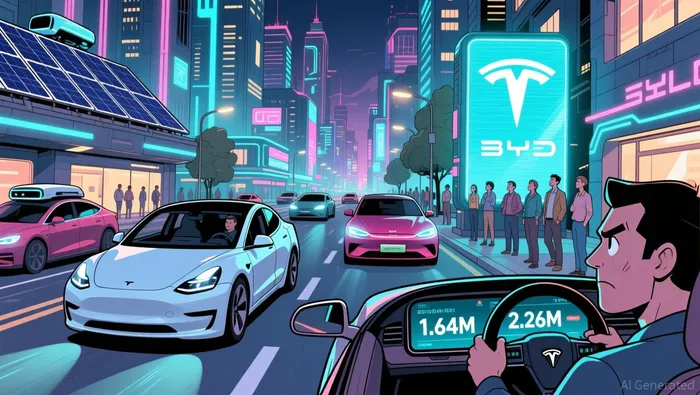
The electric vehicle (EV) landscape is undergoing a seismic shift, with Tesla's once-unassailable market position now under threat from a new generation of Chinese automakers. In 2025, Tesla's global vehicle deliveries fell by 15.61% year-on-year, delivering 418,227 units in Q4 alone-a 16% drop compared to the prior year's 495,570 units according to Q4 2025 data. This decline, most pronounced in China, has allowed BYD to overtake TeslaTSLA-- as the world's largest EV maker, delivering 2.26 million units in 2025 versus Tesla's 1.64 million. For investors, this raises a critical question: Is Tesla's waning dominance in China a harbinger of broader challenges in the global EV sector?
Tesla's China Struggles: A Microcosm of Global Pressures
Tesla's Shanghai plant, once a symbol of its aggressive expansion into Asia, delivered 851,732 vehicles in 2025-a 7% decline from 2024. This follows a 16% drop in Q4 deliveries, compounding concerns about the company's ability to compete in its second-largest market. The decline is attributed to a confluence of factors: the expiration of U.S. federal EV tax credits, which disproportionately affected demand in North America; rising competition from Chinese EVs priced 20–30% lower than Tesla's offerings; and shifting consumer preferences toward plug-in hybrids in Europe and China.
China's EV market, now the largest in the world, has become a battleground for global automakers. Tesla's market share in China has eroded as local rivals like BYD, Li Auto, and NIO have leveraged vertical integration, aggressive pricing, and tailored product strategies to capture domestic demand. For instance, BYD's recent price cuts across 22 models in its Dynasty and Ocean series have made its vehicles more accessible to price-sensitive buyers, while its Blade Battery technology has enhanced safety and range perceptions.
BYD's Strategic Playbook: A Blueprint for Global Supremacy
BYD's ascent is not accidental but the result of a calculated, multi-pronged strategy. The company has invested heavily in R&D, allocating RMB 54.2 billion in 2024 to develop cutting-edge technologies like solid-state batteries and Megawatt Flash Charging. This innovation-driven approach has enabled BYD to diversify its product lineup, offering everything from affordable sedans to luxury SUVs, while maintaining margins through in-house production of critical components.
Geographically, BYD has expanded its footprint to mitigate trade barriers and localize production. New plants in Brazil, Thailand, and Hungary-set to begin operations in late 2025-allow the company to bypass tariffs and cater to regional demand. In Europe, BYD has pivoted to PHEVs to circumvent EU tariffs on battery-electric vehicles (BEVs), a move that aligns with the region's growing appetite for extended-range vehicles according to market analysis. These strategic shifts underscore BYD's agility in adapting to regulatory and market dynamics, a stark contrast to Tesla's reliance on its U.S. and Chinese factories.
Valuation Risks: Can Tesla's Premium Justify Its Declining Deliveries?
Tesla's financials, while still robust, reveal growing valuation risks. The company's price-to-earnings (P/E) ratio of 292.05-far above the industry average- reflects investor optimism about its long-term prospects in AI, robotics, and energy storage. However, this optimism is increasingly at odds with its core automotive business. In Q4 2025, Tesla's vehicle deliveries fell short of analyst expectations, and its inventory gap widened to 16,131 units, signaling potential overproduction.
Investors must also grapple with the reality that Tesla's energy business, while growing, is not yet a profit driver. Despite record energy storage deployments of 14.2 GWh in Q4 2025, the segment remains a small fraction of total revenue compared to vehicle sales according to operational metrics. Meanwhile, BYD's diversified revenue streams spanning EVs, batteries, and renewable energy solutions-offer a more balanced risk profile.
The Broader Implications for the Global EV Sector
Tesla's struggles in China and its loss of the EV crown to BYD highlight a broader trend: the democratization of EV technology and the rise of cost-competitive, innovation-driven players. Chinese automakers, with their vertically integrated supply chains and aggressive pricing, are reshaping the industry's value proposition. For Tesla, the challenge lies in balancing its focus on high-margin, high-tech innovations (e.g., FSD and Optimus) with the need to maintain competitiveness in price-sensitive markets.
For investors, the key takeaway is clear: Tesla's valuation must be scrutinized through the lens of both its technological ambitions and its ability to adapt to a rapidly evolving market. While the company remains a leader in software and autonomous driving, its dominance in hardware and manufacturing is increasingly contested. As BYD and other Chinese rivals scale their global operations, the EV sector is entering an era of intense competition-one that demands a reevaluation of long-held assumptions about Tesla's growth trajectory.





Comentarios
Aún no hay comentarios