
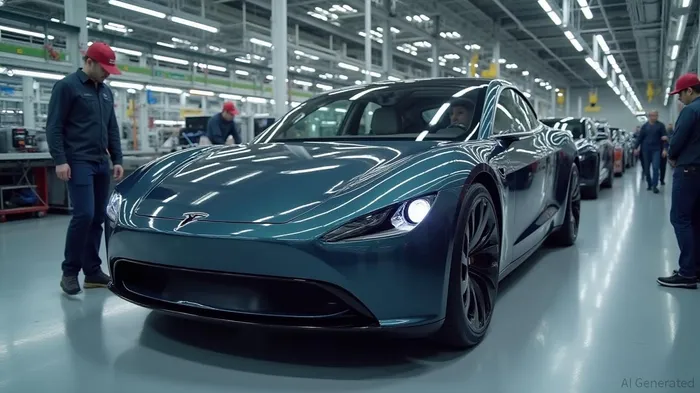
Tesla says the first Cybercab just rolled off the production line at Gigafactory Texas
Tesla says the first Cybercab just rolled off the production line at Gigafactory Texas
Tesla Unveils First Cybercab Production Unit Amid Autonomy Challenges
Tesla announced that the first production unit of its Cybercab, a fully autonomous vehicle, has rolled off the assembly line at Gigafactory Texas. The two-passenger vehicle, designed exclusively for ride-hailing and personal ownership, features no steering wheel, pedals, or manual controls, relying entirely on the company's Full Self-Driving (FSD) software. While this marks a significant manufacturing milestone, the vehicle's success hinges on the maturation of Tesla's autonomous technology, which remains unproven at scale.
Tesla's FSD software has faced scrutiny in its current robotaxi pilot. Data from Austin shows the fleet, using Model Y vehicles with the same technology, crashes at a rate of one incident every 57,000 miles—nearly four times the rate of human drivers. Additionally, the service operates at just 19% availability, with most vehicles requiring safety monitors either onboard or in trailing cars. Despite Elon Musk's claims of "unsupervised" operations, video evidence and user reports indicate persistent reliance on human oversight.
The Cybercab's production raises regulatory and technical hurdles. Federal safety standards, designed for human-driven vehicles, may require special exemptions for a car without manual controls. Tesla's chairwoman, Robyn Denholm, previously hinted at potential steering-wheel requirements, though Musk dismissed such concerns. Meanwhile, the company's next-generation AI5 chip, critical for advanced autonomy, remains delayed until mid-2027, forcing the Cybercab to launch on current-generation AI4 hardware.
Tesla's history of premature hardware bets adds further risk. Past decisions—such as removing radar, ultrasonic sensors, and turn signal stalks—were later reversed, sometimes at customer expense. The Cybercab represents the most extreme iteration of this strategy: a vehicle with no fallback if autonomy fails. Musk has acknowledged Tesla needs 10 billion miles of data to achieve "safe unsupervised self-driving," a threshold projected for July 2026, with additional testing likely extending readiness by another year.
For investors, the Cybercab underscores Tesla's high-stakes bet on autonomy. While the vehicle's $30,000 price point and mass production ambitions signal long-term potential, unresolved technical and regulatory challenges could delay profitability. Continuous production is not expected until April 2026, with street-legal approval and market adoption remaining uncertain. The outcome may shape not only Tesla's robotaxi ambitions but also its broader vision for AI-driven value creation.




Comentarios
Aún no hay comentarios