
Tesla's Crossroads: Political Storms and EV Subsidy Sunset Threaten Near-Term Gains
Tesla's stock (TSLA) has long been a barometer of investor optimism in the electric vehicle (EV) revolution. Yet today, it faces a perfect storm of political fireworks, subsidy cliffs, and intensifying competition. As CEO Elon Musk's public feud with President Donald Trump escalates—and federal EV tax credits head toward oblivion—the question looms: Is Tesla's near-term volatility a buying opportunity, or a warning sign for investors?
A Political Tempest Diverts Musk's Focus
The rivalry between Musk and Trump has entered a new phase. Musk's creation of the centrist “America Party” and his role leading the Department of Government Efficiency (DOGE) have drawn ire from the Trump administration. Analysts note Musk's political pivot risks distracting from Tesla's critical needs, including securing regulatory approvals for its autonomous driving software.
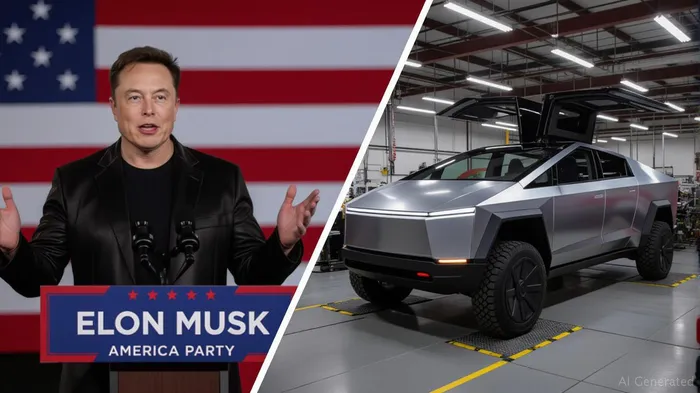
The fallout is already tangible. Tesla's stock dropped 7% in late June after Musk called Trump's signature “One Big Beautiful Bill” a “disgusting abomination.” The legislation, which accelerates the end of EV tax credits to September 30, 2025, has analysts like Wedbush's Dan Ives warning of “a dangerous diversion of focus.” Musk's recommendation of a Democratic official for NASA leadership while leading a space-related firm (SpaceX) has also sparked ethics concerns, raising regulatory risks for Tesla's government contracts.
Subsidy Dependency: The $1.2B Cliff
Tesla's financial health hinges on federal EV tax credits, now set to expire. JPMorganJPM-- estimates TeslaTSLA-- could lose $1.2 billion annually once the credits vanish—a hit that looms large as Tesla's Q1 2024 net income plummeted 71%.
The “One Big Beautiful Bill” also strips California of its power to set stricter emissions standards, a blow to Tesla's sales in its key market. While California promises state rebates, the loss of federal incentives could depress demand. Analysts project a 72% drop in U.S. EV sales without subsidies, a scenario that tests Tesla's ability to compete on price alone.
Delivery Forecasts and Competitive Pressures
Tesla's growth relies on hitting delivery targets to maintain market share. Yet rivals like Ford (F) and Rivian (RIVN) are closing the gapGAP--. Ford's Mustang Mach-E and F-150 Lightning have outsold Tesla's Model Y in key markets, while Rivian's R1T pickup targets Tesla's Cybertruck directly.
Compounding Tesla's challenges: Musk's focus on politics may slow innovation. Tesla's Autopilot software, once a differentiator, faces scrutiny over safety and regulatory delays. Competitors like Cruise (GM) and Waymo (Alphabet) are advancing faster in autonomous tech, a critical battleground for long-term EV value.
Technical Indicators: A Cautionary Signal
From a technical perspective, Tesla's stock is stuck in a volatile range. The 200-day moving average has held near $200 since early 2023, but recent dips below $180 suggest weakening momentum.
Analyst sentiment is mixed. Of 38 analysts tracked by Bloomberg, 12 recommend “hold” or lower, citing subsidy risks and Musk's distractions. Bulls, however, point to Tesla's $500 billion market cap and its dominance in battery tech as long-term advantages.
Investment Thesis: Proceed with Caution
For investors, Tesla presents a high-risk, high-reward scenario. Near-term risks—subsidy loss, political overreach, and delivery misses—argue for a wait-and-see approach. The September tax credit deadline could trigger further volatility, creating a potential buying opportunity if the stock tests its 52-week low of $150.
Long-term, Tesla's EV leadership and Musk's vision for autonomous driving and energy storage remain compelling. However, investors must weigh whether the current stock price reflects these ambitions or overvalues them in a subsidy-starved environment.
Final Take
Tesla's stock is a litmus test for the EV revolution's resilience. While its long-term position as an EV pioneer remains intact, near-term risks—from political distractions to subsidy cliffs—demand caution. Investors should consider scaling into positions below $180, but only with a multi-year horizon and a tolerance for turbulence. As Musk once said, “The journey matters more than the destination.” For Tesla shareholders, that journey is getting bumpier by the day.





Comentarios
Aún no hay comentarios