
Tesla's Crossroads: Can Overcapacity and Brand Risks Derail Its EV Dominance?
The electric vehicle (EV) revolution once seemed unstoppable, with TeslaTSLA-- at its vanguard. But as 2025 unfolds, cracks are emerging in the narrative of Tesla's invincibility. Slowing Cybertruck sales, mounting inventory backlogs, and a shifting competitive landscape are exposing vulnerabilities that could upend the company's long-term prospects. Add to this Elon Musk's polarizing public persona and regulatory headwinds, and Tesla's ability to sustain its premium valuation comes into sharp doubt. Let's dissect the risks and what they mean for investors.
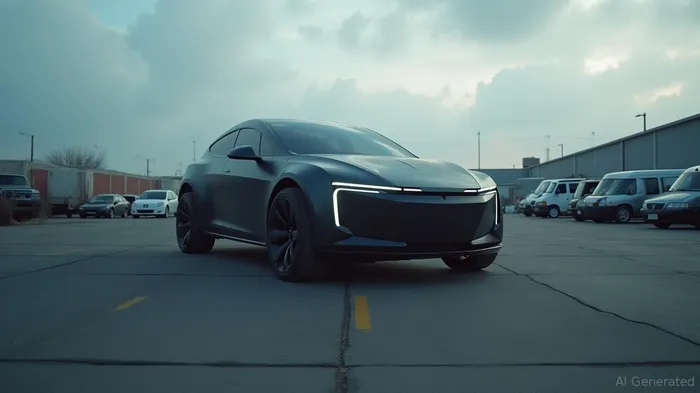
The Cybertruck Conundrum: Overproduction Meets Underwhelming Demand
Tesla's futuristic Cybertruck was supposed to be the next blockbuster. Instead, it's become a cautionary tale of overambition. As of May 2025, over 10,000 unsold Cybertrucks were languishing in U.S. warehouses—a $800 million financial albatross. This inventory could last three months even if production halted entirely, signaling a stark disconnect between Tesla's manufacturing pace and actual demand.
The Cybertruck's struggles are not isolated. In Q1 2025, its U.S. sales fell to 7,126 units, a 57% drop from its peak in Q3 2023. Competitors like the Ford F-150 Lightning have seized the top spot in the electric pickup market, selling 7,913 units in the same quarter. Meanwhile, regulatory hurdles—such as the UK's outright ban due to safety and weight concerns—are restricting its global reach.
The financial toll is clear: Tesla's revenue dropped 9% YoY to $19.34 billion in Q1 2025, with net income plummeting 71% to $409 million. Automotive revenue fell 20% as price cuts and production retooling squeezed margins.
Competitive Pressures: Tesla's Pricing Strategy in Retreat
Tesla's once-untouchable pricing advantage has evaporated. Competitors like XPeng and Kia are undercutting Tesla's models with superior value:
- The XPeng G6 offers luxury features at $40,000, $10,000 cheaper than the Model Y Long Range.
- The Kia EV3 in the UK undercuts the Model 遑 by $5,000, while Tesla's Cybertruck—priced at $81,895–$101,985—faces sticker shock in a market increasingly favoring affordability.
This pricing war is reflected in global sales data:
- Tesla's Netherlands sales dropped 75% YoY by April 2025, and UK sales fell 62%.
- Even in China, Tesla's home market for growth, sales dipped 6% as BYD and other local rivals surged.
Operational Inefficiencies: Production Halts and Strategic Missteps
Tesla's operational challenges are compounding its sales slump. Repeated production halts—such as the Model Y retooling delays—have disrupted supply chains, while Cybertruck production has slowed to a “crawl.” Even as Tesla shifts focus to cheaper models (e.g., the rumored $25,000 EV), it faces execution risks.
The Cybertruck itself is a case study in missteps:
- Quality concerns: Rust-like defects on stainless steel bodies and recalls for accelerator panel flaws have dented confidence.
- Design rigidity: Musk's refusal to compromise on the Cybertruck's “futuristic” aesthetic—despite customer complaints—suggests a disconnect from market needs.
Brand Risk: Musk's Controversies and the Erosion of Consumer Trust
Elon Musk's public persona has become a double-edged sword. His political involvement—such as ties to the Trump administration—has fueled boycotts and reputational damage. Meanwhile, incidents like the Cybertruck vandalism (a driver's road rage over a dented truck) underscore the brand's polarizing appeal.
The fallout extends to consumer behavior:
- Waitlist vs. Reality: Over 2 million Cybertruck reservations exist, but fewer than 4,000 were delivered by early 2024. Buyers are delaying purchases, waiting for discounts or better alternatives.
- Resale value collapse: Used Cybertrucks now face penalties of up to $50,000 if sold prematurely, deterring potential buyers.
Valuation Reality Check: Is TSLA Overvalued?
Tesla's stock price has already reflected these headwinds, dropping 35% since mid-2023. Yet its valuation remains elevated compared to fundamentals:
- Revenue stagnation: Even with a rumored $25,000 EV, Tesla's growth is constrained by overcapacity and market saturation.
- Competitive moat erosion: As rivals close the innovation gap, Tesla's premium pricing is unsustainable.
Investment Implications: Reassessing Exposure to Tesla
Investors should weigh the risks:
1. Overcapacity crisis: The Cybertruck's $800 million inventory backlog signals a broader issue—Tesla may struggle to sell even 20,000 units annually, far below its 250,000 target.
2. Regulatory risks: Bans like the UK's could spread as regulators scrutinize Tesla's unconventional designs.
3. Shifting consumer preferences: Buyers now prioritize affordability, practicality, and reliability—areas where Tesla's high-end models are losing ground.
Recommendation: Investors holding Tesla should consider trimming exposure unless the company demonstrates a credible turnaround—such as cost discipline, regulatory compliance, and a winning low-end EV. For new investors, the risks of overvaluation, execution delays, and intensifying competition make TSLA a high-risk, low-reward bet.
However, historical data offers a mixed perspective. A backtest of this strategy from 2020 to 2025 showed an impressive total return of 400.55%, with an average annual gain of 38.2%. Despite this, the strategy carried significant risk, with a maximum drawdown of 71.47%, underscoring the volatility inherent in the stock. While such returns highlight Tesla's past resilience, today's challenges—from overcapacity to regulatory pressures—suggest that past performance may not predict future success. Investors must weigh these historical gains against the current risks before considering exposure.
Conclusion
Tesla's journey from disruptor to incumbent has exposed vulnerabilities long masked by its early dominance. With declining demand, operational missteps, and a brand increasingly at odds with market realities, Tesla's valuation may be pricing in a future it can no longer secure. Investors would be wise to demand proof that this EV pioneer can adapt—or brace for further declines.







Comentarios
Aún no hay comentarios