
Tesla's Cost-Cutting Strategy: Navigating the Tightrope Between Volume Growth and Profitability in a Competitive EV Market
Strategic Trade-Offs: Cheaper Models and Marginal Pressures
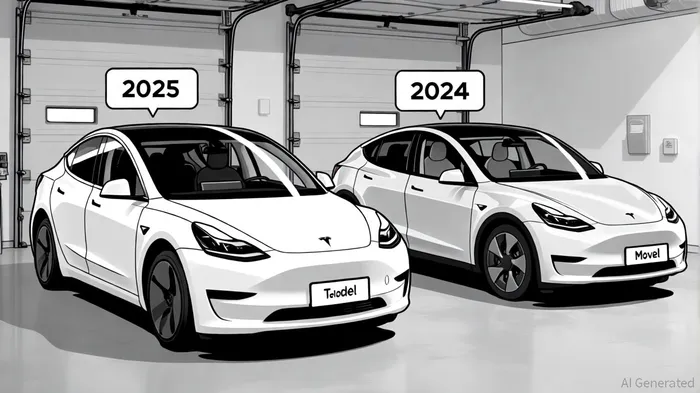
Tesla's 2025 cost-cutting strategy has centered on introducing lower-cost variants of its Model 3 and Model Y, reducing vehicle costs by $5,000 to $5,500 through measures such as smaller batteries, less powerful motors, and the removal of premium features like ventilated seats and ambient lighting, according to a Reuters report. This approach reflects a deliberate trade-off: prioritizing volume growth over short-term profitability. The Reuters report says these adjustments aim to broaden Tesla's appeal in price-sensitive markets while maintaining its technological edge.
However, the financial implications are stark. According to a Forbes analysis, Tesla's Q1 2025 results revealed a 9% year-over-year revenue decline to $19.3 billion and a 71% drop in net income to $409 million. The automotive segment's gross margin fell to 16.3%, down from 17.4% in the prior year, driven by lower average selling prices and higher per-unit costs linked to production retooling for the new Model Y. This margin compression highlights the fragility of Tesla's strategy in a market where pricing power is increasingly contested.
Competitor Dynamics: BYD's Cost-Efficiency Edge
Tesla's challenges are amplified by the rise of competitors like BYD, which has leveraged a vertically integrated supply chain and a deep parts catalog to produce affordable EVs at scale. BYD's Seagull model, priced at $12,000, undercuts Tesla's Model 3 by up to 50% in some markets, according to a TechResearchOnline analysis. This cost structure allows BYD to maintain profitability while expanding its product lineup to include both battery-only and plug-in hybrid models, catering to diverse consumer segments in developing markets.
In contrast, Tesla's reliance on premium features and a robust charging network sustains brand loyalty among tech-savvy buyers but leaves it vulnerable to margin erosion. A CarsNewsWire piece highlights BYD's localized manufacturing and lower production costs as providing a distinct edge in cost efficiency, challenging Tesla's dominance in price-sensitive regions.
Production Constraints and Inventory Challenges
Tesla's Q3 2025 record of 497,099 vehicle deliveries-partially fueled by drawing down 50,000 units of existing inventory-masked underlying production bottlenecks. While deliveries surged, production volume lagged at 447,450 units, an 11% shortfall that raises concerns about the sustainability of such growth, according to a Panabee report. This structural bottleneck could hinder Tesla's ability to meet rising demand without further margin compression, particularly as competitors like BYD scale production more efficiently.
Long-Term Gambit: Innovation vs. Profitability
Looking ahead, Tesla's investments in AI, self-driving technology, and energy storage are positioned as long-term growth drivers. However, these initiatives come at the expense of short-term profitability, as the company prioritizes innovation over immediate margin improvements, as noted in the earlier Forbes analysis. The energy storage segment, which grew 67% year-over-year to $2.72 billion in Q1 2025, offers a high-margin counterbalance to the automotive segment's struggles. Yet, investors must weigh whether these bets will pay off in a market where pricing wars and regulatory shifts could further disrupt margins.
Conclusion: A Delicate Balancing Act
Tesla's 2025 strategy exemplifies the delicate balancing act required in the EV industry: expanding unit volume to secure market share while mitigating margin pressures. While cost-cutting has temporarily boosted sales, the company's ability to sustain profitability will depend on its capacity to innovate, optimize production, and differentiate itself in a market increasingly dominated by cost-efficient rivals. For investors, the key question remains whether Tesla's long-term vision-anchored in technological leadership and energy diversification-can offset the near-term risks of margin erosion and production constraints.





Comentarios
Aún no hay comentarios