
Tesla's Autopilot Legal Risks and Their Implications for Future Profits
Tesla's autonomy-driven growth strategy, long hailed as a cornerstone of its future profitability, is increasingly under siege from regulatory and reputational risks tied to its Autopilot and Full Self-Driving (FSD) systems. Recent legal verdicts, ongoing investigations, and investor skepticism underscore a growing disconnect between the company's ambitious vision and the operational realities of its autonomous technology. As regulators intensify scrutiny and public trust erodes, the financial and strategic implications for TeslaTSLA-- could prove severe.
Regulatory Scrutiny Intensifies
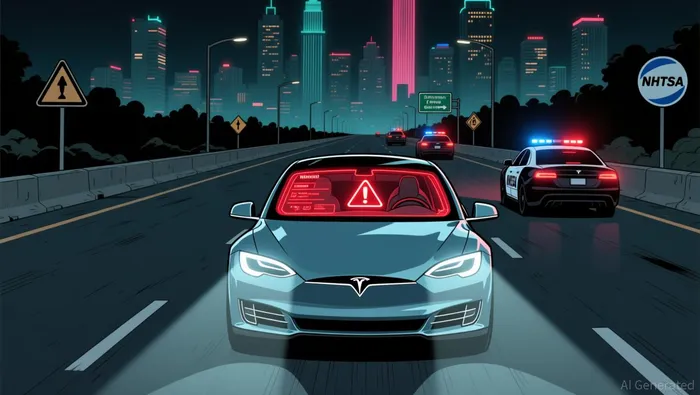
The National Highway Traffic Safety Administration (NHTSA) has launched multiple investigations into Tesla's Autopilot and FSD systems since 2023, focusing on safety violations such as vehicles running red lights, failing to detect traffic signals, and operating in low-visibility conditions according to reports. A 2023 recall (23V-838) addressed deficiencies in driver monitoring features, but NHTSA continues to evaluate the effectiveness of Tesla's software updates according to NHTSA reports. By 2025, the agency had expanded its probe to nearly 2.9 million Tesla vehicles, citing concerns over delayed crash reporting and the system's inability to ensure driver attentiveness. These investigations highlight systemic flaws in Tesla's approach to autonomous safety, raising questions about its compliance with federal standards.
Legal Verdicts and Financial Fallout
The most high-profile legal blow came in August 2025, when a Miami jury ruled Tesla 33% liable for a 2019 fatal Autopilot crash, ordering the company to pay $329 million in damages. This verdict, which included $200 million in punitive damages, triggered an immediate 1.8% drop in Tesla's stock price. The ruling not only exposed the company to further litigation but also amplified concerns about the marketing and reliability of its self-driving features. A separate wrongful death lawsuit involving a 2019 California Autopilot crash was settled in September 2025, though details remain confidential according to legal sources. These cases signal a broader trend: as Tesla expands its autonomous technology, including controversial robotaxi deployments, the legal risks-and associated costs-escalate.
Reputational Damage and Investor Skepticism
Tesla's reputation as a leader in autonomous driving has been tarnished by repeated incidents and regulatory criticism. The California Department of Motor Vehicles has sued the company for allegedly overstating the capabilities of its Autopilot systems, while NHTSA investigations have documented 14 crashes and 23 injuries linked to Autopilot since 2023 according to regulatory data. Public perception is further strained by reports of vehicles violating traffic laws, such as entering oncoming traffic lanes. Investor confidence has waned accordingly. Former Tesla AI lead Andrej Karpathy has warned that the company's progress toward full autonomy remains incomplete, a sentiment echoed by analysts noting declining profit margins and rising regulatory costs according to financial reports.
Strategic and Financial Implications
The financial toll of these challenges is becoming evident. Tesla's stock, which closed at $329.31 in late August 2025, has shown signs of bearish momentum according to market analysis, reflecting investor uncertainty. The company's high valuation, historically buoyed by expectations for AI-driven services like robotaxis, now faces headwinds as legal and reputational risks mount according to equity analysts. Delays in resolving NHTSA investigations and lawsuits could further stall the rollout of FSD, a critical component of Tesla's long-term revenue strategy. Moreover, the costs of recalls, settlements, and compliance measures may erode profitability at a time when margins are already under pressure according to industry experts.
Conclusion
Tesla's Autopilot and FSD systems represent both a technological ambition and a financial liability. While the company continues to innovate, the regulatory and legal hurdles it faces threaten to undermine its autonomy-driven growth narrative. For investors, the risks are twofold: not only does Tesla's self-driving technology face operational and safety challenges, but its ability to monetize these innovations is now clouded by litigation, reputational damage, and regulatory uncertainty. As the NHTSA and other agencies maintain their focus on autonomous safety, Tesla's path to profitability may depend on its capacity to address these systemic issues-or risk being sidelined by competitors with more robust compliance frameworks.







Comentarios
Aún no hay comentarios