
Tesla's Autonomous Revolution: Why Wedbush's $500 Target Points to a $2 Trillion Future
Tesla's stock has long been a barometer of investor confidence in the electric vehicle (EV) revolution, but its trajectory now hinges on a far grander ambition: dominating the $1 trillion autonomous vehicle market. Analysts at Wedbush Securities recently raised their price target for TeslaTSLA-- to $500 per share—a 43% jump from prior estimates—citing breakthroughs in autonomous technology as the catalyst for a valuation surge that could eventually propel the company toward a $2 trillion market cap. For investors, the question is no longer whether Tesla can sustain its leadership in EVs, but whether its autonomous systems and AI-driven innovations will redefine mobility itself.
The Golden Age of Autonomy: Tesla's 2025 Milestones
At the heart of Wedbush's bullish thesis is Tesla's upcoming June 2025 launch of its unsupervised Full Self-Driving (FSD) system in Austin, Texas. This milestone marks the first time a major automaker will deploy a Level 4 autonomous system—capable of operating without human intervention—in a consumer vehicle. The rollout is expected to accelerate Tesla's transition from a hardware-driven business to a software-as-a-service model, where recurring revenue from FSD subscriptions and robotaxi operations could eclipse traditional car sales.
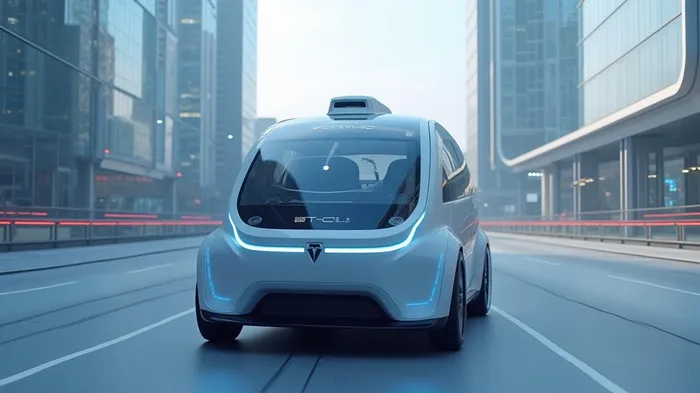
The Cybercab, slated for mass production by 2026, is another linchpin of this strategy. Wedbush estimates the robotaxi market alone could generate a $1 trillion opportunity over the next decade, with Tesla's early mover advantage in FSD technology positioning it to capture a dominant share. Pair this with the Optimus humanoid robot project—a potential game-changer for industrial automation—and Tesla's valuation becomes a bet on its ability to lead in AI-driven mobility solutions.
Valuation at the Crossroads: Growth vs. Reality
Critics argue Tesla's stock is overvalued, trading at a forward P/E ratio of ~158.73x 2026 earnings—a stark contrast to peers like Ford (5.5x) or General Motors (6.2x). Yet Wedbush dismisses these concerns, emphasizing that 90% of Tesla's future valuation could stem from autonomous software, AI, and robotics. The near-term challenges—declining EV deliveries in Q1 2025, tariff pressures, and Musk's political entanglements—are framed as temporary headwinds.
The stock's volatility since 2023 underscores investor skepticism, but Wedbush points to two near-term catalysts to reinvigorate demand: the launch of a sub-$35,000 EV and the Austin FSD rollout. These moves aim to counter Chinese competitors like BYD while reigniting growth in core markets.
Regulatory Tailwinds and Strategic Partnerships
A critical enabler of Tesla's autonomy ambitions is the regulatory landscape. Under the Trump administration, the U.S. has signaled a shift toward deregulation in autonomous vehicle deployment, potentially fast-tracking Tesla's FSD system approvals. This could also open doors for Tesla to license its software to other automakers—a $50 billion potential revenue stream, according to Wedbush.
Why the Bulls Are Right—and the Risks Are Manageable
While bears highlight risks—margin pressures from price cuts, geopolitical tensions, and brand dilution—the case for Tesla's $500 target hinges on a simple truth: autonomous technology is the ultimate moat in the mobility sector. Tesla's first-mover advantage in FSD, paired with its vertically integrated AI stack (Dojo supercomputers, Vision system), creates a near-insurmountable lead. Even Elon Musk's polarizing persona is dismissed as a minor distraction, with Wedbush estimating brand damage at less than 5% of sales.
The valuation gap between Tesla and traditional automakers reflects this divergence: investors are not just buying a car company but a tech giant in the making.
Conclusion: A $2 Trillion Vision at $500—Is Now the Time to Buy?
Wedbush's $500 price target isn't just a number—it's a roadmap. For investors willing to look beyond quarterly delivery figures and tariff wars, Tesla's autonomous future represents a once-in-a-decade opportunity. The Austin FSD launch and Cybercab rollout are not mere product updates; they're the first steps toward a world where Tesla's software is as essential as electricity itself.
The risks are real, but so is the upside. With autonomous systems unlocking trillion-dollar markets and AI projects like Optimus expanding Tesla's footprint, the $500 target could soon feel conservative. For long-term investors, the question isn't whether Tesla can hit this target—it's whether they can afford not to participate in its ascent.
Act now, or risk missing the next chapter of Tesla's revolution.





Comentarios
Aún no hay comentarios