
Tesla's Autonomous Future: How FSD and Robotaxi Progress Are Rewriting Valuation Narratives
FSD Progress and Monetization: A Tale of Two Markets
Tesla's FSD v14 update, introduced in late 2025, marked a significant leap in autonomous capabilities, enabling parking-to-parking navigation under driver supervision. However, the monetization story remains uneven. Premium models like the Model S and Model X have seen FSD adoption rates of 50–60%, driven by buyers who view the feature as a luxury. In contrast, high-volume models like the Model 3 and Model Y lag, with adoption rates in the teens despite software improvements such as end-to-end neural networks and FSD transferability.
This disparity highlights a key challenge: TeslaTSLA-- must balance accessibility with profitability. While FSD is priced at $8,000 upfront or $99/month, regulatory hurdles in Europe and China, coupled with U.S. safety investigations, have dampened adoption. Yet, the promise of "Unsupervised" FSD capabilities in late 2025 and the expanding Robotaxi network are reshaping buyer perceptions, suggesting a path to broader acceptance.
Robotaxi: The $75 Billion Question
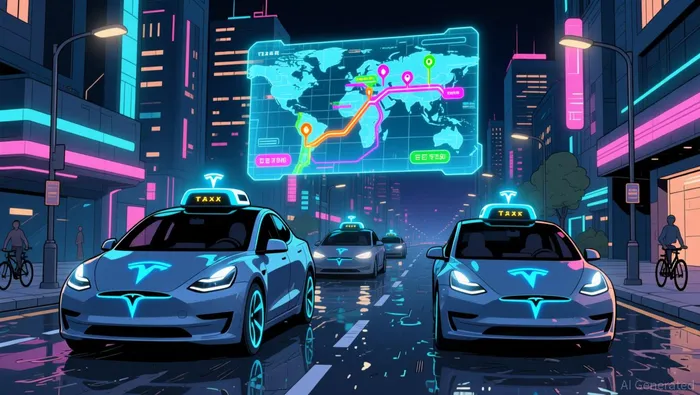
The true game-changer, however, is Tesla's robotaxi service. Stifel's analysis assigns 75% of its estimated upside to this initiative, valuing it at $158 per share. Dynamic pricing models, introduced in July 2025, already demonstrate Tesla's competitive edge. A test ride in Austin cost $1.25 per mile-far cheaper than Uber's $1.64–$2.36 and Waymo's $1.91–$2.00 per mile. With plans to expand service areas tenfold, the robotaxi network could generate $1 billion in 2026 and scale to $75 billion by 2030, representing 45% of Tesla's projected vehicle revenue.
Monetization strategies remain fluid, but the potential is clear. For context, analysts project that robotaxi will contribute $14.859 billion to Tesla's 2025 EBITDA and $19.489 billion in 2026. These figures reflect not just revenue from rides but also the broader ecosystem of data, software updates, and vehicle utilization.
Challenges and Competition: The Road Ahead
Tesla's dominance in autonomous tech is not unchallenged. Xpeng's NGP system, tested in a $20,000 electric car, offers comparable parking-to-parking functionality, while regulatory scrutiny in key markets remains a headwind. Additionally, the expiration of U.S. EV tax credits could pressure near-term margins, even as robotaxi offsets long-term risks.
Yet, Tesla's first-mover advantage and software-first approach provide a moat. Elon Musk's vision of "transformative transportation" is increasingly aligned with investor expectations, particularly as Stifel's revised valuation model allocates 20–25x 2026 EBITDA to Tesla's core business.
Valuation Implications: Beyond the Car
The implications for Tesla's valuation are profound. By 2030, robotaxi could account for nearly half of the company's revenue, shifting its identity from automaker to mobility-as-a-service provider. This transition mirrors the evolution of companies like Uber and Waymo but with a critical difference: Tesla's vertically integrated hardware-software ecosystem.
For investors, the key question is whether the market will price in these future cash flows. Stifel's $508 price target assumes a 75% contribution from robotaxi, but execution risks-regulatory, technical, or competitive-could alter this trajectory. Nevertheless, the data suggests that Tesla's autonomous future is no longer a distant dream but a tangible revenue stream reshaping its EBITDA and valuation narratives.
Conclusion
Tesla's FSD and robotaxi initiatives are rewriting the rules of the automotive industry. While challenges persist, the company's progress in 2025 has already validated its long-term vision. For investors, the focus must shift from quarterly vehicle deliveries to the compounding value of autonomous software and network effects. As Stifel's analysis shows, the road ahead is not just about cars-it's about redefining mobility itself.





Comentarios
Aún no hay comentarios