
Tesla's AI and Robotics Transition as a Valuation Catalyst in a Post-Incentive Era
Tesla's strategic repositioning from an electric vehicle (EV) manufacturer to an AI and robotics enterprise has emerged as a critical valuation driver in a post-subsidy world. As federal EV incentives in the U.S. expire and global demand normalizes, the company's ability to decouple its financial performance from automotive delivery metrics hinges on its progress in autonomous driving, robotaxis, and humanoid robotics. This transition, while ambitious, is reshaping investor sentiment and redefining Tesla's competitive moat in a rapidly evolving technological landscape.
Post-Subsidy Challenges and Strategic Reorientation
The expiration of the $7,500 U.S. federal EV tax credit at year-end 2025 triggered a "demand cliff," with Q4 2025 deliveries projected to drop 15% year-over-year to 422,850 units. This decline underscores the fragility of Tesla's traditional revenue model in a post-subsidy era, where pricing pressures and market saturation have compressed automotive gross margins to 16–18%-a stark contrast to the 25%+ margins seen in prior years according to research. However, Tesla's leadership, including Elon Musk, has long emphasized that the company's long-term value lies beyond EVs. As Musk stated, "The future of Tesla is not just electric vehicles but a world where AI and robotics redefine productivity and energy abundance".
AI and Robotics: The New Valuation Engine
Tesla's AI and robotics initiatives are now central to its valuation narrative. The company's fifth-generation AI5 chip, nearing production, and the upcoming AI6 chip are designed to power not only autonomous driving but also the Optimus humanoid robot and Cybercab robotaxi network according to market analysis. These technologies represent a shift toward high-margin software and services, with the Cybercab expected to launch in 2026 under a recurring per-mile fee model as reported. Analysts project that robotaxi services could contribute up to 45% of Tesla's automotive revenue by 2030, potentially reaching $75 billion.
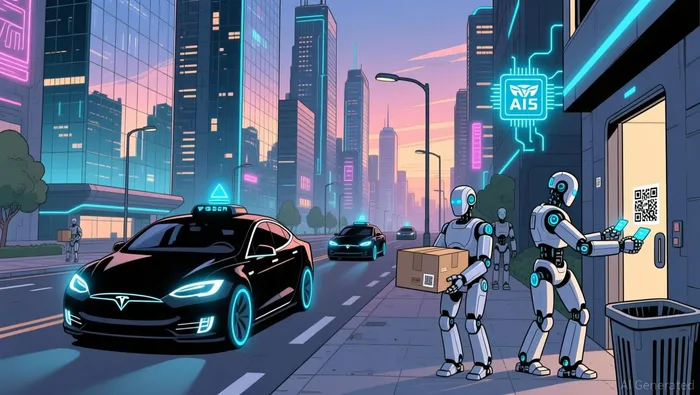
The Optimus robot, currently deployed in TeslaTSLA-- factories for logistics tasks, is slated for commercialization by late 2026 at a target price of $20,000–$25,000 per unit. Musk has even suggested that humanoid robots could constitute 80% of Tesla's total value in the long term according to analysis, a claim that reflects the company's audacious vision for automation-driven productivity. Meanwhile, Tesla's Full Self-Driving (FSD) software, already generating $326 million quarterly in revenue, is expected to scale further as adoption rates rise.
Financial Projections and Investor Confidence
Despite margin compression in its core automotive business, Tesla's valuation has soared to $1.6 trillion, driven by optimism around AI and robotics. This valuation is supported by forward-looking metrics: the company's Price-to-Earnings (P/E) ratio of 260x far exceeds the automotive industry average of 7–12x, reflecting investor bets on future software-driven revenue. Analysts like Dan Ives argue that 2026 could mark the start of a "$3 trillion AI chapter" for Tesla, contingent on successful Cybercab and Optimus deployments.
However, this optimism is not without risks. Production delays, regulatory hurdles for autonomous driving, and competition from Chinese robotics firms like Unitree and Fourier could undermine Tesla's ambitions. Additionally, the company's energy storage business, while undervalued, remains a wildcard in its 2026 valuation calculus according to analysis.
Competitive Moat and Strategic Advantages
Tesla's competitive edge in AI and robotics stems from its vertical integration and data advantage. The company's 10 million vehicles on the road serve as mobile data collection units, feeding real-time insights into neural networks and accelerating AI training. This data-driven approach, combined with custom AI chips and the Dojo supercomputer, positions Tesla to outpace rivals in autonomous driving and robotics development.
Moreover, Tesla's pivot to a "Robotaxi-as-a-Service" (RaaS) model is expected to shift its business from hardware-centric to high-margin software, a transition that could insulate it from traditional automotive margin pressures. The company's ability to leverage AI in sales strategies-such as personalized pricing and demand forecasting-further enhances its operational efficiency.
Risks and Realities
While the AI and robotics roadmap is compelling, execution risks remain. Tesla's history of overpromising timelines (e.g., delayed Model 2 production until H2 2026) raises concerns about meeting 2026 deployment targets. Regulatory scrutiny of autonomous driving and the high cost of precision components for Optimus also pose challenges. For Tesla to justify its premium valuation, it must demonstrate not only technological leadership but also scalable profitability in its new ventures.
Conclusion
Tesla's transition to an AI and robotics powerhouse is a high-stakes bet with the potential to redefine its valuation in a post-subsidy era. While the company's strategic repositioning has garnered investor confidence, the path to a $3 trillion valuation depends on overcoming production, regulatory, and competitive hurdles. For long-term investors, the key question is whether Tesla can transform its ambitious vision into a sustainable, high-margin business model-one that transcends the automotive industry and secures its place at the forefront of the AI-driven future.







Comentarios
Aún no hay comentarios