
Tesla's AI-Powered Rebrand: Is the $1.5 Trillion Valuation Justified in a Post-Subsidy Era?
Tesla's valuation has long been a subject of debate, but as the company navigates the post-subsidy era, its strategic pivot toward artificial intelligence (AI) and robotics has sparked renewed scrutiny. , the question remains: does this valuation align with Tesla's evolving business model and the risks it faces?
Post-Subsidy Delivery Challenges: A Temporary Setback
The expiration of the U.S. federal $7,500 EV tax credit in September 2025 triggered a "" of demand, leading to a sharp decline in Q4 2025 deliveries. in vehicle deliveries for the quarter, , . U.S. sales, in particular, , attributed to the tax credit cliff. New Street Research and UBS forecast Q4 deliveries , . While this represents a near-term headwind, the broader industry context-such as BYD's rise as the world's largest BEV manufacturer-highlights Tesla's shifting competitive landscape.
Strategic Pivot to AI and Robotics: A New Valuation Foundation 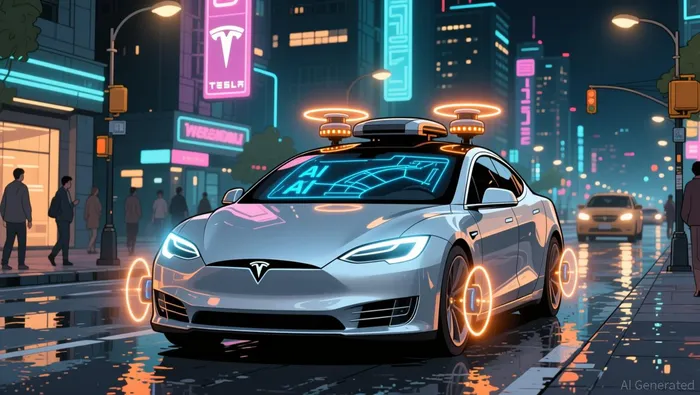
Investor sentiment has increasingly shifted from quarterly delivery metrics to Tesla's AI and robotics advancements. The company's , which boasts a six-fold improvement in autonomous driving performance, is now in unsupervised testing in Austin. robotaxi, slated for mass production in April 2026, represents a potential inflection point. If successful, Cybercab could transform Tesla into a high-margin software-defined platform, monetizing FSD licensing and autonomous ride-hailing services.
This pivot is reflected in Tesla's valuation metrics. in early December 2025, , a multiple more aligned with its AI ambitions than traditional automotive benchmarks. Analysts suggest that Tesla's long-term value is increasingly tied to its ability to monetize its AI stack, .
Sector Risks: Regulatory Hurdles and Competitive Pressures
However, the path to AI-driven growth is fraught with risks. remain a critical bottleneck, with European authorities like the Dutch RDW and U.S. NHTSA scrutinizing safety protocols. Additionally, BYD's dominance in the global BEV market, even as U.S. tariffs shield TeslaTSLA-- from direct price wars.
Internationally, Tesla's delivery growth outside the U.S. is uneven. While China and Europe are expected to see sequential improvements, year-on-year declines persist due to market saturation and aggressive local competition. Meanwhile, the broader EV sector faces margin compression from hybrid model proliferation and pricing pressures.
Valuation Alignment: A High-Wire Act
Tesla's $1.5 trillion valuation hinges on its ability to decouple from traditional automotive metrics and deliver on AI-driven revenue streams. The Cybercab's 2026 launch is pivotal, but delays or regulatory setbacks could trigger a valuation reset. Conversely, successful FSD adoption and robotaxi deployment could justify the premium multiple, particularly if Tesla captures a significant share of the autonomous mobility market.
Yet, the company's current financials remain exposed to near-term volatility. in deliveries highlight the fragility of its transition. While AI initiatives offer long-term upside, investors must weigh these against the risks of overvaluation in a sector marked by rapid technological and regulatory shifts.
Conclusion: A Calculated Bet
Tesla's rebrand as an AI and robotics leader is ambitious, but its valuation remains a double-edged sword. The $1.5 trillion market cap reflects high hopes for FSD and Cybercab, yet it also demands flawless execution. For investors, the key question is whether Tesla can navigate regulatory hurdles, maintain its technological edge, and scale its AI monetization strategies faster than competitors. In a post-subsidy era defined by uncertainty, the answer will determine whether this valuation is a visionary bet or a precarious gamble.







Comentarios
Aún no hay comentarios