
Why Tesla's Recent AI-Linked Selloff Is a Mispriced Opportunity
The recent 4.6% drop in Tesla's stock price has sparked a critical debate: Is this a warning sign for investors, or a golden opportunity to buy a transformative company at a discount? Let's break it down.
The Core Business: Strained but Resilient
Tesla's electric vehicle (EV) business is undeniably under pressure. For Q3 2025, the company delivered 462,890 vehicles-a 7.4% increase year-over-year-but net income plummeted 37% to $1.4 billion. This decline is tied to the expiry of EV tax credits and intensifying competition from cheaper rivals. Fourth-quarter deliveries are projected to fall below 448,000 units, with profits expected to shrink further.
Yet, Tesla's operational resilience remains a cornerstone of its value. The company's gross margin hit 18% in Q3 2025, the highest in over a year, and its cash reserves ($41.65 billion) provide a buffer against near-term volatility. While margins are contracting, Tesla's ability to innovate in cost-cutting and production efficiency-such as its "Standard" Model 3 and Y variants-suggests it can adapt to a maturing EV market according to analysts.
Valuation Metrics: A Tale of Two Narratives
 Here's where the story gets interesting. Tesla's valuation metrics scream speculative optimism. The stock trades at a P/E ratio of 195x expected earnings, a Price-to-Sales (P/S) ratio of 15.61x according to market analysis, and an EV/EBITDA ratio of 183.5x according to forecasts. These numbers are staggering when compared to traditional automakers but make sense when viewed through the lens of investor expectations for AI-driven growth.
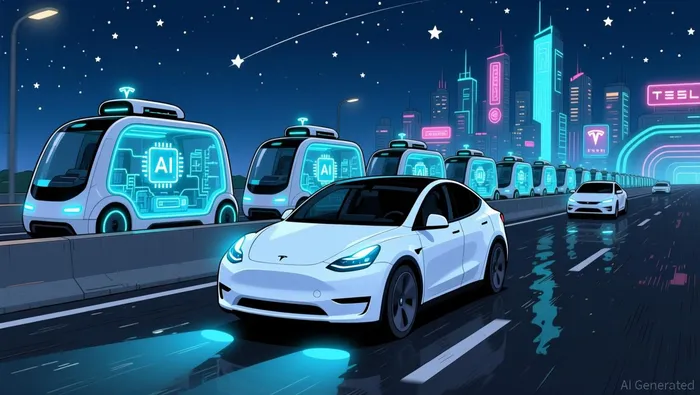
The disconnect between Tesla's current financials and its valuation isn't a flaw-it's a feature. Investors are pricing in a future where TeslaTSLA-- transitions from a hardware-centric automaker to a high-margin software and AI platform. The company's AI6 chip, for instance, could enable a 1:12 operator-to-robotaxi ratio by 2028, potentially generating $11.4 billion in annual profit from 100,000 robotaxis. This long-term narrative justifies a premium valuation, even if today's numbers look shaky.
The AI Hype: Risk or Reward?
The recent selloff was fueled by regulatory headwinds, including California's challenge to Tesla's use of terms like "Full Self-Driving Capability." While this adds near-term uncertainty, it also highlights the high stakes of Tesla's AI ambitions. The robotaxi demo in Austin, Texas-a major milestone-showed the company's technical prowess according to CNBC.
Critics argue that AI-driven revenue is years away, but history shows that disruptive tech often defies timelines. Consider Apple's transition from a niche computer maker to a mobile software giant: The market waited patiently for the payout. Tesla's AI roadmap, including its AI6 chip and robotaxi network, could follow a similar trajectory.
The Bottom Line: A Mispriced Opportunity
Tesla's stock is caught in a tug-of-war between its struggling core business and its moonshot AI vision. The recent selloff has priced in worst-case scenarios for the EV segment while underestimating the potential of AI to redefine the company's margins.
For investors with a multi-year horizon, this is a compelling inflection point. The core business, while challenged, remains a cash-flow generator. The AI narrative, though speculative, is backed by tangible progress and a valuation that assumes a 60% upside in 2026. The key is to balance skepticism about near-term risks with optimism about long-term transformation.
In the end, Tesla's story isn't just about cars-it's about reimagining mobility through AI. And in that arena, the company is still the 800-pound gorilla.





Comentarios
Aún no hay comentarios