
Tesla's AI-Driven Roadster and Its Implications for the EV and AI Markets
Production Delays and Investor Skepticism
The Roadster's timeline has been a source of frustration for years. Originally promised for 2020, the vehicle has faced multiple postponements, with Tesla CEO Elon Musk describing it as "fashionably late," per The New Wheel. High-profile cancellations by figures like OpenAI CEO Sam Altman and YouTuber Marques Brownlee (MKBHD) underscore the growing impatience among early reservation holders. Altman's public attempt to cancel his 2018 $50,000 deposit-only to face a contentious exchange with Musk over refund logistics-highlighted Tesla's struggles with customer service and transparency, according to an Economic Times article. Such incidents risk eroding trust, particularly as Tesla's 2025 earnings report explicitly states the Roadster remains in "design development," per a Yahoo Finance report.
Investor confidence is further strained by the broader pattern of overpromising. Tesla's history of delayed projects, from the Cybertruck to the Optimus robot, has led to skepticism about its ability to meet long-term commitments. A Bloomberg analysis notes that prolonged delays can disproportionately impact stock performance, as markets penalize companies for unmet expectations. For the Roadster, the stakes are high: its success could validate Tesla's vision for AI-powered mobility, but repeated failures risk alienating both consumers and shareholders.
AI Innovation: A Potential Offset for Delays
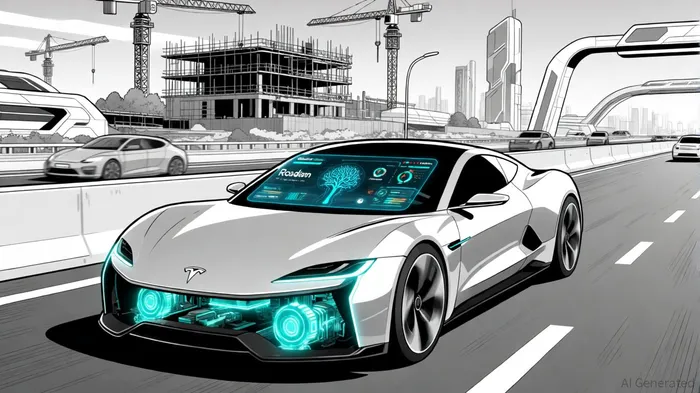
Despite the production setbacks, the Roadster's AI integration represents a significant leap forward. Musk has teased "crazy technology," including autonomous driving capabilities trained on over 10 billion miles of real-world data, according to a Blockchain News report. The vehicle is expected to leverage Tesla's Dojo supercomputer and custom D1 chips, which provide exascale computational power for training AI models. These systems could enable features like adaptive cruise control that anticipates traffic patterns and AI-optimized aerodynamics, enhancing both safety and efficiency.
The Roadster's AI advancements align with broader industry trends. According to McKinsey, AI could add up to $400 billion in value to the automotive sector by 2030 through improved efficiency and safety features. Tesla's focus on neural network-based systems for Full Self-Driving (FSD) positions the Roadster as a potential benchmark for AI-powered mobility. For instance, the vehicle's AI could reduce accident rates by up to 30%, leveraging machine learning to predict and avoid collisions. Such capabilities could justify premium pricing in the luxury EV segment, where AI-driven features are increasingly seen as differentiators.
Market Impact and Investment Potential
The Roadster's market impact hinges on its ability to bridge the gap between technological promise and tangible delivery. While delays have dampened short-term enthusiasm, the project's AI innovations could catalyze long-term growth. Statista projects the global electric sports car market to reach $50 billion by 2030, with AI enhancements driving 25% of that growth. Tesla, already a dominant player in the EV space, could leverage the Roadster to capture high-end consumers seeking cutting-edge AI experiences.
However, regulatory hurdles pose a challenge. The European Union's 2024 AI Act classifies high-risk AI systems in vehicles, requiring rigorous compliance testing. This could delay AI feature deployment and increase development costs. Additionally, ethical concerns around AI transparency and computational expenses must be addressed to ensure long-term viability.
For investors, the Roadster's potential lies in its dual role as a technological showcase and a revenue driver. Tesla's FSD subscription model, which generated $1 billion in 2023, suggests a monetization strategy rooted in continuous AI improvements. If the Roadster follows a similar model, it could create recurring revenue streams, offsetting production delays. Yet, the absence of a confirmed 2025 production timeline remains a wildcard.
Conclusion
Tesla's Roadster exemplifies the duality of innovation: it is both a symbol of the company's audacious vision and a cautionary tale of execution risks. While production delays have eroded trust and raised questions about Tesla's project management, the vehicle's AI advancements could redefine automotive standards and unlock new revenue streams. For investors, the key is to weigh these factors against broader market trends. If Tesla can deliver on its AI promises despite the setbacks, the Roadster may yet prove to be a cornerstone of its long-term growth strategy.





Comentarios
Aún no hay comentarios