
Tesla's AI and Autonomous Ecosystem as a $3 Trillion Opportunity
Tesla's transformation from an electric vehicle (EV) manufacturer to a vertically integrated AI and robotics platform is reshaping its valuation narrative. With Elon Musk's vision of a "sustainable abundance" ecosystem, the company's advancements in Full Self-Driving (FSD) technology, robotaxi ambitions, and humanoid robotics-coupled with regulatory tailwinds-position TeslaTSLA-- as a potential $3 trillion market capitalization player by 2026. This analysis examines how strategic investments in AI, regulatory progress, and revenue diversification are unlocking Tesla's valuation potential.
AI-Driven Innovation: The Foundation of Tesla's Ecosystem
Tesla's FSD v12 represents a quantum leap in autonomous driving capabilities. Built on a neural network architecture requiring 70,000 GPU hours of training, the system generates 1,000 predictions per timestep, enabling real-world adaptability. This AI stack, optimized for urban environments, is central to Tesla's robotaxi ambitions, including the Cybercab-a two-seat autonomous vehicle slated for 2026 production. The integration of xAI's Grok large language model further enhances Tesla's ecosystem, enabling context-aware in-car assistants and autonomous decision-making according to Musk's vision.
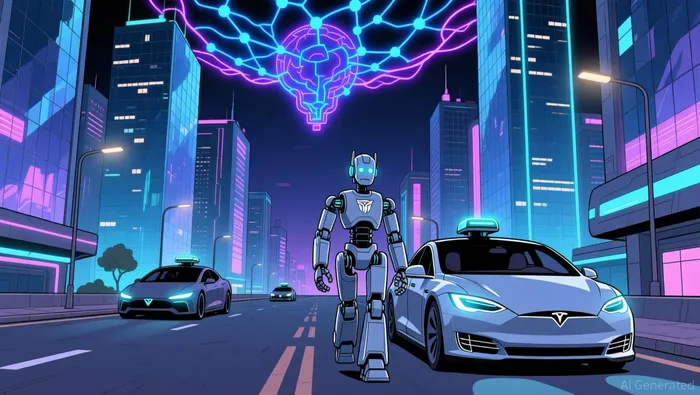
Parallel advancements in robotics, particularly the Optimus humanoid robot, underscore Tesla's cross-platform AI strategy. Designed to perform "boring, dangerous, or repetitive tasks," Optimus leverages the same computing stack as Tesla's vehicles, with Musk projecting annual production of 1 million units within five years. The development of custom AI chips (AI5 and AI6) reinforces this synergy, reducing dependency on third-party hardware and accelerating performance according to industry reports.
Regulatory Tailwinds: Navigating Global Expansion
Regulatory progress remains a critical catalyst for Tesla's AI and robotics initiatives. In the U.S., the National Highway Traffic Safety Administration (NHTSA) has emphasized updating AV frameworks to balance innovation and safety. While states like Florida and Kentucky have enacted laws permitting limited autonomous operations, California's stringent requirements-such as mandatory human safety drivers-remain a hurdle according to recent analysis.
In Europe, the September 2025 UNECE amendment enabling System-Initiated Maneuvers (SIM) marks a pivotal step for FSD adoption, allowing hands-off highway lane changes according to Tesla insiders. However, full urban autonomy remains pending, with the Dutch RDW evaluating national approval by February 2026-a potential domino effect for EU-wide deployment according to market forecasts.
China, Tesla's fastest-growing market, is expected to grant full FSD approval by early 2026, according to Musk. This would unlock advanced features tailored to local traffic conditions, addressing current limitations like gear-shifting and traffic sign recognition.
Valuation Catalysts: From EVs to AI-Driven Services
Tesla's valuation is increasingly decoupling from traditional automotive metrics. Analysts project that autonomous systems could account for 90% of Tesla's enterprise value by 2029, driven by recurring revenue from robotaxi networks and Optimus sales. Wedbush's Dan Ives highlights the robotaxi initiative as the "golden goose" for a $3 trillion valuation, with Cybercab production starting in 2026.
Financial models from Wedbush and Deepwater Asset Management suggest Tesla's AI and robotics initiatives could justify a $3 trillion market cap by 2026. This includes:
- Robotaxi Networks: Projected to generate $100 billion annually by 2030 through mobility-as-a-service subscriptions.
- Optimus Revenue: Long-term potential of $10 trillion in revenue, with production scaling from thousands to hundreds of thousands of units by 2030.
- AI Chip Sales: The AI5 and AI6 chips could create a standalone revenue stream, reducing reliance on third-party suppliers according to industry analysis.
Challenges and Skepticism
Despite these tailwinds, risks persist. Technical hurdles-such as Optimus's overheating and battery limitations-delay production timelines. Regulatory scrutiny, particularly in the U.S. and Europe, remains a wildcard, with investigations into FSD's safety performance underway. Additionally, geopolitical tensions, including potential U.S.-China trade restrictions, could disrupt supply chains.
Conclusion: A New Paradigm for Valuation
Tesla's AI and autonomous ecosystem represents a paradigm shift in valuation metrics. By 2026, the company's transition from one-time car sales to recurring AI-driven services-robotaxis, robotics, and energy storage-could justify a $3 trillion valuation. According to market analysts, regulatory progress in key markets, coupled with Musk's aggressive reinvestment in AI infrastructure ($80 billion between 2024–2030), underscores this potential. While execution risks remain, the alignment of technological innovation, regulatory momentum, and revenue diversification positions Tesla as a unique investment opportunity in the AI era.





Comentarios
Aún no hay comentarios