
Tesla's Accelerated Autonomous Driving Push: A Strategic Inflection Point for Robotaxi Scalability
The race to dominate the autonomous driving and robotaxi markets has entered a critical phase, with Tesla's recent advancements in Full Self-Driving (FSD) v12.5 and its ambitious robotaxi roadmap positioning the company at a potential inflection point. For investors, the question is whether Tesla's cost-based advantages and technological agility can overcome regulatory hurdles and safety skepticism to achieve scalable profitability.
Tesla's Technological and Cost Advantages
Tesla's FSD v12.5 represents a quantum leap in autonomous capabilities, with a threefold improvement in the number of miles driven between necessary human interventions compared to earlier versions. This progress is underpinned by Tesla's camera-only vision system, which leverages its fleet of over 5 million vehicles for continuous AI training. By avoiding costly LIDAR and radar hardware, TeslaTSLA-- has slashed the cost per robotaxi to an estimated $20,000–$25,000, a fraction of Waymo's $75,000 (for its newer Zeekr RT model) or the $150,000 of its earlier Jaguar I-PACE-based vehicles according to cost analysis.
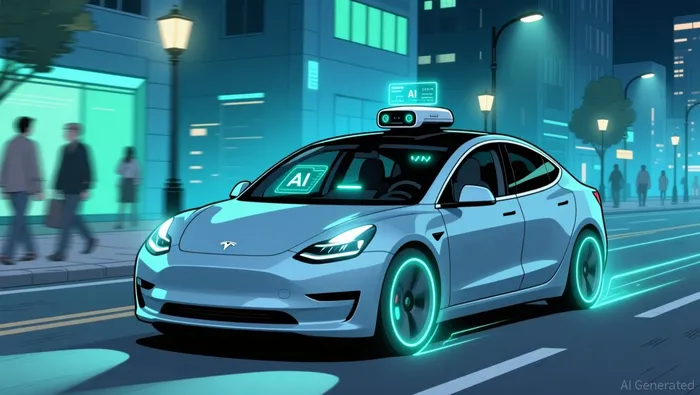 This cost efficiency extends to operational metrics. According to a report by Digital Habitats, Tesla's robotaxi could achieve a cost per mile of $0.81, outpacing Waymo's $1.15–$1.22 range as data shows. The disparity stems from Tesla's ability to scale its neural network using real-world data from its existing fleet, reducing reliance on expensive simulation environments. Furthermore, Tesla's Over-the-Air (OTA) updates enable rapid iteration, a capability lacking in competitors like Ford and GM, which rely on traditional dealership networks for software upgrades.
Regulatory Hurdles and Strategic Risks
Despite these advantages, Tesla faces significant regulatory headwinds. The National Highway Traffic Safety Administration (NHTSA) has launched multiple investigations into FSD-related incidents, including red-light violations and wrong-way driving according to recent reports. These probes highlight a broader issue: the U.S. lacks standardized safety frameworks for autonomous systems, creating ambiguity for both regulators and developers. In Europe, Tesla's FSD rollout has been delayed by demands for multi-sensor compliance, a stark contrast to its vision-based approach according to analysis.
Tesla's premature announcement of FSD approval in the Netherlands backfired, with regulators clarifying that additional safety conditions remain unmet as reported. Meanwhile, traditional automakers like GM and Ford, though slower in innovation, are leveraging partnerships (e.g., GM's Ultra Cruise with LIDAR) and regulatory familiarity to hedge against Tesla's disruption according to industry analysis.
Financial Viability and Market Projections
The financial case for Tesla's robotaxi hinges on its ability to achieve profitability at scale. Digital Habitats estimates that a 3:1 ratio of robotaxis to teleoperators could yield $150,000 in annual profits per vehicle, assuming Uber-like pricing models according to projections. By comparison, Waymo's more conservative rollout-focused on geofenced cities with pre-mapped infrastructure-prioritizes safety but delays economies of scale according to market analysis.
However, Tesla's margins are not without risks. While maintenance costs for its robotaxis are projected at $500–$1,000 annually according to estimates, Waymo's sensor-heavy systems may incur higher upkeep. Moreover, Morgan Stanley forecasts a dual oligopoly by 2032, with Tesla and Waymo capturing 70% of U.S. autonomous mileage, but this assumes Tesla can resolve its safety and regulatory challenges as market analysis indicates.
Conclusion: A High-Stakes Bet on Scalability
Tesla's robotaxi strategy is a high-velocity bet on cost efficiency and AI-driven scalability. Its camera-based system and fleet learning model offer a compelling value proposition, but the path to profitability is fraught with regulatory and safety hurdles. For investors, the key variables will be the pace of international regulatory approvals, the resolution of NHTSA investigations, and Tesla's ability to maintain its technological edge against rivals like Waymo. If Elon Musk's vision of hundreds of thousands of self-driving Teslas on U.S. roads by 2026 materializes, the rewards could be transformative. But until then, this remains a speculative play on a company navigating uncharted territory.







Comentarios
Aún no hay comentarios