
Tesla's $8 Billion Bet: How Strategic Capital Allocation Could Unlock a $1 Trillion Valuation
The electric vehicle revolution is only the beginning. Tesla's latest $8 billion U.S. investment—part of a $44 billion CapEx legacy since its founding—is not merely about building cars but about dominating the next trillion-dollar frontier: autonomous mobility. With its sights set on robotaxis, AI-driven manufacturing, and a vision to redefine transportation, Tesla's capital allocation strategy is a masterclass in long-term value creation. Let's dissect how this plays out.
Strategic Capital Allocation: Manufacturing Muscle Meets Autonomous Ambition
Tesla's $8 billion U.S. investment for 2025 is bifurcated but synergistic:
- Manufacturing Scale: Expanding Gigafactories to support Model Y production and new models.
- Autonomous Tech: Accelerating R&D for Full Self-Driving (FSD) software and the Cybercab, its dedicated robotaxi.
This dual focus reflects a deliberate strategy to capitalize on two growth vectors: hardware dominance in EVs and software supremacy in autonomous systems. Analysts at Wedbush estimate autonomous initiatives alone could add $1 trillion to Tesla's valuation, while Cathie Wood's Ark Invest envisions a $10 trillion global robotaxi market by 2035—positioning TeslaTSLA-- to capture a lion's share.
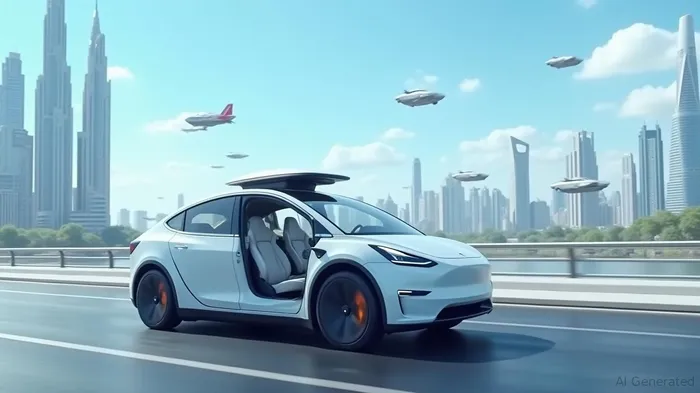
The Robotaxi Opportunity: From Pilot to Profit Machine
The Cybercab, set for production by 2026, is Tesla's flagship in this new frontier. Key milestones include:
- 2025 Pilot Launch: Starting in Austin, Texas, with a fleet of Model Y vehicles operating in a “geo-fenced” area.
- 2026 Full Deployment: A fully autonomous Cybercab (no steering wheel or pedals) aims to scale to 25 U.S. cities within a year.
The vision is clear: Tesla owners can rent out their vehicles via a ridesharing platform, turning idle cars into revenue-generating robots. Musk claims Tesla's AI-driven FSD—now leveraging neural networks and 1.3 billion miles of real-world data—gives it a 99% market share advantage over rivals like Waymo.
Note: A chart showing Tesla's stock price rising from $150 in 2022 to $350 in early 2025, with dips reflecting regulatory concerns but overall upward momentum.
Risks vs. Rewards: Near-Term Hurdles, Long-Term Gold
Near-Term Risks:
1. Execution: Past FSD delays have dented credibility. The Austin pilot's success—especially in navigating regulatory approval—is critical.
2. Competition: Waymo and GM's Cruise are already testing robotaxis. Tesla's late entry requires flawless execution.
3. Regulatory Friction: U.S. and global policymakers remain cautious. Musk's political entanglements (e.g., with Trump) could complicate approvals.
Long-Term Rewards:
1. Scalability: A global fleet of Tesla vehicles (over 3 million on the road) can generate data to refine FSD, creating a moat.
2. Margin Expansion: Robotaxi services offer high margins, unlike hardware sales. Ark Invest projects autonomous revenue could hit $951 billion by 2029.
3. Network Effects: The more vehicles in the fleet, the better FSD becomes—a virtuous cycle.
Valuation: $1 Trillion Is the Floor, Not the Ceiling
Wedbush's $2 trillion target by 2026 hinges on Tesla's ability to monetize its software. Cathie Wood's $2,600/share price target by 2029 assumes the robotaxi becomes Tesla's core business. Even skeptics acknowledge the company's $1 trillion+ valuation is already baked in, with autonomous tech accounting for 90% of its enterprise value by 2029 (Ark's model).
Investment Thesis: Patience Pays—But Watch for Catalysts
Hold for the Long Run:
- Tesla's CapEx is a bet on future cash flows, not immediate profits. Investors must prioritize time horizon over quarterly results.
- The Austin pilot (June 2025) and Cybercab launch (2026) are binary events—success here could trigger a valuation explosion.
Sell Signals:
- Regulatory bans on autonomous vehicles.
- FSD delays beyond 2026 or loss of data advantage.
Current Positioning:
At $350/share (as of June 2025), Tesla trades at ~18x Ark's 2029 EBITDA estimates. This is fairly priced, but upside accelerates if robotaxi adoption outpaces expectations.
Final Take: Tesla's Autonomous Play Is a Moonshot Worth Backing
Tesla isn't just an automaker—it's a technology company in a car's body. Its $8 billion U.S. investment is fueling a transition to a software-driven future, where robotaxis could eclipse EV sales in profitability. While risks are real, the upside—a $1 trillion valuation today, $2 trillion by 2026—is too compelling to ignore. For investors with a 5+ year horizon, this is a generational opportunity.
Stay tuned for the Austin pilot results—this could be the moment Tesla's vision goes from science fiction to Wall Street reality.





Comentarios
Aún no hay comentarios