
Tesla's 2026 EV Sales Rebound: Strategic Shifts and Market Dynamics Driving a New Era
As 2026 unfolds, TeslaTSLA-- stands at a pivotal crossroads, poised to redefine its dominance in the electric vehicle (EV) market through strategic product transitions and groundbreaking advancements in autonomous technology. The company's ability to navigate a recalibrating EV landscape-marked by shifting consumer preferences, competitive pressures, and evolving financial dynamics-will determine whether it can reclaim its position as the industry's uncontested leader. This analysis examines how Tesla's 2026 Model Y refresh, Full Self-Driving (FSD) adoption, and robotaxi commercialization will catalyze a sales rebound, while also exploring broader investment implications in a low-interest-rate environment.
The Model Y 2026 Refresh: A Catalyst for Sales Recovery
Tesla's Model Y has long been its best-selling vehicle, accounting for a significant portion of its global EV market share. The 2026 redesign introduces a "Standard" trim priced at $39,990, a $5,000 reduction from the Premium RWD variant, making it more accessible to price-sensitive buyers according to Car and Driver. This lower entry point, combined with a 321-mile driving range on 18-inch wheels and design upgrades such as full-width light bars and enhanced cabin insulation, positions the Model Y to regain lost momentum. Analysts project that these changes will help Tesla offset the decline in 2025 deliveries, which fell to 1.64 million units, and drive a modest recovery to 1.75 million in 2026.
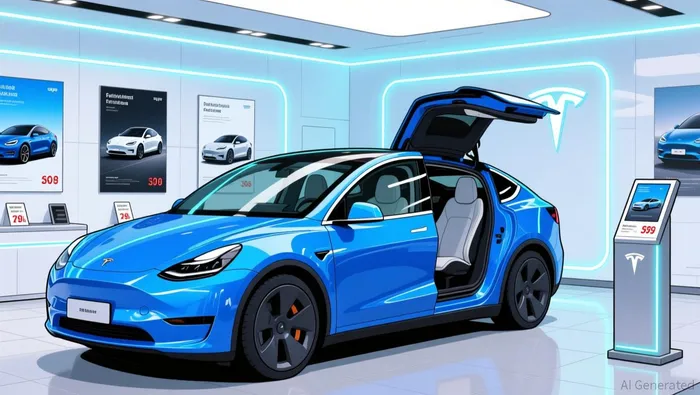
The Model Y's role is further amplified by its competitive positioning. While rivals like BYD and Xiaomi are gaining traction in specific markets, Tesla's vertically integrated software and hardware ecosystem- enabling rapid over-the-air updates-provides a unique edge. Additionally, the vehicle's affordability aligns with industry trends toward lower-cost EVs, a shift underscored by Ford's pivot to hybrids and extended-range electric vehicles (EREVs). By maintaining its grip on the Model Y's market share, Tesla can stabilize its core revenue stream while preparing for the broader AI and robotics transition.
FSD Adoption and Robotaxi: The Software-Driven Revenue Revolution
Tesla's Full Self-Driving (FSD) technology is no longer a speculative feature but a cornerstone of its business strategy. By 2026, FSD v13 has achieved 99.95% reliability, logging over 2 billion autonomous miles-a testament to its maturity and safety. Analysts project that FSD subscriptions alone will generate $12 billion in 2026, contributing to a broader software and services revenue stream that could rival automotive sales. This shift is critical for Tesla's long-term profitability, as software margins far exceed those of hardware.
The commercialization of Tesla's robotaxi service, set to launch in April 2026 with the Cybercab, represents an even more transformative opportunity. With an estimated operating cost of $0.25 per mile-far below traditional ride-hailing services- Cybercabs could disrupt urban mobility and create a recurring revenue model. Analyst Peter Vogel of New Street Research estimates that robotaxi services could generate $40 billion in revenue and $15 billion in EBIT by 2030, with Tesla capturing roughly 50% of the market. This transition from a hardware-centric to a service-based model not only diversifies Tesla's income but also aligns with broader industry trends toward AI-driven autonomy.
Market Dynamics and Investment Implications
The EV market in 2026 is characterized by a recalibration of strategies, driven by profitability concerns and evolving consumer behavior. While low interest rates theoretically support EV adoption by reducing borrowing costs, automakers are increasingly prioritizing economic feasibility over aggressive electrification targets. Ford's shift to a 50% electrified portfolio by 2030-focusing on hybrids and EREVs-reflects this pragmatic approach. Tesla, however, is uniquely positioned to capitalize on these dynamics. Its FSD and robotaxi initiatives offer high-margin solutions to range anxiety and cost barriers, two persistent challenges for EV adoption.
For investors, Tesla's strategic pivot to AI and robotics introduces new layers of complexity and opportunity. The company's ability to monetize autonomy-through FSD subscriptions and robotaxi networks-could redefine its valuation metrics, moving beyond traditional automotive benchmarks. In a low-rate environment, where capital is cheaper and risk premiums are lower, Tesla's software-driven revenue streams may attract disproportionate investor enthusiasm. However, risks remain, including high capital expenditures for robotaxi infrastructure and potential commoditization of autonomous services.
Conclusion: A Defining Year for Tesla's Future
Tesla's 2026 sales rebound hinges on its ability to execute two parallel transitions: a product-focused recovery led by the Model Y and a strategic pivot toward AI and robotics. The Model Y's affordability and design upgrades will stabilize near-term sales, while FSD and robotaxi will unlock long-term value through software and services. These moves are not just about maintaining market share-they are about redefining the company's identity in an era where EVs are no longer the sole frontier of innovation.
For investors, the key takeaway is clear: Tesla's success in 2026 will depend on its capacity to balance hardware innovation with software monetization. In a market where low interest rates and competitive pressures are reshaping the landscape, Tesla's dual focus on product affordability and AI-driven services positions it as a compelling, albeit complex, investment opportunity.







Comentarios
Aún no hay comentarios