
Tesla's 2026 Catalysts: Robotaxi, Optimus, and the SpaceX Effect
Tesla's strategic repositioning in 2026 hinges on three transformative catalysts: the maturation of its Robotaxi service, the scaling of the Optimus humanoid robot, and the cascading financial and technological synergies from SpaceX's anticipated $1.5 trillion IPO. These elements collectively position the company to transcend its identity as an automotive manufacturer and emerge as a cornerstone of a broader AI-driven, multi-planetary infrastructure ecosystem.
Robotaxi: Navigating Hurdles to Autonomous Dominance
Tesla's Robotaxi program has made incremental progress in 2025, securing regulatory approvals in Arizona and Nevada and introducing features like dynamic pricing and a two-tier cleaning fee system to enhance user experience. However, operational challenges persist. As of late December 2025, only 34 Model Y vehicles were operational in Austin, Texas-a stark contrast to Elon Musk's projection of 500 units by year-end. This discrepancy underscores the complexities of scaling autonomous fleets, compounded by safety concerns. The National Highway Traffic Safety Administration is investigating three robotaxi crashes in September 2025, raising questions about regulatory scrutiny and public trust.
Despite these hurdles, TeslaTSLA-- remains committed to its driverless vision. The company aims to remove safety monitors from its robotaxis by year-end 2025, a critical step toward fully autonomous operations. Success here could redefine urban mobility and generate recurring revenue streams, but failure risks reputational damage and delayed timelines. Investors must weigh Tesla's technical prowess against its track record of overpromising, particularly as competitors like Waymo and Cruise accelerate their own AV deployments.
Optimus: The $10 Trillion Bet on Humanoid Robotics
The Optimus humanoid robot represents Tesla's boldest leap into the future. During the Q4 2024 earnings call, Musk outlined a roadmap projecting Optimus to generate up to $10 trillion in long-term revenue, potentially becoming the "overwhelming majority" of Tesla's value in coming decades. This audacious claim is grounded in Tesla's vertical integration strategy: the company has developed all components in-house, including advanced dexterous hands capable of delicate tasks.
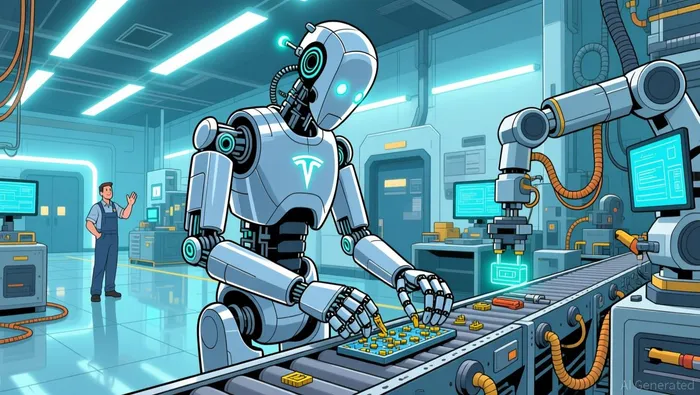 Production scaling is central to this vision. Tesla plans to produce several thousand Optimus units in 2024, with Version 2 (V2) launching mid-2025 and a third production line by 2026. If executed, this trajectory could revolutionize manufacturing, logistics, and service industries by automating repetitive tasks. For example, Optimus could streamline Tesla's own factory operations while expanding into healthcare, construction, and elder care. However, the robot's commercial viability depends on cost reductions and software refinements-areas where Tesla's automotive expertise may provide a unique advantage.
The SpaceX Effect: Capital, Connectivity, and Cross-Pollination
SpaceX's anticipated $1.5 trillion IPO in mid-to-late 2026 could serve as a financial lifeline for Tesla's AI ambitions. Analysts suggest that the IPO's liquidity could accelerate development of full self-driving capabilities, Optimus, and AI-powered infrastructure. This cross-pollination is already evident: Starlink's satellite internet service is enhancing Tesla's autonomous systems by overcoming ground-based connectivity limitations and enabling real-time data processing.
Moreover, a pre-IPO stake in SpaceX is being considered to align governance structures and streamline resource allocation for large-scale projects. This strategic alignment could create a feedback loop where advancements in space-based AI data centers (via SpaceX) fuel progress in terrestrial robotics (via Tesla). For instance, Starship's 2026 satellite deployments may expand Starlink's capacity, indirectly supporting Tesla's AI training compute needs. Such synergies position Tesla as an "Interstellar Infrastructure Supplier," a term that encapsulates its role in Musk's multi-planetary vision.
Strategic Repositioning and Long-Term Value Creation
The convergence of these catalysts signals Tesla's repositioning from a carmaker to a diversified tech empire. Robotaxi's potential to disrupt transportation, Optimus's capacity to automate labor, and SpaceX's capital and infrastructure support collectively create a flywheel effect. If successful, these initiatives could unlock value across multiple sectors, from AI-driven services to interplanetary logistics.
However, risks remain. Regulatory delays, technical bottlenecks, and market skepticism could derail timelines. For example, the NHTSA's investigations into robotaxi safety highlight the fragility of public trust in autonomous systems. Similarly, Optimus's commercial adoption hinges on solving the "last mile" problem of human-robot interaction.
Conclusion
Tesla's 2026 catalysts-Robotaxi, Optimus, and the SpaceX effect-represent a high-stakes bet on the future of AI and automation. While challenges abound, the company's vertical integration, software expertise, and Musk's visionary leadership provide a unique edge. For investors, the key question is whether Tesla can translate these ambitious plans into scalable, profitable realities. If it succeeds, the rewards could be transformative; if it falters, the consequences could be equally profound.







Comentarios
Aún no hay comentarios