
Why Tesla's 2025 Disappointment Signals A Strategic Reassessment For Investors
The electric vehicle (EV) revolution has long been synonymous with TeslaTSLA--, Inc. (TSLA). Yet, as 2025 unfolds, the company's stock performance and valuation metrics reveal a growing disconnect between its current financial reality and its aspirational AI-driven future. For investors, this divergence demands a strategic reassessment: Is Tesla's overvaluation a warning sign, or a mispricing of its long-term potential in robotics and autonomous driving?
Valuation Realism: A Market Out of Sync with Fundamentals
Tesla's 2025 financial performance underscores a stark valuation gap. Traditional metrics like the DCF model estimate its fair value between $69 and $138 per share, while its current market price far exceeds these benchmarks. By September 2025, Tesla's P/E ratio had surged to 293.83, and its P/S ratio reached 15.61, both multiples significantly higher than industry averages. Morningstar's fair value estimate of $300 per share further highlights the disconnect, as the stock trades at a premium to intrinsic value.
This overvaluation is compounded by operational headwinds. Third-quarter 2025 earnings revealed a 9% year-over-year revenue growth but a sharp decline in operating margins below 5% due to aggressive price cuts and rising costs. Analysts at Morgan Stanley have downgraded Tesla to "Equal Weight," citing valuation concerns and a $425 price target, while others, like Wedbush, remain cautiously optimistic, projecting a $600 target price based on AI advancements. The mixed signals reflect a market grappling with Tesla's ability to sustain profitability amid slowing global EV demand and intensifying competition from Chinese automakers.
AI/Robotics Catalysts: The Road to a $10 Trillion Vision
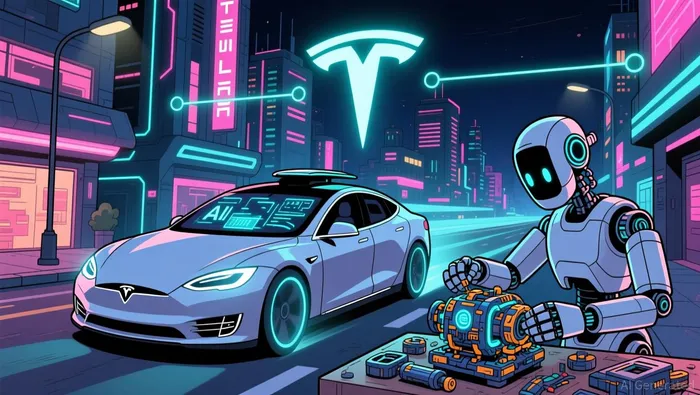 The company's Full Self-Driving (FSD) system has achieveda 20x improvement in "miles to critical disengagement" with v14.1.x, and regulatory approvals in the U.S. are accelerating, with over-the-air updates enabling incremental improvements. However, European and Chinese regulators remain cautious, with approvals expected as late as February 2026.
The Optimus humanoid robot, or Tesla Bot, represents an even greater leap. With a target production of 5,000 units in 2025 and 50,000–100,000 units in 2026, Tesla aims to scale to 500,000–1 million units annually. Analysts estimate the humanoid robot market could reach $5–7 trillion by 2050, and Tesla's pricing strategy ($20,000–$30,000 per unit) positions it to capture a significant share. While current prototypes face technical hurdles-such as overheating and limited dexterity-Gen-3 improvements are underway.
Strategic Reassessment: Balancing Risks and Rewards
For investors, the key lies in reconciling Tesla's current overvaluation with its long-term AI/robotics potential. The company's R&D investments, which reached $1.63 billion in Q3 2025, signal a commitment to innovation, but execution risks remain. Regulatory delays, technical bottlenecks, and competition from Chinese robotics firms like Unitree could slow progress. Conversely, breakthroughs in FSD and Optimus could unlock unprecedented value, as Musk's vision of a $10 trillion revenue stream from robotics suggests.
The strategic reassessment hinges on two factors: time horizon and risk tolerance. Short-term investors may find the current valuation unappealing, given the P/E of 205x and margin pressures. However, long-term investors who believe in Tesla's AI roadmap-particularly its potential to dominate autonomous driving and industrial automation-might view the stock as a speculative bet on a transformative future.
Conclusion: A Tipping Point for Tesla's Value Proposition
Tesla's 2025 performance has exposed the fragility of its valuation, but it has also illuminated a path forward. The company's pivot to AI and robotics is no longer a distant aspiration; it is a tangible, capital-intensive endeavor with the potential to redefine its value proposition. For investors, the challenge is to weigh the present-day risks of overvaluation against the future rewards of a $10 trillion robotics market. In this high-stakes environment, strategic reassessment is not just prudent-it is imperative.





Comentarios
Aún no hay comentarios