
Tesco's Strategic Position in the UK Retail Sector Amid Holiday Sales Surge and Competitive Pricing Dynamics
The UK retail sector has long been a battleground for market dominance, with grocery giants like Tesco navigating a landscape defined by razor-thin margins, shifting consumer preferences, and relentless competition. As the 2023–2025 holiday seasons unfolded, Tesco's performance. This analysis evaluates Tesco's strategic positioning, focusing on its pricing dynamics, sustainability initiatives, and competitive resilience, while assessing the long-term viability of its profit trajectory.
Financial Performance and Strategic Leverage
Tesco's recent financial results underscore its adaptability. For the 2023 holiday season, the company reported , . This momentum carried into 2025, where the retailer maintained its full-year profit guidance, projecting adjusted operating profits . Notably, Tesco's strategic emphasis on value-such as matching Aldi's prices on 600+ lines and offering 9,000 weekly Clubcard Prices deals- .
These gains are not merely short-term. Tesco's focus on fresh food , respectively) reflects a diversified approach to mitigating sector-specific risks. Meanwhile, its Central European operations, despite regulatory headwinds in Hungary, have shown resilience, . Such regional diversification, coupled with cost management, has enabled Tesco to exceed its 2025 emissions reduction targets , a move that aligns with growing consumer demand for sustainability and operational efficiency.
Competitive Dynamics and Pricing Strategies
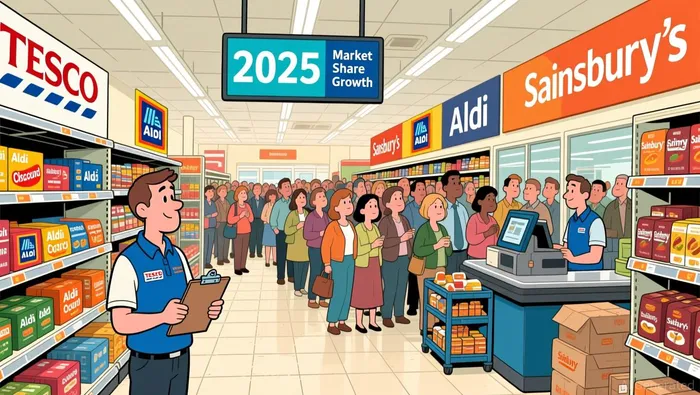
The UK grocery sector remains fiercely contested, with discounters like Aldi and Lidl eroding traditional retailers' market share. Sainsbury's, for instance, , . Aldi's highlights its appeal to price-sensitive consumers. Yet, Tesco's aggressive pricing strategies-such as its Aldi Price Match initiative- have allowed it to retain , its strongest in nine years.
However, sustainability of these gains hinges on Tesco's ability to balance affordability with profitability. While private label sales now account , offering cost-effective alternatives to national brands, the retailer must avoid a race to the bottom. demonstrate a nuanced approach: leveraging volume growth to offset margin pressures. This strategy appears to resonate, as UK grocery inflation has slowed , easing some consumer cost burdens.
Sustainability as a Strategic Pillar
Beyond pricing, Tesco's sustainability initiatives are increasingly integral to its competitive edge. By partnering with and to repurpose surplus food, the company has not only reduced waste but also enhanced brand perception, . Its decarbonization efforts- exceeding 2025 emissions targets-align with broader industry trends, . Such initiatives are not merely ethical; they reinforce operational efficiency, a critical factor in maintaining profit margins amid rising supply chain costs.
Assessing Profit Sustainability
The question remains: Can Tesco sustain these gains in a sector where profit margins are notoriously fragile? The answer lies in its ability to innovate while managing external pressures. For instance, , the rise of convenience-focused formats-such as Dunelm's smaller stores and Ocado's delivery capabilities- poses new challenges. Additionally, regulatory shifts in Central Europe could impact packaged goods sales, as seen in Hungary.
Yet, Tesco's strategic agility offers optimism. Its revised profit outlook. This optimism is bolstered by its omnichannel approach, which integrates digital and physical experiences, and its focus on Gen Z consumers, who prioritize health and sustainability.
Conclusion
Tesco's strategic position in the UK retail sector is underpinned by a blend of pricing innovation, sustainability leadership, and operational resilience. While competitive pressures and macroeconomic headwinds persist, the company's ability to adapt-whether through dynamic pricing, supply chain optimization, or eco-conscious branding-positions it to sustain profit gains. For investors, the key takeaway is clear: Tesco's long-term success will depend not on short-term cost-cutting but on its capacity to align value, quality, and sustainability in an increasingly fragmented market.







Comentarios
Aún no hay comentarios