
Terreno Realty's Strategic Expansion in Industrial Real Estate: A High-Yield Opportunity in Coastal U.S. Markets?
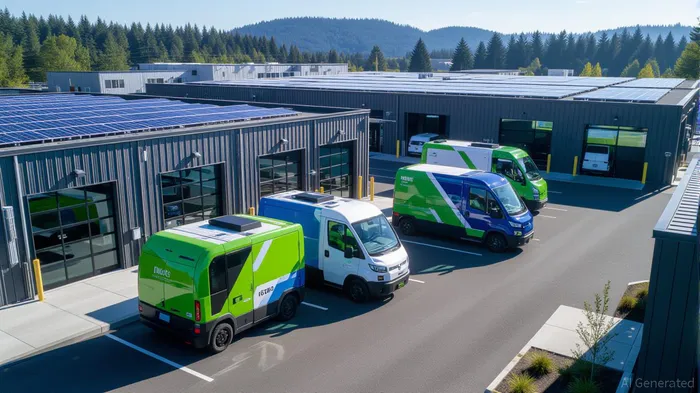
In the ever-shifting landscape of industrial real estate, Terreno Realty CorporationTRNO-- has made a bold move with its recent $426.9 million acquisition of a multi-market portfolio spanning Seattle, Miami, and Northern New Jersey. The deal, structured around a 5.0% stabilized cap rate, raises a critical question: Is this a shrewd bet on long-term value creation in a sector poised for renewed growth, or a precarious gamble in a market facing normalization pressures?
The 5.0% Cap Rate: A Competitive Edge or a Misstep?
Stabilized cap rates—calculated as net operating income divided by acquisition cost—serve as a barometer for real estate value. Terreno's 5.0% figure, while modest, aligns with broader industry trends. In Northern New Jersey, where industrial rents have surged 8.3% year-over-year to $11.86 per square foot, cap rates have stabilized near 4.5–5.0% due to low vacancy rates (4.9%) and robust transaction volumes. Similarly, Miami's industrial market, despite a 11.8% vacancy rate, commands high rents ($12.86 per square foot) and a $3.33 per square foot lease spread, suggesting pricing power that could support cap rates in the 4.8–5.2% range. Seattle, meanwhile, balances strong demand (a $2.67 per square foot lease spread) with rising vacancies, but its strategic logistics infrastructure and e-commerce tailwinds keep cap rates competitive.
Terreno's 5.0% acquisition cap rate thus appears well-positioned. It reflects a disciplined approach to value-add opportunities, particularly in markets where supply constraints and demand for modern logistics facilities are tightening. The company's focus on coastal U.S. markets—gateways to international trade and e-commerce hubs—further insulates it from the oversupply risks plaguing secondary inland markets.
Coastal Markets: The New Frontier of Industrial Demand
The acquisition portfolio underscores Terreno's bet on coastal markets, which are increasingly central to the U.S. economy. Northern New Jersey's proximity to New York City and the Port of New York-Norfolk ensures its relevance in a post-pandemic supply chain. Miami's role as a Latin American trade hub and its exposure to e-commerce growth (despite vacancy challenges) position it for long-term resilience. Seattle, with its tech-driven logistics demand and access to Pacific trade routes, remains a linchpin for global supply chains.
These markets are also benefiting from policy tailwinds. The recently enacted Big Beautiful Bill, which allows 100% tax expensing for industrial assets, is expected to catalyze $2.7 trillion in manufacturing commitments by 2025. This legislative shift not only boosts demand for industrial space but also enhances the cash flow potential of properties like those acquired by TerrenoTRNO--.
Risks and Rewards in a Rising-Cycle Environment
While the 5.0% cap rate is attractive, it is not without risks. Miami's high vacancy rate and speculative construction pipeline could pressure cap rates if absorption slows. Seattle's rising vacancies, though still below the national average, hint at a potential softening in demand. However, these risks are mitigated by Terreno's strategy: acquiring properties at a discount to replacement cost and leveraging its operational expertise to enhance cash flow.
The broader industrial sector is also navigating a transition. After years of post-pandemic construction booms, the U.S. industrial vacancy rate hit 9.3% in Q2 2025, the highest in over a decade. Yet, with new construction pipelines shrinking to 2015 levels, supply constraints are emerging. This dynamic favors landlords with high-quality assets in prime locations—a category where Terreno's portfolio excels.
Investment Implications
For investors, Terreno's acquisition represents a calculated play on industrial real estate's long-term fundamentals. The 5.0% cap rate, while not eye-popping, is competitive in a sector where cap rate compression is expected to accelerate in 2026. The company's focus on coastal markets—where demand is driven by e-commerce, manufacturing, and logistics—positions it to outperform in a rising-cycle environment.
However, caution is warranted. The industrial sector's normalization is not uniform. While Northern New Jersey and Seattle offer strong tailwinds, Miami's oversupply risks could dampen returns. Investors should monitor key metrics: lease spreads, vacancy trends, and construction pipelines in these markets. A narrowing lease spread or a spike in vacancies could signal overvaluation.
Conclusion
Terreno Realty's 5.0% stabilized cap rate acquisition is a testament to its strategic acumen in a complex market. By targeting high-demand coastal corridors and leveraging policy-driven demand, the company is positioning itself to capitalize on industrial real estate's enduring appeal. For investors seeking a balance of yield and growth, this move—while not without risks—offers a compelling case for long-term value creation.





Comentarios
Aún no hay comentarios