
Terra Luna Classic's Volatility and Its Implications for Cryptocurrency Portfolio Strategy
In the ever-shifting landscape of cryptocurrency, TerraLUNA-- Luna Classic (LUNC) has emerged as a case study in hyper-volatility and speculative risk. As of October 2025, LUNCLUNC-- trades at $0.00005565, with a market capitalization of $306 million, yet its trajectory remains defined by sharp swings and cautious optimism, according to Gate's LUNC outlook. For investors navigating the complexities of crypto portfolio strategy, understanding LUNC's volatility-and how to manage it-is critical.
Volatility Metrics and Market Dynamics
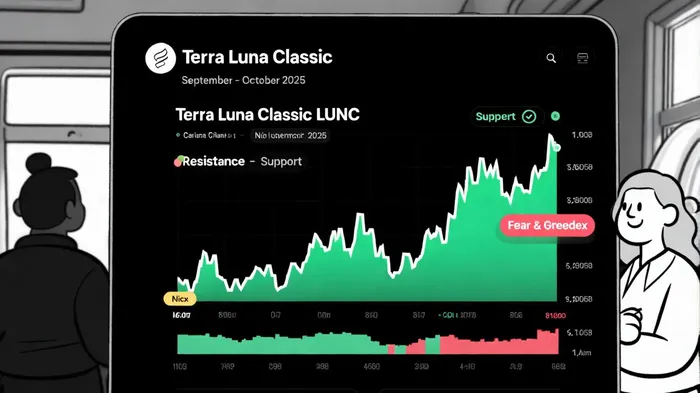
LUNC's 30-day historical volatility stands at 5.72%, a figure that, while moderate by crypto standards, underscores its susceptibility to rapid price shifts, per the CoinMarketCap analysis. Over the past week, the token has declined 6.25%, and its year-over-year drop of 33.78% reflects persistent uncertainty, as noted in the Gate outlook. Technical analysis reveals a consolidation phase, with resistance at $0.000061 and support at $0.000055, suggesting limited directional momentum, according to a Cryptopolitan forecast. Meanwhile, the Fear & Greed Index, a barometer of investor psychology, hovers at 43, signaling a "Fear" atmosphere-a point highlighted in the Gate outlook. This duality-between technical stagnation and psychological caution-creates a fertile ground for both risk and opportunity.
Drivers of Volatility: Legal, Technical, and Structural Factors
LUNC's volatility is not random. Key catalysts include legal developments, such as the guilty plea of Terraform Labs co-founder Do Kwon in August 2025 for wire fraud related to the 2022 collapse; that event intensified selling pressure, compounding existing market jitters (as reported by CoinMarketCap). Conversely, the v3.5.0 network upgrade in August 2025, aimed at reactivating the Market Module to boost liquidity, introduced speculative optimism-another point noted in the CoinMarketCap analysis.
Structurally, LUNC's deflationary mechanisms-such as token burns-have reduced its circulating supply. In October 2025 alone, Binance burned 356.5 million LUNC tokens, temporarily pushing the price up 8%, according to a Coinreporter report. However, with a circulating supply of 5.5 trillion tokens, these burns have limited long-term impact. The token's decentralized ownership structure, with no single entity controlling a significant share, is a positive for stability, the Gate outlook adds, yet its massive supply remains a barrier to meaningful price appreciation.
Strategic Implications for Portfolio Management
For investors, LUNC's volatility demands a nuanced approach. Risk management must be the cornerstone of any strategy. Given its high beta and low liquidity, LUNC should be allocated as a satellite asset rather than a core holding. Position sizing should reflect its speculative nature, with stop-loss orders placed near key support levels (e.g., $0.000055) to mitigate downside risk, as the Cryptopolitan forecast recommends.
Historical backtests from 2022 to 2025 reveal that breakouts above resistance levels have historically yielded an average return of 12% over five trading days, while breakdowns below support have led to an average drawdown of 18% within the same period. However, the hit rate for these signals was only 58%, underscoring the need for disciplined risk management.
Diversification is equally critical. LUNC's performance is decoupled from broader crypto indices, making it a potential hedge against correlated assets. However, its sensitivity to regulatory shifts-such as potential U.S. enforcement actions against Terra's ecosystem-means it should be paired with more stable assets like BitcoinBTC-- or EthereumETH--, according to a Binance post.
For speculative positioning, LUNC offers asymmetric potential. Conservative price forecasts suggest a 2025 range of $0.00004–$0.00005, while optimistic scenarios project $0.00006–$0.00007, per the Gate outlook. Long-term projections, including a potential $0.00015 by 2030, hinge on ecosystem adoption and utility-driven demand, the Gate outlook also observes. Traders might consider short-term options strategies (e.g., straddles) around key events like the v3.5.0 upgrade, while long-term investors could explore dollar-cost averaging to smooth volatility.
Conclusion: Balancing Risk and Reward
Terra Luna Classic embodies the paradox of crypto investing: a token with deflationary mechanics and ecosystem potential, yet plagued by regulatory uncertainty and structural challenges. For risk-tolerant investors, it offers a speculative avenue to capitalize on volatility, provided it is managed with discipline. For others, it serves as a cautionary tale of the perils of hyper-volatile assets. In either case, LUNC's inclusion in a portfolio must be deliberate, informed by rigorous analysis, and aligned with a broader strategy that prioritizes resilience over recklessness.






Comentarios
Aún no hay comentarios