
Terminal Finance and the Rise of Yield-Bearing Stablecoins as a Liquidity Catalyst in DeFi
The Terminal Thesis: Yield-Bearing Stablecoins as a Flywheel
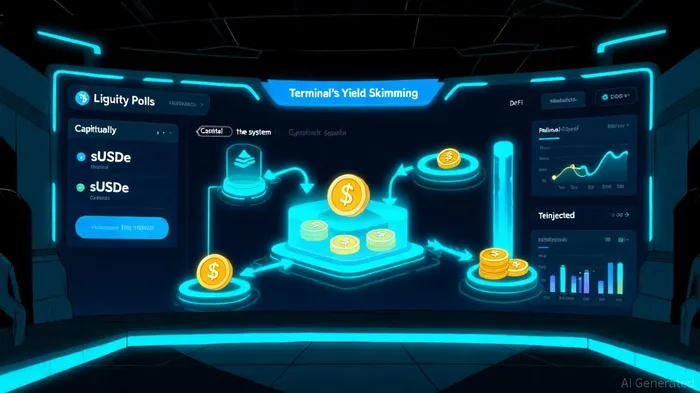
Terminal's core innovation lies in its focus on yield-bearing stablecoins and institutional-grade assets. By leveraging Ethena's synthetic dollar (USDe) and its yield-bearing counterpart (sUSDe), the platform creates a liquidity engine that captures and redistributes yield. This mechanism, dubbed "Yield Skimming," reinjects returns from assets like sUSDe into the DEX economy, creating a flywheel effect that benefits liquidity providers, traders, and token holders, according to CoinLaw.
The pre-launch metrics are staggering. Terminal's three capped pre-deposit vaults hold 225 million USDeUSDe--, 10,000 WETH, and 100 WBTC, with deposits coming from both retail and institutional participants, according to Barchart. This liquidity is not just a numbers game-it's a validation of the platform's ability to attract capital in a market where yield opportunities for stablecoins are traditionally limited. For context, Solstice Finance, a Solana-native DeFi protocol, launched its USX stablecoin with $160 million in TVL in Q3 2025, per ZyCrypto, but Terminal's figure is nearly double that, achieved in a pre-launch phase.
Institutional Adoption and Cross-Chain Ambitions
Terminal's success is further amplified by its strategic partnerships and cross-chain vision. The platform plans to integrate with protocols like Pendle, EtherFi, and Morpho, positioning itself as a central hub for yield-bearing stablecoins, according to Stocktwits PR. This interoperability is critical for DeFi 2.0, where liquidity fragmentation across chains has historically hindered growth.
Institutional interest is also surging. SharpLink Gaming, a major EthereumETH-- treasury firm, announced in Q3 2025 that it would deploy $200 million in ETHETH-- onto the LineaLINEA-- layer-2 network to generate yields via staking and restaking mechanisms, according to Yahoo Finance. While not directly tied to Terminal, this move underscores a broader trend: institutional capital is increasingly seeking DeFi infrastructure that offers programmable, transparent, and scalable returns. Terminal's focus on yield-bearing stablecoins aligns perfectly with this demand.
The Tokenomics Incentive
Terminal's token generation event (TGE), slated for late 2025, will further accelerate adoption. Early participants in the pre-deposit phase are already earning Terminal Points, which will translate into governance token allocations and airdrops, per Barchart. This design mirrors successful DeFi 1.0 models but with a critical upgrade: the token's utility is deeply tied to liquidity provision and yield generation, not just speculative trading.
Why This Matters for DeFi 2.0
Terminal's pre-launch success is not an outlier-it's a symptom of a larger shift. DeFi 2.0 protocols are no longer just competing on TVL; they're competing on capital efficiency and institutional trust. By solving the "yield gap" for stablecoins and institutional assets, Terminal is building a bridge between traditional finance (TradFi) and decentralized systems.
For investors, the implications are clear: protocols that can capture and redistribute yield-like Terminal-are likely to dominate the next phase of DeFi. The $280 million TVL is not just a milestone; it's a signal that the market is ready for infrastructure that prioritizes real economic value over speculative hype.
Conclusion
Terminal Finance's pre-launch metrics, institutional partnerships, and yield-centric design position it as a key player in the DeFi 2.0 narrative. As the platform launches in late 2025, its ability to scale cross-chain liquidity and maintain its flywheel effect will be critical. For now, the data suggests that yield-bearing stablecoins are not just a niche experiment-they're a liquidity catalyst that could redefine DeFi's role in the broader financial ecosystem.






Comentarios
Aún no hay comentarios