
TeraWulf's $1.025 Billion Funding and Strategic Expansion into HPC and AI Infrastructure: A Deep Dive into Long-Term Value Creation
Strategic Capital Allocation and Debt Financing
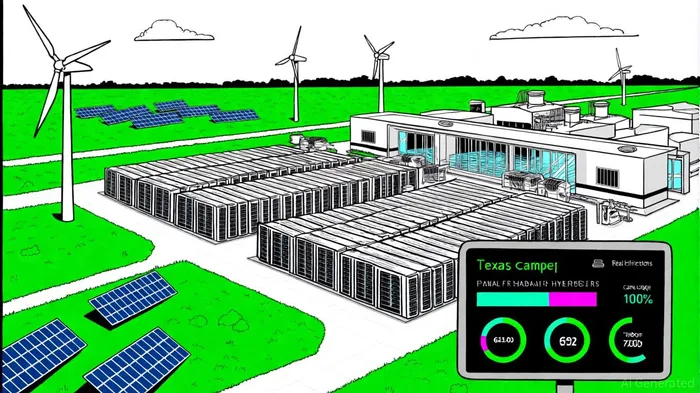
TeraWulf's $1.025 billion funding round, netting $999.7 million after expenses, is earmarked for constructing a 168-megawatt data center campus in Abernathy, Texas. This project is part of a 25-year joint venture with Fluidstack, a leading AI cloud provider, which secures $9.5 billion in contracted revenue for TeraWulf. Google's commitment to back $1.3 billion of Fluidstack's lease obligations, as reported in The MinerMag article, provides critical financial stability, reducing the company's exposure to volatile capital markets (The MinerMag article).
The debt structure-project-level financing tied to long-term hosting agreements-demonstrates disciplined capital allocation. By leveraging institutional partners like Google, TeraWulf mitigates risk while securing predictable cash flows. This approach contrasts with traditional Bitcoin mining operations, which face revenue volatility tied to cryptocurrency price swings and energy costs, as highlighted by the TS2 Tech article (TS2 Tech article).
Market Positioning and Competitive Advantages
TeraWulf's pivot to HPC/AI infrastructure aligns with a sector projected to grow at a 30.4% CAGR through 2030 (the Grand View Research report). The company's dual-use model-serving both blockchain and AI workloads-enhances asset utilization. For instance, its Lake Mariner campus in New York is contracted for 360 MW of critical IT load, with 89% of energy sourced from zero-carbon hydro and nuclear power, according to CoinLaw analysis (CoinLaw analysis). This sustainability edge, combined with access to low-cost, reliable energy, differentiates TeraWulf from competitors reliant on fossil fuels (as noted by TS2 Tech).
Financially, TeraWulf's Q3 2025 preliminary results underscore its capital efficiency. Revenue surged 84% year-over-year to $48–$52 million, with adjusted EBITDA rising to $15–$19 million, as the TeraWulf Q3 release shows (TeraWulf Q3 release). These figures reflect the early success of its HPC pivot, as the company now commands over 510 MW of contracted capacity and targets 250–500 MW of annual additions (per The MinerMag article).
Environmental Sustainability and Scalability
While specific sustainability metrics for the Texas project remain undisclosed, TeraWulf's broader strategy emphasizes zero-carbon energy. Its New York and Pennsylvania operations already leverage hydro and nuclear power, reducing grid dependency and operational costs (as noted by TS2 Tech). This focus on clean energy not only aligns with global decarbonization trends but also enhances the company's appeal to ESG-focused investors.
Scalability is another strength. TeraWulf's Lake Mariner campus, with pending approvals for 750 MW of power, is designed to support both AI and Bitcoin mining workloads (per CoinLaw analysis). This flexibility allows the company to adapt to market shifts while maintaining high-margin revenue streams. Analysts project the campus could generate ~$315 million in annual net operating income, with an 85% margin (CoinLaw analysis).
Risk Mitigation and Institutional Backing
TeraWulf's partnerships with Fluidstack and Google provide a robust risk-mitigation framework. The 25-year hosting agreement with Fluidstack ensures long-term revenue visibility, while Google's $1.3 billion lease backing reduces financing complexity (The MinerMag article). Additionally, Google's 8% equity stake in TeraWulf, noted in CoinLaw analysis, signals strong alignment of interests, further de-risking the venture.
The company's capital structure also reflects prudence. Convertible notes and high-yield bonds are being used to fund specific projects, avoiding over-leveraging. For example, the Lake Mariner campus is supported by $3.2 billion in senior secured notes, according to CoinLaw analysis, ensuring liquidity for expansion.
Conclusion: A High-Conviction Play in a High-Growth Sector
TeraWulf's strategic expansion into HPC/AI infrastructure is a masterclass in capital efficiency and long-term value creation. By securing long-duration contracts with investment-grade partners, leveraging zero-carbon energy, and maintaining financial flexibility, the company is well-positioned to capitalize on the $223.45 billion HPC/AI market (the Grand View Research report). While environmental metrics for new projects remain opaque, the broader sustainability narrative and institutional backing provide a compelling case for investors seeking exposure to the AI infrastructure boom.
As the Texas data center comes online in late 2026 (The MinerMag article), TeraWulf's ability to scale its dual-use model and maintain profitability will be critical. For now, the company's Q3 2025 results and strategic momentum suggest it is on track to deliver outsized returns in a sector poised for explosive growth.





Comentarios
Aún no hay comentarios