
Is Teradyne Stock a Justified Bet Amid Sky-High Valuations and Explosive AI-Driven Growth?
The semiconductor test equipment sector has long been a barometer for broader tech cycles, but TeradyneTER-- (TER) has emerged as a standout player in 2025, riding a wave of AI-driven demand. With a trailing P/E ratio of 77.48 and an EV/EBITDA of 51.81-well above industry averages-the stock has drawn both admiration and skepticism. This article examines whether Teradyne's valuation reflects its structural growth potential or if it has priced in too much optimism.
Valuation Metrics: A Premium on Earnings and Cash Flow
Teradyne's current valuation metrics are striking. Its trailing P/E of 77.48 and forward P/E of 43.20 place it in the stratosphere compared to peers, whose average P/E hovers around 38.1x. The EV/EBITDA ratio of 51.81 further underscores the premium investors are paying for the company's operational cash flow generation. Historically, Teradyne's EV/EBITDA has fluctuated between 12.92 in 2021 and 23.22 in 2023, but the 2025 level suggests a dramatic acceleration in expectations.
The P/S ratio of 6.63, 65.88% above the industry average, adds to the concern. While high-growth companies often trade at elevated multiples, such metrics typically require robust revenue growth and margins to justify. Teradyne's third-quarter 2025 results showed 7% year-over-year revenue growth in its Semiconductor Test Group, which accounts for 78.8% of sales. However, sustaining such growth in a sector prone to cyclicality remains a challenge.
Structural Demand: AI as a Tailwind
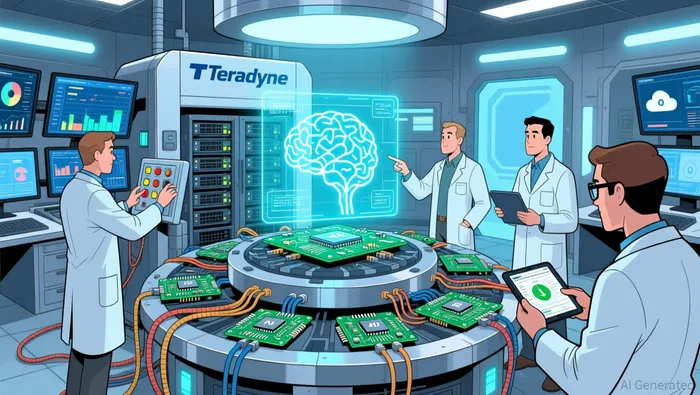
The case for Teradyne hinges on its positioning in the AI infrastructure boom. The Semiconductor Test Group's 23% sequential revenue jump in Q3 2025 was driven by demand for SoC testing, memory testing, and advanced networking devices. The launch of the Titan HP system-level test platform in October 2025, tailored for AI and cloud infrastructure, has further solidified its relevance.
Analysts project this momentum to continue. Management's Q4 2025 revenue guidance of $920 million to $1 billion reflects confidence in AI-driven demand, while industry observers anticipate 17.01% revenue growth in 2026. Goldman Sachs upgraded Teradyne to Buy in late 2025, citing "sustained strength in compute and memory testing" and a potential design win with a Merchant GPU tester. UBS and Stifel similarly raised price targets, with UBS setting a $200 target.
Valuation Realism vs. Growth Sustainability
The disconnect between Teradyne's valuation and its fundamentals raises questions. A DCF model suggests the stock is 82.3% overvalued based on projected cash flows, while its P/E of 75.5 far exceeds both industry and peer averages. Critics argue that much of the AI-driven upside is already priced in, making the stock vulnerable to execution risks or cyclical slowdowns.
Yet, structural demand for semiconductor test equipment remains robust. AI's reliance on high-bandwidth memory (HBM) and advanced SoCs ensures long-term relevance for Teradyne's offerings. The company's $1 billion share repurchase program and expansion into robotics via a new U.S. hub in Michigan also signal confidence in its long-term prospects.
Risks to Consider
While AI growth is a tailwind, risks persist. Weak free cash flow generation and inventory levels above historical averages highlight operational challenges. Additionally, the semiconductor test market is capital-intensive, and delays in AI adoption cycles could disrupt revenue streams. Analysts caution that elevated 2026 expectations may not materialize, particularly if foundries or OSAT partners scale back orders.
Conclusion: A High-Stakes Bet
Teradyne's valuation is undeniably stretched, but its structural positioning in AI infrastructure offers a compelling narrative. The company's ability to capitalize on multiyear orders from leading foundries and its innovation in test platforms like Titan HP could justify the premium. However, investors must weigh the risks of overvaluation against the potential for sustained growth. For those with a long-term horizon and tolerance for volatility, Teradyne may represent a justified bet-but only if the AI-driven tailwinds prove as enduring as the market expects.





Comentarios
Aún no hay comentarios