
Teradyne in the Rotation: A Structural Play or a Momentum Trap?
Jim Cramer's endorsement was unequivocal. In a recent lightning round segment, when asked about TeradyneTER--, he delivered a classic "buy, buy, buy!" call, adding that he has known the management for years and "I think that thing is terrific." He framed the company as a well-run industrial story, a view he reiterated earlier in the year, calling it "incredibly well-run". The market, for a time, agreed. Since that April 3rd call aired, the stock has delivered a staggering almost 90% gain.
Yet that explosive move now sits at the heart of a broader market rotation. The very momentum that propelled Teradyne higher is now being questioned as investors shift from yesterday's winners to new opportunities. The rotation is palpable. Just yesterday, for instance, shares of Constellation Energy, a stock that had been a standout performer, "traded down with the cohort" as the broader market saw a shift in leadership. This sets up a critical test for Teradyne: is its rally a structural re-rating of a quality business, or a momentum play that has simply run its course in a churning market?
Decoding the Growth Engine: AI and Onshoring Tailwinds
The stock's 90% surge since Cramer's call is not a random momentum event. It is a direct bet on two powerful, multi-year structural trends: the AI hardware build-out and the reshoring of global supply chains. The company's own guidance provides the clearest signal of where the near-term growth is coming from.
First, the AI demand is concrete and accelerating. Teradyne's CEO pointed to strong AI-related demand in Compute and Memory as the driver for exceeding Q3 expectations. Looking ahead, the company is guiding for a 25% sequential revenue increase in Q4'25. That is a massive acceleration, signaling that the AI test cycle is not just starting but is in full swing. This isn't a fleeting cyclical upturn; it's the foundational demand for the next generation of chips that will define the semiconductor industry for years.
Second, the advanced robotics business is playing a critical supporting role. Its collaborative and mobile robots are being deployed to automate manufacturing and warehouse operations. This isn't just about efficiency-it's a direct beneficiary of the onshoring trend. As companies bring production back to North America and Europe, they need automated solutions to manage labor costs and ensure quality. Teradyne's robotics segment provides that essential infrastructure, creating a dual revenue stream from both the AI chip demand and the physical factories that produce them.
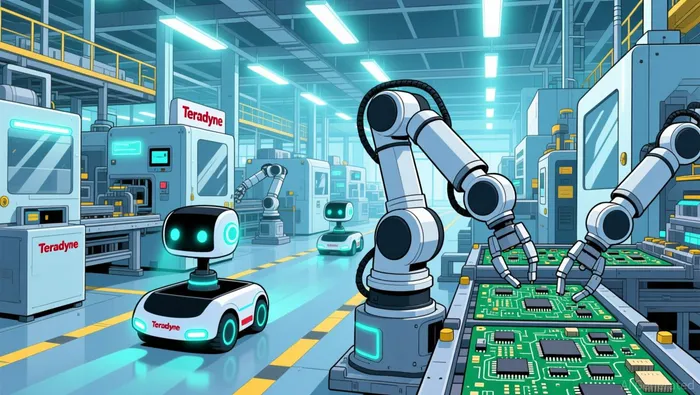
The market has clearly priced in these tailwinds. The stock's explosive move suggests investors believe the AI-driven growth in test equipment and the onshoring-driven demand for automation are now fully reflected. The question now is whether that optimism is justified by the durability of these trends. The guidance for a 25% sequential jump is a strong validation, but it also sets a high bar. Any stumble in that trajectory would quickly reset expectations. For now, the growth engine is firing on all cylinders, but its performance will be the ultimate test of whether this is a rotation or a re-rating.
Financial Impact and Valuation Scenarios
The translation of Teradyne's powerful business growth into financial performance reveals a nuanced picture. On the surface, the numbers are strong: revenue of $769 million in Q3'25 topped expectations, and the company is guiding for a massive 25% sequential revenue jump in Q4. Yet the bottom line tells a more complex story. The company's non-GAAP EPS of $0.85 for the quarter was actually down from $0.90 a year ago. This margin pressure, even as sales grow, is a critical signal. It suggests that the intense demand for AI test equipment and robotics solutions is being met with rising costs-whether for raw materials, labor, or the capital required to scale production. The market's recent surge has priced in the top-line acceleration, but it has not yet fully rewarded the company for navigating this profitability squeeze.
This sets up a fundamental contrast with other investment themes in the market. While activist-driven plays like Big Lots focus on unlocking value through operational changes or capital return, Teradyne's growth story is more technology-driven and infrastructure-focused. Its appeal lies in being a foundational supplier for the AI and automation build-out, not in delivering a high yield or a simple turnaround. This distinction matters for valuation. The stock's premium is a bet on the durability and scale of these structural trends, not on near-term earnings per share growth. The recent rotation, where money flows from richly valued leaders to overlooked laggards, tests that premium directly.
The key risk is that momentum-driven gains reverse if the underlying growth trajectory moderates. Jim Cramer himself has warned that momentum rallies in AI-linked stocks can reverse quickly once supply catches up. For Teradyne, that means the explosive sequential growth in Q4 must be sustained. Any deceleration in AI test demand or a slowdown in onshoring-related automation orders would quickly expose the stock to the same rotation pressures that have hit other high-flying names. The valuation, already elevated after a 90% run, offers little room for error. The financials show a company executing well but facing cost headwinds, while the market has priced in perfection. The setup is one of high conviction meeting high risk.
Catalysts and Watchpoints for the Thesis
The structural growth thesis now faces a series of forward-looking tests. The primary catalyst is the upcoming Q4'25 earnings report, which will confirm whether the company's bold guidance for a 25% sequential revenue jump is on track. That 25% acceleration is the clearest signal that AI-related demand in Compute and Memory is not just robust but accelerating. A beat on that guidance would validate the market's bet on the AI hardware build-out. A miss, however, would immediately challenge the sustainability of the growth narrative that has powered the stock's surge.
Beyond the headline number, a key watchpoint is any update on the Robotics segment's contribution to the onshoring trend. While the segment's $75 million in Q3 revenue is a solid part of the story, the market needs to see evidence that demand for collaborative and mobile robots is scaling in tandem with the physical reshoring of manufacturing. Any guidance suggesting a slowdown or a shift in investment priorities for automation would be a red flag for the broader industrial thesis.
The overarching risk, however, is not a company-specific stumble but a broader market rotation. As CNBC's Jim Cramer has noted, momentum rallies in AI-linked stocks can reverse quickly once supply catches up. The recent shift in leadership, where shares of a former leader like Constellation Energy "traded down with the cohort," illustrates this dynamic. For Teradyne, the 90% gain since Cramer's endorsement has created a classic setup for such a rotation. If money flows out of richly valued tech leaders to find value elsewhere, the stock's premium valuation offers little cushion. The thesis depends on the AI and onshoring trends continuing to outpace the market's appetite for rotation. The coming earnings and guidance will show if that divergence is still widening.





Comentarios
Aún no hay comentarios