
Tencent's Share Buyback: A Strategic Move or a Short-Term Signal?
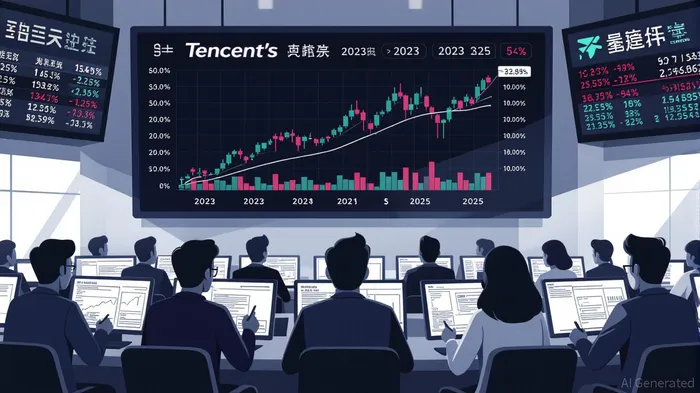
In the ever-evolving landscape of global tech giants, Tencent's recent share buyback program has sparked intense debate among investors. With a staggering 80 billion Hong Kong dollars allocated for repurchases in 2025 alone—part of a broader 121 billion HKD shareholder return strategy—Tencent is sending a clear message to the market. But is this a calculated, long-term capital allocation strategy, or merely a short-term tactic to buoy investor sentiment?
Capital Allocation: Balancing Growth and Returns
Tencent's 2025 buyback plan must be viewed through the lens of its broader financial priorities. The company has consistently reinvested in high-growth areas, particularly artificial intelligence (AI), with R&D spending reaching 70.69 billion RMB in 2024. This includes AI-native applications like YuanbaoYB-- and enhancements to WeChat and Tencent Cloud. Such investments are not just about maintaining competitiveness but also about securing future cash flows.
However, Tencent's ability to fund these initiatives while rewarding shareholders hinges on its free cash flow. In 2024, the company generated 162.47 billion RMB in free cash flow, albeit a slight decline from prior years due to increased capital expenditures. The 80 billion HKD buyback (approximately 9.3 billion USD) represents a significant portion of this cash flow, raising questions about whether the company is prioritizing short-term stock price stability over long-term reinvestment.
Yet, Tencent's capital allocation strategy appears more nuanced. Its Return on Invested Capital (ROIC) of 11.48% suggests efficient use of capital, and its debt-to-equity ratio of 0.39x indicates a conservative balance sheet. By pairing buybacks with a 32% dividend increase to 41 billion HKD, Tencent is signaling confidence in its ability to sustain both growth and shareholder returns. This dual approach—investing in AI while returning capital—aligns with the principles of disciplined capital allocation championed by value investors.
Shareholder Confidence: A Signal of Strength or Desperation?
Share buybacks often serve as a barometer of management's confidence in a company's intrinsic value. Tencent's aggressive repurchase pace—HKD 1 billion per day in December 2023—and its 2025 announcement suggest a belief that its shares are undervalued. This is further reinforced by its Q1 2025 financials: revenues of 180 billion RMB (up 13% YoY) and a 39% operating margin, demonstrating resilience amid macroeconomic headwinds.
Critics, however, argue that buybacks can mask underlying challenges. For instance, Tencent's gaming segment—its historical cash cow—now faces regulatory scrutiny and saturation in core markets. While the company still derives over 40% of its operating income from gaming, its pivot to AI and cloud services is critical for long-term relevance. The buyback program, therefore, could be a strategic move to stabilize investor sentiment during this transition.
Strategic Implications and Risks
Tencent's buyback strategy is not without risks. The company's increased capital expenditures—62.93 billion RMB in 2024—for AI infrastructure and property, plant, and equipment could strain liquidity if growth in these areas underperforms. Additionally, regulatory pressures in China's tech sector remain a wildcard, potentially limiting Tencent's ability to scale its AI ambitions.
Nevertheless, the company's financial health provides a buffer. A current ratio of 1.25x and a debt-free balance sheet suggest Tencent has the flexibility to navigate these challenges while maintaining its capital return commitments. Moreover, its strategic partnerships—such as the Ryde GroupRYDE-- collaboration for autonomous driving—underscore its ability to leverage external resources for growth.
Conclusion: A Strategic Move with Caveats
Tencent's share buyback program is best understood as part of a multifaceted capital allocation strategy. By returning 121 billion HKD to shareholders in 2025 while investing heavily in AI, Tencent is balancing immediate investor expectations with long-term innovation. The key question is whether these investments will translate into sustainable growth. For now, the company's strong financials and disciplined approach to capital efficiency justify viewing the buyback as a strategic move rather than a short-term signal.
That said, investors should remain vigilant. The success of Tencent's AI-driven transformation will ultimately determine whether this capital allocation strategy delivers lasting value or becomes a temporary salve for deeper structural challenges.
Source:
[1] A Value Investors Guide to Tencent [https://substack.com/home/post/p-139003214?utm_campaign=post&utm_medium=web]
[2] Tencent Leverages Unrivaled Network Effects To Fuel Growth on Multiple Fronts [https://www.morningstarMORN--.com/company-reports/1094996-tencent-leverages-unrivaled-network-effects-to-fuel-growth-on-multiple-fronts]
[3] Tencent Holdings AI-Driven Growth & Financial Analysis [https://monexa.ai/blog/tencent-holdings-latest-financial-and-ai-driven-gr-TCEHY-2025-07-04]
[4] Tencent Made a Substantial Buyback in the First Quarter [https://news.futunn.com/en/post/55059782/tencent-made-a-substantial-buyback-in-the-first-quarter-17]







Comentarios
Aún no hay comentarios