
Tencent's Share Buyback and Its Implications for Investor Confidence
In recent months, Tencent Holdings has signaled a dual-pronged approach to capital allocation, combining aggressive share repurchases with strategic investments in artificial intelligence (AI). This strategy, unveiled in early 2025, has sparked renewed interest among investors, who are now scrutinizing how the tech giant balances shareholder returns with long-term innovation.
A $10 Billion Bet on Shareholders
Tencent's latest $10 billion share buyback program, announced in March 2025 and set to span 24 months, underscores its commitment to returning value to shareholders. This follows a record $14.4 billion repurchase in 2024, which reduced the company's share capital to its lowest level since 2014, according to a Kaohoon report. The move builds on a recent $193 million single-day buyback—the largest since 2006—executed in January 2025, according to a Morningstar article. These actions reflect confidence in Tencent's financial resilience, particularly after an 11% year-on-year revenue increase in Q4 2024, which Kaohoon also noted.
The buyback program is not merely a short-term tactic but part of a broader strategy to optimize capital structure. By reducing the number of outstanding shares, Tencent aims to enhance earnings per share (EPS) and signal undervaluation to the market. Tencent's annual results show the company's liquidity position—bolstered by $47.5 billion in cash reserves as of December 2024—provides ample flexibility to sustain such programs (Tencent's annual results).
Reallocating Capital for the AI Era
While buybacks capture headlines, Tencent's 2024 annual report reveals a more nuanced capital allocation strategy. The company increased capital expenditures (capex) by 221% year-on-year to RMB76.8 billion ($10.7 billion), driven by AI infrastructure demands, according to an EqualOcean analysis. This includes purchases of NVIDIA's H20 GPUs to support AI inference workloads and the integration of models like DeepSeek into platforms such as WeChat, according to a TrendForce article. For 2025, capex is projected to remain above $10 billion, with AI investments accounting for a “low double-digit percentage” of revenue, an EqualOcean analysis shows.
This pivot toward AI aligns with Tencent's vision of dominating the “intelligent era.” The company is not only upgrading its internal capabilities but also funding external AI startups like Zhipu AI and Baichuan Intelligence, a development highlighted by TrendForce. Such investments position Tencent to leverage its vast user base and application scenarios for rapid AI monetization.
Balancing Shareholder Value and Strategic Growth
The interplay between buybacks and AI investments raises questions about Tencent's capital allocation priorities. On one hand, the company has returned HKD112 billion ($14.4 billion) to shareholders in 2024 through buybacks and raised dividends by 32%, as reported by EqualOcean. On the other, it is committing significant resources to AI, a sector with high upfront costs but long-term growth potential.
This balance appears sustainable. Tencent's free cash flow of RMB155.3 billion ($21.6 billion) in 2024 was noted by EqualOcean, and the company reported a net cash position of RMB76.8 billion ($10.7 billion) in its annual results. The company's approach mirrors that of industry peers like Meta and Amazon, which have historically used robust cash flows to finance both shareholder returns and transformative investments.
Implications for Investor Confidence
Tencent's dual strategy is likely to bolster investor confidence in two ways. First, the buybacks signal management's belief in the company's intrinsic value, a psychological boost for shareholders. Second, the AI investments address long-term growth concerns, countering narratives of stagnation in its core gaming and social media businesses.
However, risks persist. A 10.77% decline in cash reserves year-on-year, noted in Tencent's annual results, highlights the need for disciplined capital allocation. If AI returns materialize slowly, investors may question the trade-off between near-term buybacks and long-term innovation.
Conclusion
Tencent's 2025 share buyback program and AI investments reflect a calculated effort to maximize shareholder value while securing a leadership position in the AI revolution. By leveraging its liquidity and strategic foresight, the company is navigating the delicate balance between rewarding shareholders and fueling innovation. For investors, this duality presents both opportunity and caution—a testament to Tencent's evolving role in the global tech landscape.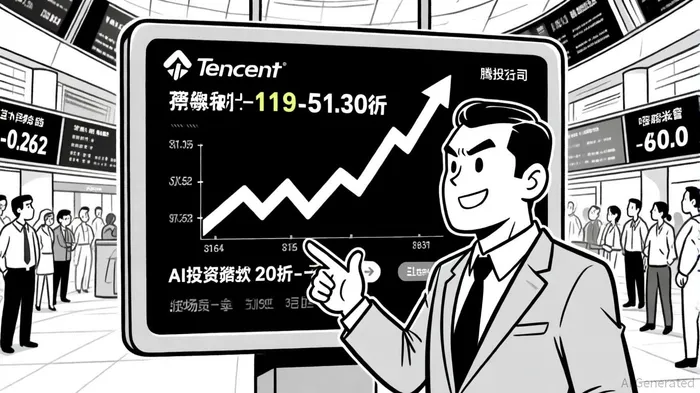







Comentarios
Aún no hay comentarios