
Tenaris's Q1 Sales Decline Highlights Persistent Global Demand Headwinds
Tenaris, a leading global supplier of seamless steel tubing for the energy and construction sectors, reported Q1 2025 net sales of $2.922 billion—a 15% year-over-year decline compared to $3.442 billion in Q1 2024. This drop underscores the challenges facing industrial manufacturers amid shifting macroeconomic conditions and sector-specific demand dynamics. While the company noted a 3% sequential increase from Q4 2024, the year-over-year contraction raises critical questions about the sustainability of its growth trajectory.
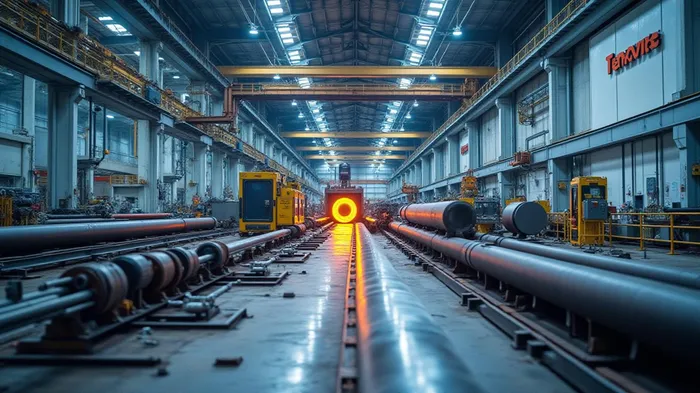
The decline in sales reflects broader headwinds across Tenaris’s key markets. In the energy sector, oil and gas companies have scaled back capital expenditures as commodity prices remain volatile and geopolitical tensions influence supply chains. Meanwhile, construction and infrastructure projects in emerging markets—traditionally a growth driver—have slowed due to funding constraints and policy uncertainties. These factors are compounding the challenges TenarisTS-- faces in maintaining historical sales levels.
To contextualize the performance, investors should examine Tenaris’s sales trends against regional and sectoral benchmarks. The would reveal whether the company is underperforming relative to its peers. Additionally, tracking the could shed light on how input cost pressures and energy demand trends are impacting profitability.
The company’s management emphasized cost discipline in its Q1 results presentation, highlighting efforts to streamline operations and improve margins. However, with gross profit margins contracting to 18% in Q1 2025 from 22% a year earlier, the strategy’s effectiveness remains unproven. Investors will need to assess whether these measures can offset the top-line pressures or if further restructuring is necessary.
A deeper dive into the geographic breakdown of sales reveals uneven performance. While North America, a critical market for the energy sector, saw a 20% sales decline year-over-year, the EMEA (Europe, Middle East, Africa) region fared slightly better with an 8% drop. This regional disparity suggests that Tenaris’s exposure to the volatile energy sector continues to weigh on results, particularly as U.S. shale producers prioritize returns over new drilling.
Looking ahead, the outlook hinges on two key variables: the recovery of global industrial demand and Tenaris’s ability to diversify its customer base. The company’s long-term contracts with major energy firms provide some stability, but the lack of significant new project wins in Q1 points to lingering caution among clients. Meanwhile, its push into the renewable energy and hydrogen infrastructure sectors—a strategic pivot announced in 2024—has yet to materialize into meaningful revenue streams.
Tenaris’s valuation presents a mixed picture. Trading at a trailing P/E of 9.5x, it is undeniably cheap relative to its five-year average of 14x. However, this discount reflects investor skepticism about near-term earnings resilience. A would help determine whether the discount is justified or represents an undervaluation opportunity.
In conclusion, Tenaris’s Q1 results highlight the precarious balance between cost management and top-line growth in a challenging macro environment. The 15% sales decline underscores the sector’s vulnerability to energy demand cycles and global economic uncertainty. While the stock’s valuation offers a potential margin of safety, investors must weigh the risks of prolonged weakness against the company’s long-term strategic initiatives. Without a meaningful rebound in global industrial activity or a clearer path to diversification, Tenaris’s path to sustained growth remains fraught with obstacles. For now, the data suggests caution, as the company navigates a landscape where the headwinds may yet prove stronger than its tailwinds.





Comentarios
Aún no hay comentarios