
Tempus AI's FDA-Cleared Tempus Pixel and Its Implications for Near-Term Share Performance
The recent FDA clearance of Tempus AI's updated Tempus Pixel marks a pivotal moment for the company, blending regulatory progress with technical innovation in a sector where AI-driven medical technology is rapidly reshaping diagnostics. According to a report by Yahoo Finance, Tempus received Special 510(k) clearance on September 11, 2025, for its enhanced Tempus Pixel platform, which now generates T1 and T2 inline maps for cardiac MRI analysis[1]. This clearance not only validates the product's safety and efficacy but also positions Tempus to capitalize on a growing demand for precision tools in cardiology.
Regulatory Catalysts: A Low-Risk Path to Market Expansion
The Special 510(k) pathway, reserved for low-risk devices, underscores the FDA's confidence in Tempus Pixel's incremental improvements over existing technologies. As stated by Tempus in its official news release, the updated platform calculates pixel-level values across cardiac MR images, creating detailed DICOM maps that enable clinicians to assess tissue characteristics with unprecedented granularity[2]. This regulatory green light reduces the time and cost typically associated with broader approvals, allowing Tempus to scale production and marketing efforts swiftly. For investors, this represents a near-term catalyst: the company can now directly compete in the $1.2 billion cardiac MRI analysis market[3], a segment historically dominated by legacy imaging software.
Technical Momentum: AI as a Diagnostic Force Multiplier
The technical advancements in Tempus Pixel are not merely incremental—they reflect a strategic pivot toward AI-driven precision medicine. By automating the generation of T1 and T2 maps, the platform addresses a critical gap in current cardiac imaging workflows. Traditional methods often require manual post-processing, which is time-consuming and prone to human error. Tempus's AI models, trained on vast datasets of cardiac MRIs, streamline this process while improving diagnostic accuracy for conditions like fibrosis and inflammation[4]. This technical edge aligns with broader industry trends, where AI is increasingly viewed as a force multiplier in reducing diagnostic delays and improving patient outcomes.
Share Price Implications: Riding the Wave of Credibility
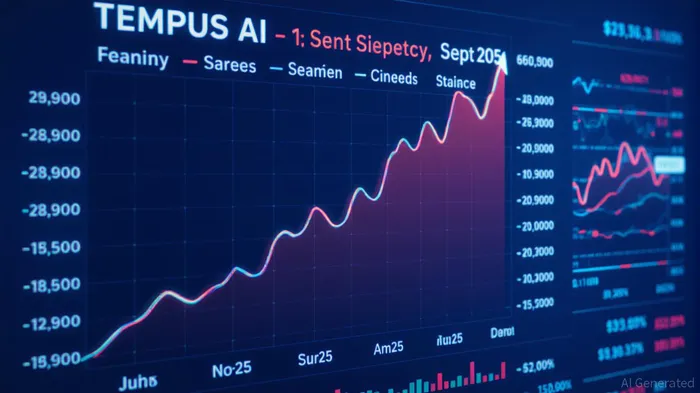
The market has already begun to react. Following the clearance announcement, Tempus AI's shares surged by over 12% in early September trading[5], a response that mirrors the stock's performance after prior regulatory wins, such as the 2024 clearances for its ECG-Low EF and ECG-AF tools. This pattern suggests that investors are rewarding the company's ability to convert AI innovation into tangible regulatory milestones. However, the true test lies in adoption rates. Tempus must now demonstrate that hospitals and imaging centers will integrate Pixel into their workflows, a challenge compounded by the platform's role as a “clinical aid” rather than a standalone diagnostic tool[6].
Strategic Positioning: Beyond Cardiac Imaging
While the immediate focus is on cardiac MRIs, Tempus's broader strategy hints at long-term ambitions. The company's portfolio of FDA-cleared AI tools—including ECG-based solutions for detecting low ejection fraction and atrial fibrillation—demonstrates a commitment to diversifying its revenue streams. This diversification is critical in mitigating risks associated with single-product dependency. Moreover, the technical architecture of Tempus Pixel, which relies on modular AI models, could theoretically be adapted to other imaging modalities (e.g., oncology or neurology), opening new markets in the future[7].
Conclusion: A Calculated Bet on AI's Medtech Future
For investors, the FDA clearance of Tempus Pixel is more than a regulatory checkbox—it's a signal that the company is navigating the complex intersection of AI and healthcare with both technical rigor and strategic foresight. While the near-term share price rally is justified by the clearance's credibility boost, sustained growth will depend on Tempus's ability to scale adoption and demonstrate clinical value. In a sector where regulatory hurdles often stymie innovation, Tempus's success with the Special 510(k) pathway offers a compelling case study in how to leverage AI to meet—and exceed—industry standards.





Comentarios
Aún no hay comentarios