
Teledyne (TDY): A Strategic Play in Autonomous Vehicle Innovation and Long-Term Value Creation
In an era where artificial intelligence and autonomous systems are reshaping industries, Teledyne TechnologiesTDY-- (TDY) stands out as a formidable player. By combining cutting-edge product launches with robust financial resilience, the company is positioning itself at the forefront of the AI-driven industrial tech sector. For investors seeking long-term value creation, Teledyne's strategic focus on autonomous vehicle innovation-both on land and under the sea-offers a compelling case.
Pioneering Autonomous Vehicle Innovation
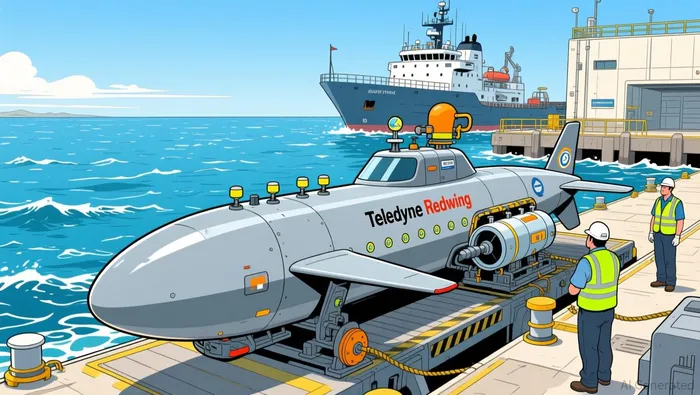
Teledyne's 2025 product portfolio underscores its leadership in autonomous systems. The launch of Redwing, the world's most advanced commercial subsea glider, marks a breakthrough in marine autonomy. This autonomous underwater vehicle (AUV) is embarking on a five-year global circumnavigation mission to collect oceanographic data, enhancing climate modeling and weather forecasting. Redwing's use of buoyancy-driven propulsion and advanced sensors to measure salinity, temperature, and depth demonstrates Teledyne's technical prowess in environmental monitoring.
On land, TeledyneTDY-- FLIR OEM's introduction of the Tura thermal camera-a first-of-its-kind Automotive Safety Integrity Level (ASIL-B) compliant longwave infrared (LWIR) sensor- addresses critical safety gaps in autonomous vehicles and advanced driver-assistance systems (ADAS). By enabling high-performance thermal imaging, Tura enhances pedestrian detection in low-visibility conditions, a key challenge for AVs. Meanwhile, Teledyne FLIR Defense's reusable loitering munitions highlights the company's expansion into defense-focused autonomous systems, with modular payloads and electro-optical/thermal imaging capabilities supporting precision strikes for the U.S. Marine Corps.
Collaborations further amplify Teledyne's reach. A Memorandum of Understanding (MoU) with BMT, a maritime engineering firm, aims to integrate Teledyne's underwater vehicle expertise with BMT's safety and assurance frameworks, accelerating the development of reliable maritime autonomy solutions. These initiatives collectively position Teledyne as a cross-sector innovator in autonomous systems.
Financial Resilience Fuels Sustained Growth
Teledyne's financial performance in 2025 reinforces its credibility as a long-term investment. In Q3 2025, the company reported $1.54 billion in revenue, exceeding forecasts, and $5.57 in EPS, a 9.2% year-over-year increase. Free cash flow reached $314 million, with a gross profit margin of 42.75%, reflecting operational efficiency. The company raised its 2025 non-GAAP EPS guidance to $21.45–$21.60, signaling confidence in its growth trajectory.
Debt management is another strength. As of Q3 2025, Teledyne's leverage ratio stood at 1.4x, down from 1.8x in early 2025 and 1.5x in 2024, indicating disciplined capital structure management. This trend, coupled with a $224.6 million free cash flow in Q1 2025, underscores the company's ability to fund innovation while maintaining financial flexibility.
Teledyne's strategic investments in R&D- reaching $82.4 million in Q2 2025-highlight its commitment to staying ahead in AI-driven industrial tech. These funds are directed toward digital imaging, unmanned systems, and AI applications, aligning with global demand for smarter, safer autonomous solutions.
Strategic Position in a High-Growth Sector
The AI-driven industrial tech sector is poised for explosive growth. The global automotive AI market is projected to expand from $18.83 billion in 2025 to $38.45 billion by 2030, growing at a 15.3% CAGR. Similarly, the autonomous vehicle market is expected to surge from $2.3 trillion in 2025 to $8.4 trillion by 2035, driven by AI, machine learning, and sensor advancements. Teledyne's product suite-spanning thermal imaging, nano drones, and maritime AUVs-directly addresses these trends.
The company's Black Hornet nano-drone, recently approved for U.S. military use, and its mobile counter-drone system exemplify its ability to leverage AI for defense applications. Analysts note that Teledyne's pending acquisition of TransponderTech and past acquisitions of Qioptiq and Excelitas have strengthened its capabilities in aerospace, defense, and advanced optics, enabling vertical integration and access to high-margin markets.
Long-Term Value Creation: A Balanced Approach
While Teledyne's growth is evident, risks such as supply chain disruptions and defense contract dependencies persist. However, its diversified product portfolio and strong balance sheet mitigate these concerns. For instance, the company's expansion into nano drones- projected to generate $500 million in sales by 2026-demonstrates its ability to capitalize on niche, high-growth markets.
Investor sentiment is also shifting. With a $621 fair value estimate based on defense and imaging sector momentum, some analysts argue Teledyne's stock is undervalued despite its strong fundamentals. This aligns with broader market trends, as the AI in industrial automation sector is forecasted to grow from $20.02 billion in 2024 to $90.28 billion by 2033, driven by predictive maintenance and AI-enabled robotics.
Conclusion
Teledyne Technologies is a masterclass in strategic innovation and financial discipline. By pioneering autonomous systems-from subsea gliders to thermal imaging for AVs-and maintaining a lean, resilient balance sheet, the company is well-positioned to thrive in the AI-driven industrial tech sector. As global demand for autonomous solutions accelerates, Teledyne's ability to merge technological leadership with fiscal prudence makes it a compelling long-term investment.





Comentarios
Aún no hay comentarios