
Tech Stock Correction: Is Now the Time to Re-Enter the AI-Driven Winners?
The recent market corrections in high-growth tech stocks like Nvidia (NVDA) and Tesla (TSLA) have sparked intense debate among investors. With both companies shedding significant value in 2025-Nvidia losing $800 billion in market capitalization in early November alone and TeslaTSLA-- facing a 9.3% weekly decline-questions abound: Are these dips a buying opportunity, or a warning sign of overvaluation and unsustainable momentum? For investors seeking to re-enter the AI-driven winners, the answer hinges on a nuanced analysis of valuation metrics, competitive dynamics, and macroeconomic risks.
Nvidia: A Pillar of AI, But at What Cost?
Nvidia's dominance in AI infrastructure has cemented its position as a bellwether for the sector. As of November 2025, the stock trades at a forward P/E of 45.30, a discount to its 3-year average of 68.34, and a PEG ratio of 1.49, suggesting its valuation is justified by projected 74% EPS growth according to finance charts. Wall Street analysts remain overwhelmingly bullish, with 35 out of 37 rating the stock as a "buy" and an average price target implying 23% upside according to Fool analysis.
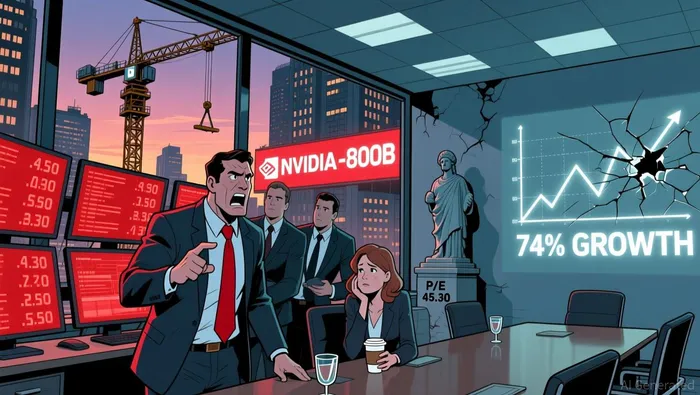 However, the correction reflects growing skepticism. Regulatory pressures, including U.S. export restrictions on advanced semiconductors, have curtailed Nvidia's access to China, a market where state-funded data centers are now required to use domestically designed chips according to investing analysis. Meanwhile, competition from AMD and Intel is intensifying, and the company's reliance on AI-driven demand exposes it to cyclical risks if infrastructure spending slows according to Yahoo Finance.
Despite these headwinds, Nvidia's fundamentals remain robust. Its upcoming Vera Rubin NVL144 CPX platform is expected to maintain performance leadership into 2026 according to investing analysis, and a $100 billion collaboration with OpenAI underscores its strategic positioning in the AI ecosystem according to investing analysis. For investors, the key question is whether the current 7% weekly decline represents a temporary overcorrection or a more systemic reassessment of its growth narrative.
Tesla: Volatility and the Specter of Overvaluation
Tesla's stock has long been a barometer of speculative fervor in the tech sector. As of November 2025, it trades at a P/E ratio of 278.52-far exceeding its 3-year average of 130.73 and the industry average of 36.94 for Apple according to finance charts. This extreme valuation, coupled with a 12-month revenue growth rate of -1.6%, signals growing concerns about market saturation and execution risks according to Forbes analysis.
Analysts are divided. While 14 out of 37 rate Tesla a "buy," 10 have assigned a "sell" rating, with an average price target implying 18% downside according to Fool analysis. The stock's recent volatility reflects skepticism about its core electric vehicle business and the feasibility of ambitious projects like the robotaxi and Optimus humanoid robot according to Fool analysis. Yet, Tesla's brand strength and first-mover advantage in EVs remain formidable, and its FSD (Full Self-Driving) software could unlock new revenue streams if regulatory hurdles are cleared.
Valuation Metrics: A Tale of Two Tech Giants
Comparing valuation metrics reveals stark contrasts. Nvidia's P/E of 45.30 is below the Semiconductors & Semiconductor Equipment industry average of 135.16 according to Nasdaq analysis, while its P/B ratio of 36.01 far exceeds the sector average of 5.72 according to Nasdaq analysis. This suggests the market is pricing in long-term growth but remains cautious about short-term risks. In contrast, Tesla's P/E of 297.6 is among the highest in its peer group, with only Polestar (PCAR) matching its valuation according to Forbes analysis.
For NvidiaNVDA--, the correction may present an entry point for investors who believe its AI-driven revenue visibility into 2026 is undervalued according to Yahoo Finance. For Tesla, the high valuation demands a higher bar for execution-robotaxi launches and international expansion must deliver tangible results to justify its premium.
Strategic Re-Entry: Balancing Opportunity and Risk
Re-entering the AI-driven winners requires a disciplined approach. For Nvidia, the current pullback offers a chance to buy into a company with strong earnings visibility and a dominant position in AI infrastructure, albeit with regulatory and competitive risks. For Tesla, the key is to assess whether its valuation aligns with its ability to scale new technologies and maintain profit margins in a crowded EV market.
Investors should also consider diversification. While Nvidia's PEG ratio of 1.49 suggests growth is fairly priced according to finance charts, its exposure to AI-specific cycles means it's not immune to macroeconomic shifts. Tesla's volatility, meanwhile, underscores the importance of hedging against overvaluation in high-beta stocks.
Conclusion
The recent corrections in Nvidia and Tesla reflect a market recalibrating to the realities of AI-driven growth and EV market saturation. For Nvidia, the current valuation offers a compelling entry point for long-term investors who believe in its AI leadership. For Tesla, the high P/E demands a closer look at execution risks and competitive pressures. In both cases, strategic re-entry requires a balance of optimism and caution-a recognition that while the AI revolution is real, the path to sustained growth is anything but certain.





Comentarios
Aún no hay comentarios