
The Tech Sell-Off: A Cautionary Tale for AI-Driven Stocks
The AI-driven tech sector has long been a beacon of innovation and growth, but recent market dynamics suggest a growing disconnect between soaring valuations and the fundamentals of earnings performance. As investors grapple with the aftermath of a sharp tech sell-off in late 2025, the question looms: Are the stratospheric multiples assigned to AI-centric stocks sustainable, or are we witnessing the early signs of a correction?
Earnings Growth vs. Valuation Realism
NVIDIA, the poster child of the AI revolution, exemplifies this tension. In Q4 2024, the company reported record revenue of $22.1 billion, with its Data Center segment alone contributing $18.4 billion-a 409% year-over-year surge. By Q3 2025, NVIDIA's revenue had further ballooned to $57.0 billion, with the Data Center segment accounting for 89.8% of total revenue. These figures underscore the company's dominance in AI infrastructure, yet its trailing P/E ratio of 65.8 remains significantly higher than its five-year average of 62.19. While this premium reflects investor optimism about its leadership in AI, it also raises concerns about whether the stock is priced for perfection. 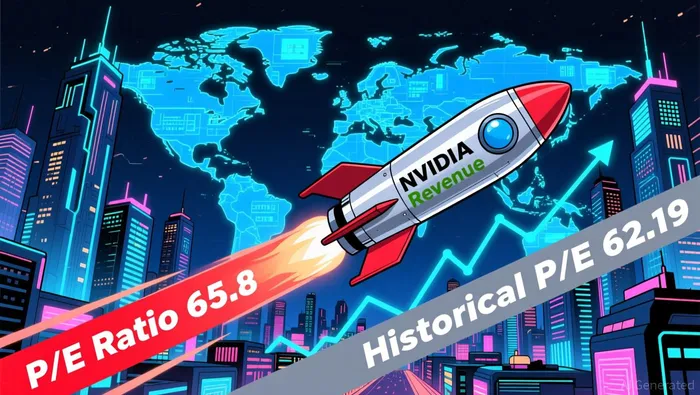
The broader Magnificent 7 (Mag-7) group, which includes NVIDIANVDA--, MicrosoftMSFT--, and Alphabet, has similarly outperformed the S&P 500. In Q4 2024, the Mag-7's aggregate earnings reached $131.2 billion, growing 31.7% year-over-year compared to the S&P 500's 16.9%. However, their valuations tell a different story. Microsoft, for instance, trades at a forward P/E of 36, a stark contrast to NVIDIA's 65.8. Alphabet, while still commanding a premium, lags behind both. This disparity highlights a critical question: Are investors overpaying for AI hype, or is the sector's long-term potential justifying these multiples?
The Risks of Overvaluation
The data suggests a widening gap between earnings growth and valuation metrics. NVIDIA's Q3 2025 results, which exceeded analyst expectations by $1.6 billion, pushed its revenue to $57.0 billion-a 62% year-over-year increase. Yet, even as the company's financials strengthen, its P/E ratio remains elevated. This pattern is not unique to NVIDIA. The Mag-7's aggregate revenue growth in Q4 2024, while impressive at 12.8%, was the lowest since Q2 2023. Analysts project that the group's earnings growth will slow to 17.1% in 2025, down from 36.8% in 2024, signaling potential headwinds as the market normalizes.
The S&P 500's broader index (S&P 493) is also expected to play a larger role in earnings growth, reducing the Mag-7's dominance. This shift could exacerbate volatility in AI-driven stocks, particularly if investor sentiment turns cautious. For example, NVIDIA's projected Q4 FY2026 revenue of $65.0 billion may not be enough to sustain its current valuation if macroeconomic conditions deteriorate or if AI adoption slows.
A Call for Prudence
While the AI sector's transformative potential is undeniable, investors must balance optimism with realism. The recent sell-off-triggered by concerns over inflated valuations and macroeconomic uncertainty-serves as a reminder that even high-growth stocks are vulnerable to market corrections. As one analyst noted, "The AI story is still in its early innings, but the current multiples assume a level of dominance that may not be sustainable."
For now, the Mag-7's earnings resilience offers a buffer. However, as 2025 progresses, investors should monitor key metrics: Can NVIDIA and its peers maintain their revenue growth without further margin compression? Will the broader market's earnings contribution from the S&P 493 offset the Mag-7's slowdown? And most critically, are these valuations aligned with long-term cash flow expectations?
Conclusion
The AI-driven tech sector remains a cornerstone of innovation, but its valuation dynamics demand scrutiny. While companies like NVIDIA have delivered extraordinary earnings, the market's current pricing reflects a high degree of speculative optimism. As the sell-off of late 2025 illustrates, even the most promising stocks are not immune to corrections when fundamentals lag behind expectations. For investors, the lesson is clear: Embrace the AI revolution, but do so with a healthy dose of skepticism and a focus on earnings realism.





Comentarios
Aún no hay comentarios