
Tech Sector Resilience Amid Macroeconomic Uncertainty: Navigating Cyclical and Structural Growth Drivers
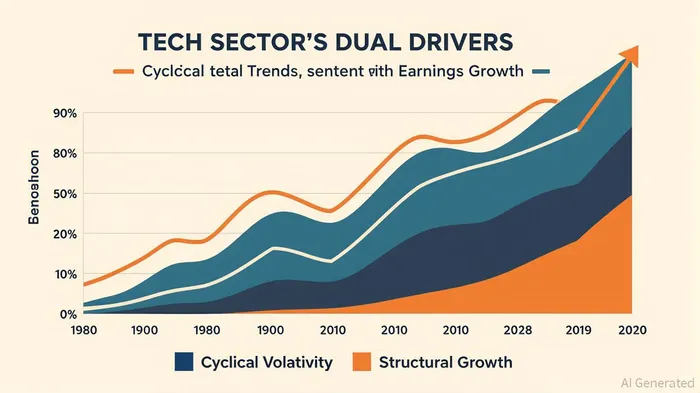
The technology sector's performance in 2025 has been a study in contrasts, balancing cyclical pressures from macroeconomic uncertainty with enduring structural growth fueled by artificial intelligence (AI) and innovation. As investors grapple with shifting dynamics, the interplay between these two forces defines the sector's resilience—and its risks.
Cyclical Pressures: Volatility and Rebalancing
Cyclical factors have introduced significant volatility to the tech sector in 2025. Trade tensions and policy uncertainty, particularly in the U.S., have prompted a reevaluation of global supply chains and risk exposures. Tariff-driven stagflationary risks have led to a broad market rebalancing, with small-cap and value stocks surging. The Russell 2000 small-cap index rose over 7.3% in August 2025, while the MorningstarMORN-- US Value Index gained 5.05%, reflecting a shift away from mega-cap dominance [1]. This rotation is partly driven by anticipation of Federal Reserve rate cuts and undervalued small-cap equities trading at a 15% discount to fair value [1].
Monetary policy remains a key cyclical lever. Dovish central bank commentary in late 2024 supported tech and financials, as investors bet on accommodative rates and AI-driven growth [5]. However, by Q3 2025, trade tensions and U.S. fiscal challenges—such as rising debt and policy unpredictability—have tempered long-term optimism about the sector's structural dominance [5].
Structural Strength: AI and Innovation as Anchors
Structural growth drivers, however, continue to underpin the tech sector's long-term appeal. AI remains the most transformative force, with generative AI reshaping software development and user interfaces [1]. Global IT spending is projected to grow 9.3% in 2025, with data centers and software seeing double-digit gains [1]. Semiconductor demand, critical to AI adoption, has also surged: Nvidia's Q3 2025 earnings estimates rose 4.4% in two months, reflecting robust industry tailwinds [1].
Microsoft and other tech giants exemplify this structural momentum. Microsoft's Q3 2025 earnings are forecast to grow 10.6% year-over-year, driven by cloud and AI services [1]. Meanwhile, Deloitte notes that structural demand for embedded systems and cybersecurity is expanding, particularly in Europe and Asia, where fiscal stimulus is narrowing earnings gaps with U.S. peers [5].
Earnings and Sentiment: A Mixed Picture
Earnings trends highlight the sector's duality. Tech sector earnings for Q3 2025 are expected to rise 12.0% year-over-year, outpacing the S&P 500's 5.1% growth [1]. However, market sentiment has cooled slightly, with Q4 2024 executive sentiment scoring 1.22% net positivity—a dip from prior quarters but still aligned with long-term averages [1]. This suggests cautious optimism, as investors balance near-term macro risks with structural opportunities.
Sector rotation patterns further illustrate this tension. While communication services and tech led in Q4 2024, momentum has flagged in mega-cap stocks by mid-2025 [3]. Tactical allocations now favor utilities and financials, while energy and materials are underweighted [3]. This shift underscores a broader recalibration toward defensive and value-oriented strategies.
Strategic Implications for Investors
The 2025 landscape demands a nuanced approach. Cyclical pressures—trade tensions, rate uncertainty, and sector rotation—necessitate diversification and risk management. Yet structural trends in AI, semiconductors, and IT spending offer long-term growth potential. Investors should prioritize quality stocks with strong fundamentals in structural areas (e.g., AI infrastructure, cybersecurity) while hedging against cyclical volatility through small-cap and value exposure.
As Deloitte observes, “The tech sector's resilience lies in its ability to adapt to macroeconomic headwinds while capitalizing on innovation-driven demand” [5]. This duality will likely define the sector's trajectory in the coming quarters.







Comentarios
Aún no hay comentarios