
TDK Corporation: Is Growth and Recovery Already Priced In?
The question of whether TDK Corporation's stock has already priced in its anticipated growth and recovery hinges on a nuanced analysis of its valuation metrics, industry positioning, and analyst expectations. As a global leader in electronic components, sensors, and energy solutions, TDK operates in a sector marked by cyclical demand and technological innovation. Recent financial results and valuation data suggest that while the market has acknowledged some optimism, the full extent of TDK's recovery potential may still be undervalued.
Financial Performance and Valuation Metrics
TDK's Q4 2024 results revealed mixed signals. The Magnetic Application Products segment, a critical revenue driver, saw a year-over-year sales decline of 8.2% due to weak HDD demand[2]. However, Q4 sales surged 20% sequentially, signaling early signs of stabilization[2]. Despite this, the company missed earnings estimates (9 cents vs. 19 cents expected[4]) and reported a trailing P/E ratio of 27.05 and a P/B ratio of 2.25[1]. These metrics suggest investors are paying a premium for TDK's book value but remain cautious about near-term earnings potential.
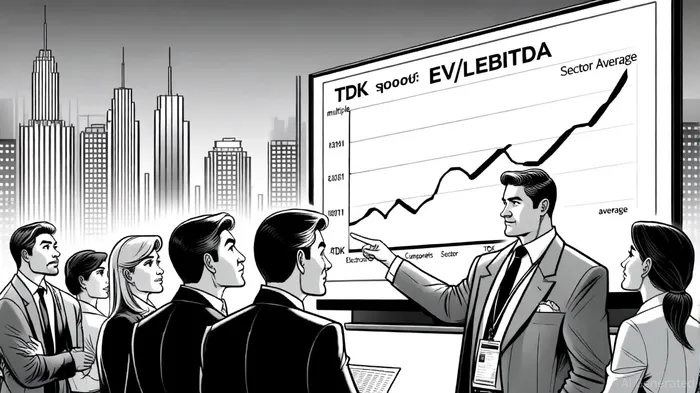
On the valuation front, TDK trades at an EV/Revenue of 1.8x and an EV/EBITDA of 8.9x[2]. These multiples are starkly lower than the Electronic Components sector averages of 1.87x (EV/Revenue) and 21.77x (EV/EBITDA)[5]. The EV/EBITDA discount is particularly striking, implying the market is underestimating TDK's profitability relative to peers. This discrepancy could reflect lingering concerns about the HDD market's recovery or skepticism about the company's restructuring efforts.
Analyst Expectations and Growth Prospects
Analysts project modest but steady growth for TDK. Earnings per share (EPS) are forecast to rise at 12.7% annually[2], outpacing the 3.8% revenue growth expectation[2]. This divergence highlights a focus on margin expansion rather than top-line acceleration, a trend supported by TDK's restructuring initiatives. For Q4 2024, the forward P/E ratio stands at 21.43[1], a 22% discount to the trailing P/E of 27.05[1]. This suggests the market is pricing in some, but not all, of the expected earnings improvement.
However, the broader context is critical. The Information Technology sector, which includes TDK's sensor and energy applications, trades at an EV/EBITDA of 27.25[3], far exceeding TDK's 8.9x. While TDK is not a pure-play tech stock, its exposure to high-growth areas like automotive sensors and energy storage should theoretically justify a higher multiple. The current valuation appears to undervalue these strategic segments, which are less cyclical than HDDs.
Industry Comparisons and Risk Factors
TDK's EV/EBITDA of 8.9x is 56% below the sector average[5], a gap that could narrow if the HDD market rebounds faster than expected. However, risks persist. The Magnetic Application Products segment's performance remains tied to the volatile HDD industry, which faces long-term displacement from SSDs. Additionally, TDK's restructuring efforts, while improving profitability, may not fully offset declining demand in legacy markets[2].
That said, the company's Energy Application Products and Sensor Application Products segments are growing at a faster pace, driven by demand for EV components and industrial automation. These areas are less exposed to cyclical downturns and could drive sustainable growth. Analysts' cautious revenue forecasts (¥585.09 billion for Q3 2025[1]) suggest a conservative approach to capital allocation, which may limit upside potential but also reduce volatility.
Conclusion: Undervalued Potential or Overlooked Risks?
TDK's valuation metrics indicate that the market has not fully priced in its long-term growth prospects. The EV/EBITDA discount relative to the sector suggests investors are underestimating the company's ability to improve margins and diversify into higher-growth areas. However, the HDD market's sluggish recovery and modest revenue growth expectations temper optimism. For investors, the key question is whether TDK can leverage its restructuring and innovation in sensors/energy to outperform sector averages. If the company executes successfully, the current valuation offers a compelling entry point. If not, the discount may persist.







Comentarios
Aún no hay comentarios