
Taylor Swift's Eras Tour and the Redefinition of Celebrity Brand Value in the Modern Entertainment Landscape
In the ever-evolving entertainment industry, Taylor Swift's Eras Tour has emerged as a paradigm-shifting case study in celebrity brand longevity and financial value creation. By generating over $2 billion in ticket sales alone and catalyzing a $7 billion retail impact, the tour has not only redefined the economics of live entertainment but also underscored the strategic interplay between cultural relevance, fan engagement, and diversified revenue streams. For investors and industry analysts, Swift's approach offers a blueprint for how modern entertainment assets can transcend traditional metrics to achieve sustained profitability and brand equity.
Financial Performance: A New Benchmark for Live Entertainment
Taylor Swift's Eras Tour has shattered records, with $2,077,618,725 in ticket sales from 149 shows between March 2023 and December 2024, doubling the previous industry benchmark. This figure is further amplified by $200 million in merchandise revenue in 2023 alone, according to Forbes, alongside a $7 billion economic ripple effect, including $1.95 billion in travel and lodging and $1.05 billion in apparel sales, as reported by Chainstore Age. The tour's ancillary revenue streams, such as the $250 million global box office for the 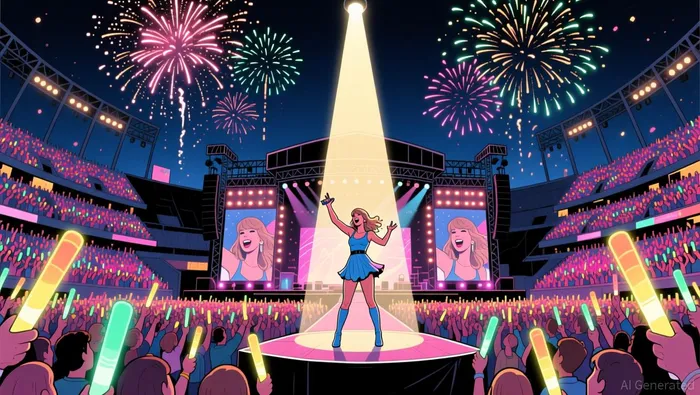 Taylor Swift: The Eras Tour film, highlight its ability to monetize across platforms. These figures position Swift as a dominant force in experiential entertainment, a sector increasingly valued for its capacity to drive multi-channel revenue.
Strategic Foundations of Brand Longevity
Swift's sustained relevance stems from a calculated blend of emotional storytelling, legal acumen, and fan-centric innovation. Her re-recording strategy-reclaiming control over her early discography through "Taylor's Version"-transformed a legal vulnerability into a strategic asset, reducing consumption of original versions by 59%. This move not only preserved her artistic integrity but also reinforced her brand's authenticity, a critical factor in maintaining fan loyalty.
Her merchandise strategy further exemplifies this approach. By leveraging limited-edition physical artifacts and premium formats, Swift creates perceived scarcity, driving urgency and collectibility. This aligns with broader industry trends where experiential and physical goods command higher margins than digital content, as noted by EY. Additionally, her direct engagement with fans-through social media, surprise album drops, and community-driven initiatives-fosters a participatory culture that amplifies brand amplification, as observed in marketing analysis.
Comparative Analysis: Outpacing Peers in Value Creation
While contemporaries like Beyoncé and BTS have achieved significant financial success, Swift's Eras Tour remains unparalleled in its scale and diversification. Beyoncé's Renaissance Tour grossed $127.6 million in July 2023 and $179 million in August, according to Today.com, while her 2025 Cowboy Carter Tour earned $407 million, as reported by Yahoo. However, Swift's $2 billion in ticket sales and $7 billion retail impact far exceed these figures. Similarly, BTS's 2026 projected tour revenue of $1.05 billion, as projected by Asian Entertainment and Culture, pales in comparison to the Eras Tour's economic footprint.
This disparity underscores Swift's unique ability to merge nostalgia with innovation. Unlike K-pop acts that rely heavily on concert-driven revenue, Swift's brand extends into retail, film, and location-based experiences, creating a more resilient asset. Her strategic control over IP, coupled with diversified income streams, positions her as a benchmark for celebrity brand valuation in 2025.
Industry Trends and Future Implications
The entertainment sector is increasingly prioritizing experiential and location-based revenue models, as highlighted by EY, a space where Swift excels. Her ability to adapt to technological shifts-such as pivoting to remote collaboration during the pandemic for Folklore and Evermore, as detailed by Lerners-demonstrates agility in a rapidly evolving landscape. Meanwhile, her refusal of high-profile sponsorships that conflict with brand values (e.g., declining a $100 million FTX deal, as reported by Lerners), highlights a risk-averse approach that preserves long-term equity.
For investors, Swift's model suggests that entertainment assets with strong IP control, diversified revenue streams, and authentic audience engagement will dominate future valuations. As AI and ad-supported models reshape content distribution, her emphasis on physical and experiential touchpoints offers a counterbalance to digital saturation.
Conclusion: A Blueprint for Entertainment Asset Valuation
Taylor Swift's Eras Tour is more than a financial triumph-it is a masterclass in redefining what constitutes value in the entertainment industry. By merging emotional storytelling with strategic business decisions, she has created a brand that transcends generational and cultural boundaries. For investors, her success underscores the importance of prioritizing authenticity, IP control, and diversified revenue in an era where consumer loyalty is both a challenge and an opportunity. As the industry evolves, Swift's approach offers a compelling framework for evaluating and nurturing high-impact entertainment assets.







Comentarios
Aún no hay comentarios